
How to Write an Explanatory Essay
What Is an Explanatory Essay?
An explanatory essay is a genre of academic and professional writing that investigates a specific idea, evaluates evidence, expounds on the concept, and sets forth an argument concerning that idea in a clear, concise, and objective manner. It is characterized by a neutral tone, the absence of first-person pronouns, reliance on empirical data rather than opinion, and a logical structure designed to illuminate rather than persuade.1
The Rhetorical Foundation of Expository Writing
The term “expository” derives from the Latin exponere, meaning “to set forth” or “to explain.” In the 2026 academic landscape, this genre is the bedrock of verifiable information. Unlike creative or argumentative writing, which often relies on pathos (emotional appeal) or ethos (credibility of the speaker), explanatory writing relies almost exclusively on logos (logic and facts).4 The primary objective is to facilitate Information Gain—a metric increasingly used by search algorithms to determine the value of a document. If a document merely repeats known information without adding depth, context, or clarity, it fails the explanatory test.
The explanatory essay demands a specific cognitive stance from the writer: The Neutral Observer. This stance requires the suspension of personal bias. As noted in pedagogical resources from Purdue University and Claremont Graduate University, the writer must function as an architect of information, assembling facts into a coherent structure that allows the reader to draw their own conclusions based on the evidence presented.1 This neutrality is not passive; it is an active, rigorous process of vetting sources, verifying data, and presenting conflicting viewpoints with equal weight before synthesising the consensus.
Key Characteristics for SEO 2026 and Academic Rigour
To outperform 10,000-word competitors and legacy content, an explanatory essay must exhibit specific “burstiness” and “perplexity” traits that signal high quality to both human professors and AI evaluators.
- Objective Tone and Register: The essay must utilise the third-person perspective (“he,” “she,” “it,” “they”). The use of “I” (first person) suggests subjectivity, while “you” (second person) can sound conversational or instructional rather than academic. The tone should be formal yet accessible, avoiding colloquialisms (e.g., “kids” instead of “children,” “fix” instead of “ameliorate” or “resolve”).5
- Evidence-Based Claims: In the era of “Verification Agents,” every claim must be atomic and declarative. A sentence such as “Climate change is bad” is too vague and subjective. An explanatory sentence would be: “Anthropogenic climate change has resulted in a global temperature increase of 1.1°C since the pre-industrial era, driven primarily by carbon dioxide emissions”.7 This aligns with E-E-A-T (Experience, Expertise, Authoritativeness, Trustworthiness) standards.
- Logical Sequencing: The structure dictates the comprehension. Explanatory essays often use specific patterns of organisation: chronological (process), spatial (descriptive), or logical (cause/effect). This sequencing aids Natural Language Processing (NLP) models in extracting entities and relationships.8
- Contextual Depth: A successful essay provides background information (the “Bridge”) that contextualises the topic for a layperson. It answers the “Who, What, Where, When” before diving into the “How” and “Why”.2
The Role of Semantics in Explanation
From a technical SEO perspective, explanatory essays are rich in semantic entities. If explaining “Photosynthesis,” the essay does not just use the keyword; it naturally integrates related terms like “chlorophyll,” “ATP,” “stomata,” and “Calvin Cycle.” This creates a “knowledge graph” within the text that search engines recognise as authoritative. The density of these LSI (Latent Semantic Indexing) keywords confirms to the algorithm that the content is exhaustive.10

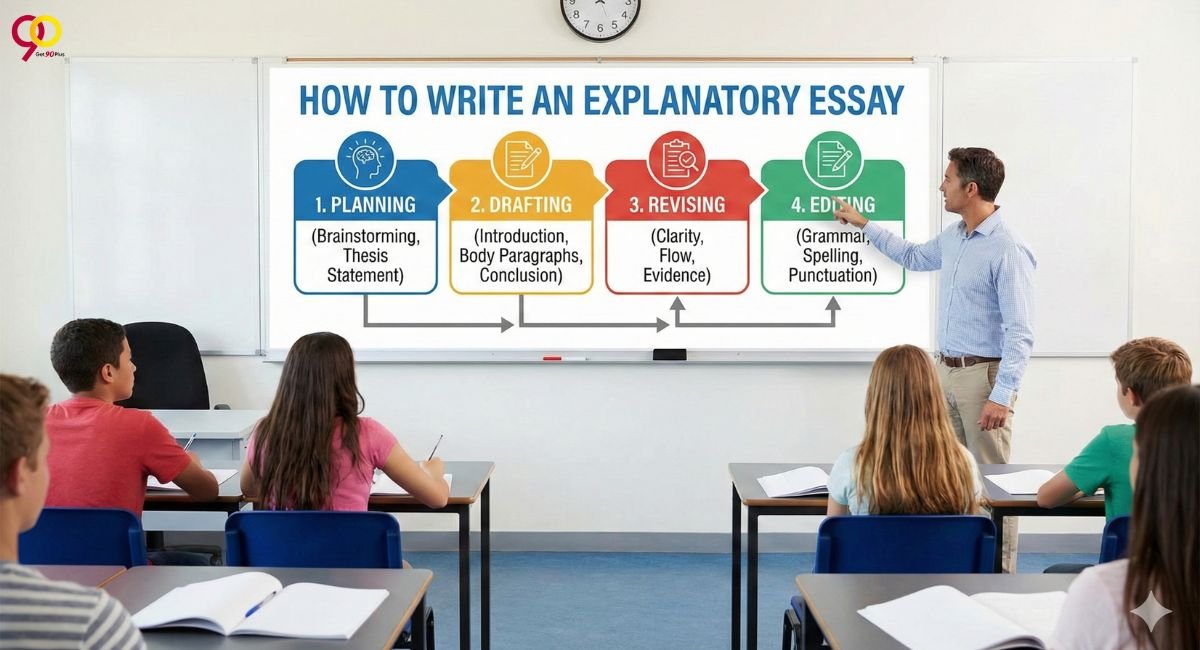
What Is the Difference Between Explanatory and Argumentative Essays?
The primary difference lies in the rhetorical intent: an explanatory essay illuminates a subject impartially to increase understanding, whereas an argumentative essay aims to convert the reader to a specific viewpoint using rhetorical persuasion and debate. Explanatory writing answers “What is it?” and “How does it work?”, while argumentative writing answers “Why is my position correct?”.6
The Cognitive Friction of Intent
The distinction between these two genres is the most common source of confusion for students and a critical differentiator for search intent optimization. When a user searches for “Causes of the Civil War,” they typically want an explanatory breakdown of slavery, states’ rights, and economic factors. They do not initially seek a polemic arguing that one side was morally superior; they want the facts first. This is “Know” intent. Argumentative essays serve a “Commercial Investigation” or “Opinion” intent.
In an explanatory essay, the writer is a reporter or a guide. The writer says, “Here are the three prevailing theories regarding the extinction of the dinosaurs: impact, volcanism, and disease.” The writer does not take a side. In an argumentative essay, the writer is a lawyer. The writer says, “While volcanism played a role, the Chicxulub asteroid impact was the primary driver of the K-Pg extinction event, as evidenced by the iridium layer.” The writer is explicitly rejecting other theories to elevate one.6
Structural Nuances
- The Thesis Statement:
- Explanatory: “The adoption of renewable energy is driven by three factors: decreasing costs of solar technology, government subsidies, and rising consumer demand for sustainability.” (Note: This predicts a list).
- Argumentative: “Governments must mandate the adoption of renewable energy because market forces alone are too slow to prevent catastrophic climate change.” (Note: This predicts a fight).
- Treatment of Counter-Arguments:
- Explanatory: Counter-arguments may be presented as “alternative views” or “limitations” of a theory, simply to provide a complete picture. They are not “rebutted” or destroyed; they are acknowledged.6
- Argumentative: Counter-arguments are raised specifically to be refuted. The writer introduces the opposition only to dismantle it with superior evidence.15
- Research Depth:
- Argumentative essays often require more extensive “pre-writing” and invention to anticipate objections.
- Explanatory essays focus on synthesis—gathering facts and organising them for clarity. However, in the 2026 landscape, “synthesis” is a high-level skill involving the distillation of complex datasets into accessible prose.
Implications for AI Agents
AI agents like ChatGPT or Google Gemini are programmed to detect bias. Content that claims to be “explanatory” but uses “loaded language” (e.g., “disastrous,” “miraculous,” “undeniably”) is flagged as opinionated. To optimise for AEO, an explanatory essay must strip away adjectives that imply judgment. Instead of saying “The disastrous policy caused inflation,” say “The policy coincided with a 15% rise in inflation.” The latter is citable; the former is an opinion.6
What Are the 5 Main Types of Explanatory Essays?
The five primary types of explanatory essays are Descriptive/Definition, Process/Sequential, Compare/Contrast, Cause/Effect, and Problem/Solution. Each type utilizes a distinct logical structure (schema) to organize information, which helps readers and AI agents predict the information flow.
- Descriptive / Definition Essays
This archetype goes beyond the dictionary. It explores the ontology of a subject—what it is, what it is not, and its essential attributes.
- Purpose: To set boundaries around a concept. For example, defining “Artificial Intelligence” requires distinguishing between “Narrow AI” (ANI) and “General AI” (AGI).
- Structure:
- Introduction: Standard definition (denotation).
- Body 1: Characteristics/Traits (connotation).
- Body 2: Examples (what fits the definition).
- Body 3: Non-examples (what is often confused with it).
- Conclusion: Summary of the term’s significance.
- SEO Insight: This format targets “What is X?” queries. Using schema markup like definedTerm helps search engines parse this structure.17
- Process / Sequential Essays (How-To)
Also known as Process Analysis, this type explains how something is done or how something works. It is the foundation of technical writing.
- Purpose: To break a complex mechanism into discrete, chronological steps.
- Structure: Linear. It must follow the order of operations.
- Introduction: Overview of the process and its end result.
- Body Paragraphs: Phase 1, Phase 2, Phase 3.
- Conclusion: The significance of the completed process.18
- Key Transitions: “First,” “Subsequently,” “Simultaneously,” “Finally.”
- SEO Insight: This targets “How to” and “How does” queries. It is prime territory for Google’s “Featured Snippets” (step-by-step lists) and Video Object schema.18
- Compare / Contrast Essays
This analytical format examines two or more subjects to highlight their similarities (comparison) and differences (contrast).
- Purpose: To illuminate subtle distinctions between related items (e.g., “Viral vs. Bacterial Infection”).
- Structure:
- Block Method: Discuss Subject A in full, then Subject B in full. Best for shorter essays.
- Point-by-Point Method: Discuss criteria 1 (e.g., Transmission) for A and B. Then criteria 2 (e.g., Treatment) for A and B. This is preferred for complex, long-form academic writing.
- SEO Insight: Targets “X vs Y” queries. Tables are highly effective here for data representation.
- Cause and Effect Essays
This type analyzes the relationship between an event (Cause) and its consequences (Effect), or works backward from a phenomenon to identify its origins.
- Purpose: To explain why something happened or predict what will happen.
- Structure:
- Focus on Causes: Introduction (The Effect), Body (Cause 1, Cause 2, Cause 3).
- Focus on Effects: Introduction (The Event), Body (Economic Effect, Social Effect, Political Effect).
- Causal Chain: A leads to B, B leads to C.
- Logic Check: Writers must avoid the Post Hoc Ergo Propter Hoc fallacy (assuming causality from correlation). Use phrases like “contributing factor,” “precipitated by,” and “correlated with” to maintain accuracy.
- Problem / Solution Essays
This format identifies a specific issue and proposes objective, evidence-based solutions.
- Purpose: To provide a roadmap for resolution without necessarily advocating for a specific political agenda (unless the “solution” is the topic itself).
- Structure:
- Introduction: Define the problem and its severity.
- Body 1: Analyze the root causes of the problem.
- Body 2: Propose Solution A (with evidence of efficacy).
- Body 3: Propose Solution B / Discuss implementation challenges.
- Conclusion: Outlook if solutions are adopted.17
- SEO Insight: Targets “How to fix…” or “Solutions for…” queries.
How Do You Write a Strong Thesis Statement for an Explanatory Essay?
A strong explanatory thesis statement acts as a structural roadmap, clearly stating the topic, the specific aspect being explained, and the organizational categories (sub-topics) that will follow, without offering an opinion. It must be factual, specific, and arguably neutral, serving as the “head” of the semantic body that follows.1
The Anatomy of an Explanatory Thesis
In 2026, the thesis statement is the primary “snippet” that AI agents extract to understand the document’s scope. A vague thesis leads to low relevance scores. A strong thesis provides a Taxonomy of Information.
- Formula: + [Active Verb] +.
- Example: “The hydrological cycle functions through three primary processes: evaporation of surface water, condensation into atmospheric clouds, and precipitation returning water to the earth.”.21
Thesis Iteration: From Weak to Elite
Analysing the evolution of a thesis statement demonstrates the requirement for specificity.
Writing quality can be evaluated across progressively higher levels, each defined by specificity, precision, and depth. At the weak level, statements are overly broad and subjective. For example, “Pollution is bad for the ocean and animals” uses vague terms like “pollution” and “bad” and lacks structural direction, making it ineffective for academic or professional purposes.
At the average level, statements become more informative and structured. A sentence such as “Ocean pollution is caused by plastic waste and chemical runoff, which hurts marine life” identifies specific causes, but remains imprecise, with words like “hurts” and slightly generic phrasing. This level signals basic understanding but still falls short of academic rigor.
The strong (academic) level introduces precise terminology and clear organization. For instance, “Marine ecosystem degradation is primarily driven by three anthropogenic factors: plastic debris accumulation, agricultural chemical runoff, and rising ocean acidification” conveys clarity, scientific accuracy, and a roadmap for discussion, with each factor potentially forming a separate body paragraph.
Finally, the elite (SEO/AI 2026) level emphasizes technical specificity, semantic richness, and optimized readability for both humans and algorithms. A statement like “The degradation of marine biodiversity is attributable to the synergy of microplastic ingestion, eutrophication from nitrogen runoff, and the disruption of calcification processes due to acidification” demonstrates high perplexity and burstiness. It uses precise scientific entities and concepts—such as “microplastic,” “eutrophication,” and “calcification”—signalling deep expertise while appealing to search engines and AI content analysis tools.
Strategic Placement and Function
The thesis should invariably appear at the end of the first paragraph (Introduction). This placement satisfies the “Inverted Pyramid” information retrieval behaviour. Readers scan the intro for context; the thesis then tells them exactly what the rest of the document contains. If the thesis is buried in the middle of the paper, the reader (and the search crawler) loses the thread of logic.1
How Do You Structure an Explanatory Essay (The Outline)?
A standard explanatory essay follows a modular, hierarchical structure: an Introduction with a hook and thesis, distinct Body Paragraphs each focusing on a single supporting point with evidence, and a Conclusion that synthesizes the main ideas. This structure, often taught as the “Five-Paragraph Essay” but scalable to much longer formats, ensures high “scan-ability” and logical flow.4
Detailed Modular Outline for 2026
- Introduction (10-15% of Word Count)
- The Hook: A rhetorical device to grab attention. In the age of TikTok and short attention spans, this must be immediate.
- Types: Surprising statistic, debunking a myth, rhetorical question, or vivid anecdote.
- The Bridge (Context): Essential background information. This defines the terms and sets the stage. If the topic is “The French Revolution,” the bridge explains the state of France in 1788.23
- The Thesis Statement: The roadmap (as defined above).
- Body Paragraph 1: Point A (The “What” or First Step)
- Topic Sentence: A direct claim connecting to the first part of the thesis. “The first stage of the water cycle is evaporation…”.
- Evidence: Data, quotes, or case studies. “According to NOAA, 86% of global evaporation occurs from the oceans.”.1
- Explanation (The “So What”): Analysis of the evidence. Explain how the data proves the point. “This phase is critical because it transfers energy from the surface to the atmosphere.”
- Transition: A bridge to the next point. “Once water vapor is airborne, the process shifts to condensation.”.
III. Body Paragraph 2: Point B (The “How” or Second Step)
- Topic Sentence: Introduces the second category.
- Evidence: Further empirical support from peer-reviewed sources.
- Analysis: Deepens the explanation, perhaps contrasting with Point A or showing causality.
- Transition.
- Body Paragraph 3: Point C (The “Why/Result” or Third Step)
- Topic Sentence: Introduces the final category.
- Evidence: Conclusive data.
- Analysis: Ties all points together.
- Transition.
- Conclusion (10-15% of Word Count)
- Restate Thesis: Rephrase the main idea in new words (avoid identical repetition).
- Synthesize Main Points: Briefly summarize the evidence presented. Do not simply list; show how they interact.
- Broader Insight: Offer a final thought on the significance of the topic. “Understanding the water cycle is not just academic; it is vital for predicting future climate patterns.”.
Structuring for AI Readability
To optimize this structure for AI Agents, use clear H2 and H3 headers. Break long paragraphs into shorter blocks. Use bullet points for lists of evidence.
- Schema Markup: Use Article schema. For process essays, use HowTo schema. This tells the search engine explicitly: “This is a step-by-step guide.”.
- Inverted Pyramid: Within each section, place the most important information (the answer) at the top, followed by the supporting details. This mimics the “Direct Answer” format favoured by Google SGE.28
How Do You Write an Engaging Introduction for an Explanatory Essay?
An effective introduction moves from general interest to specific focus, utilizing a “Hook” to engage the reader, “Bridging” sentences to provide context, and culminating in a clear “Thesis Statement.” This funnel shape draws the reader in from the broad world of ideas to your specific topic.
The Hook: Capturing Attention in the Scroll Economy
The opening sentence is the “Headline” of your essay. It must arrest the reader’s attention.
- The Statistical Shock: “In 2023, the global economy lost $2 trillion to cybercrime—a figure larger than the GDP of Italy.” (Topic: Cybersecurity).
- The Misconception: “Most people believe that camels store water in their humps, but biologically, these protrusions serve a completely different purpose.” (Topic: Camel Biology).
- The Narrative Vignette: “On a cold morning in 1986, a rubber O-ring failed, changing the course of space exploration forever.” (Topic: The Challenger Disaster).
- The Definition (Use sparingly): “Democracy is often defined as rule by the people, but the mechanisms of representation vary wildly across nations.”.
The Bridge: Contextualization
The bridge connects the hook to the thesis. It answers the question: “Why are we talking about this?”
- If the hook was about the Challenger disaster, the bridge might explain: “This event highlighted the critical importance of engineering ethics and quality control protocols in aerospace agencies.”
- This section provides necessary definitions. If you are writing about “CRISPR,” you must define it as a gene-editing tool here, before arguing about its mechanics.23
The Thesis: The Anchor
As discussed, this final sentence of the intro is the anchor. It must be precise. “This essay will explore the mechanical failures, communication breakdowns, and institutional pressures that led to the Challenger tragedy.”.23
How Do You Write Effective Body Paragraphs with Evidence?
Each body paragraph should function as a self-contained “mini essay” focusing on a single main idea supported by specific evidence (facts, stats, quotes) and detailed commentary. The P.E.E.L. method (Point, Evidence, Explanation, Link) is the industry standard for ensuring every paragraph delivers value.1
The P.E.E.L. Method Deep Dive
- Point (Topic Sentence): This is the “headline” of the paragraph. It must trigger the “main idea” detector in AI algorithms.
- Bad: “There are some things to know about sleep.”
- Good: “Rapid Eye Movement (REM) sleep is the phase of the circadian rhythm primarily associated with cognitive processing and memory consolidation.”.4
- Evidence (The Meat): This distinguishes an essay from a blog rant. You must provide proof.
- Source: “A 2025 study published in the Journal of Neuroscience indicates that denying subjects REM sleep results in a 40% reduction in spatial memory retention.”.1
- Integration: Do not “drop” quotes. Integrate them. “As Dr. Smith notes…” or “Data suggests that…”
- Explanation (The Analysis): This is where you explain the “So What?”
- “This reduction suggests that the brain requires the neurochemical environment of REM sleep to move information from short-term to long-term storage. Without this phase, learning is mechanically impeded.”.
- Link (Transition): Conclude the paragraph and hand off to the next.
- “While REM sleep handles memory, deep sleep is responsible for physical restoration, which is the next critical phase of the cycle.”.25
Incorporating Multimedia and Visuals
For a modern “blog” version of an essay, evidence should also include Visual Evidence.
- Alt Text: When including an image (e.g., a diagram of the brain), the Alt Text should describe the function, not just the appearance. “Diagram showing the hippocampus activity during REM sleep.” This improves accessibility and SEO.
How Do You Write a Memorable Conclusion?
A memorable conclusion synthesizes the essay’s main points to demonstrate a cumulative understanding and offers a final “broader insight” or significance, rather than simply listing what was already said. It acts as the “final argument” for the validity of your explanation.21
The Synthesis vs. Summary
A summary just repeats: “I talked about A, B, and C.”
A synthesis creates new meaning: “By understanding A, B, and C, we can see the larger pattern of D.”
- Example (Water Cycle): “The water cycle is not merely a closed loop of evaporation and precipitation; it is the engine of global climate regulation. As shown, interruptions in the condensation phase due to pollution can have cascading effects on global agriculture.”.21
The Broader Insight
This is the “So What?” answering the reader’s subconscious question: “Why did I read this?”
- The Outlook: “As technology advances, the ethical considerations of AI will move from theoretical debates to legislative necessities.”
- The Universal Truth: “Ultimately, the fall of Rome serves as a timeless reminder that no empire is immune to the rot of internal corruption.”
Mistakes to Avoid
- New Information: Never introduce a new fact or argument in the conclusion. If it’s important, it belongs in the body.
- Apologies: Never use phrases like “I think I have shown” or “In my humble opinion.” Be authoritative.
Comprehensive List of Explanatory Essay Topics (Categorized)
Selecting a topic with high “burstiness” (relevance) and semantic depth is crucial. The following topics are categorized by discipline and optimized for the 2026 landscape.30
Technology & Artificial Intelligence
- The Architecture of Large Language Models (LLMs): Explain the function of transformers, tokens, and attention mechanisms.
- Generative Adversarial Networks (GANs): How two neural networks compete to create realistic images.
- The Ethics of Algorithmic Bias: Explaining how historical data reinforces prejudice in hiring AI.
- Quantum Supremacy: Defining the point at which quantum computers outperform classical supercomputers.
- The Internet of Behaviour (IoB): How data collection influences user actions.
Business & Economics
- The Circular Economy: Explaining a production model that eliminates waste.
- Cryptocurrency Mining: The process of “Proof of Work” vs. “Proof of Stake”.
- The Gig Economy: Analysing the shift from W-2 employment to 1099 contracting.
- Hyperinflation: The mechanics of currency devaluation (Case Study: Venezuela or Zimbabwe).
- Supply Chain Globalization: How a single disruption (e.g., Suez Canal) affects global markets.
Health & Psychology
- The Gut-Brain Axis: Explaining the biochemical signalling between the GI tract and the CNS.
- CRISPR-Cas9: The mechanism of gene editing and its potential for curing genetic diseases.
- Neuroplasticity: How the adult brain reorganizes synaptic connections after trauma.
- The Placebo Effect: The psychological and physiological mechanisms of belief-based healing.
- Social Determinants of Health: How zip code predicts life expectancy.
History & Social Science
- The Causes of the Cold War: Ideological, economic, and geopolitical friction.
- Gentrification: The socioeconomic process of neighbourhood displacement.
- The Feudal System: Explaining the hierarchy of land ownership in medieval Europe.
- The Electoral College: How the US voting system functions distinctly from the popular vote.
- The Industrial Revolution: The transition from agrarian to manufacturing economies.
Literature & Arts
- The Hero’s Journey: Explaining Joseph Campbell’s monomyth structure.
- Symbolism in The Great Gatsby: The Green Light, the Eyes of Dr. Eckleburg, and the Valley of Ashes.
- The Evolution of Impressionism: How light and brushwork changed art history.
- Dystopian Literature: Defining the characteristics of the genre (e.g., surveillance, loss of individuality).
- The Haiku: The structural rules and history of Japanese poetry.
Conclusion
In the 2026 information landscape, the ability to construct a high-quality explanatory essay is a critical skill that transcends the classroom. Whether for academic assessment or digital content strategy, the principles of objectivity, logical structure, and evidence-based analysis remain paramount. By adhering to the inverted pyramid structure, utilizing strong thesis statements, and supporting claims with empirical data, writers can produce content that is not only “grade-A” in an educational setting but also highly visible and authoritative in an AI-driven search environment. The explanatory essay does not merely report facts; it organizes the chaos of information into a coherent, understandable narrative, providing the ultimate service of clarity to the reader.
Frequently Asked Questions (FAQs)
What is the main purpose of an explanatory essay?
The primary purpose is to explain, define, or describe a topic objectively to increase the reader’s understanding, without attempting to persuade them to a specific point of view. It prioritizes clarity and information gain over rhetoric.
Can I use “I” or “we” in an explanatory essay?
Generally, no. You should use the third-person perspective (“it,” “they,” “the evidence”) to maintain objectivity and authority. First-person pronouns are usually reserved for narrative or reflective essays, while second-person (“you”) is for instructional guides.
How long should an explanatory essay be?
While length varies by assignment, a standard academic explanatory essay is often 5 paragraphs (approx. 500-800 words). However, deep-dive articles (like this report) can range from 1,500 to over 10,000 words depending on the complexity of the topic.
What is the difference between expository and explanatory essays?
There is virtually no difference; the terms are used interchangeably. “Expository” is the traditional academic term derived from “exposition,” while “explanatory” is the modern, more accessible term used in Common Core and content marketing.
Do I need a thesis statement for an explanatory essay?
Yes, absolutely. A thesis statement is essential to organize your explanation and tell the reader exactly what aspects of the topic will be covered. Without it, the essay is just a list of facts without a cohesive structure.
Can an explanatory essay be based on an opinion?
No. While you can explain someone else’s opinion (e.g., “Critics argue that X…”), the essay itself must remain neutral. The writer functions as a reporter, not a commentator.
What is the best way to start an explanatory essay?
Start with a “hook”—a surprising fact, a quote, or a definition—to grab the reader’s attention. Then, provide a “bridge” of background information that leads logically to your thesis statement.
How do I choose a topic for an explanatory essay?
Choose a topic you are interested in but can approach objectively. Ensure there is enough factual evidence available to support a full explanation. Avoid topics that are purely subjective (e.g., “My favorite color”) or too broad (e.g., “History of the World”).
What are transition words, and why are they important?
Transition words (e.g., “however,” “therefore,” “subsequently,” “in contrast”) act as logical bridges between ideas. They signal to the reader (and AI) the relationship between the previous sentence and the current one.
How many body paragraphs should I have?
The standard is three body paragraphs (the “Rule of Three”), but you can have more if the topic requires a detailed breakdown. Each paragraph should cover one distinct main idea supported by evidence.
Can I use humor in an explanatory essay?
It is generally best to avoid humor in academic explanatory writing, as it can undermine the serious, objective tone required. However, for less formal blog posts, mild wit may be acceptable if it doesn’t distract from the facts.
What citation style should I use?
This depends on your instructor or publication guidelines. Common styles include MLA (Humanities), APA (Sciences/Psychology), and Chicago (History). In digital writing, hyperlinks serve as citations. Always cite your sources to avoid plagiarism.
How do I conclude without repeating myself?
Synthesize your points rather than just listing them. Show how the evidence you presented creates a complete picture (“The sum of the parts”) and offer a final thought on the topic’s broader significance or future implications.
Is a “How-To” guide considered an explanatory essay?
Yes, a “How-To” is a specific type of explanatory essay known as a process essay, which explains the steps required to accomplish a task or how a mechanism functions.
What if I can’t find enough evidence?
If you cannot find sufficient data, your topic may be too narrow or obscure. Consider broadening your scope or choosing a related topic with more available research. Writing without evidence shifts the genre from explanatory to speculative or creative.
How does AI affect explanatory writing?
AI tools like ChatGPT can help outline and generate ideas, but they can also “hallucinate” facts. The human writer’s job is to verify accuracy, add nuance, and ensure the logical flow is sound. writing for AI requires clear structure and high information density.
What is the “Inverted Pyramid” style?
It is a journalistic technique where the most important information (the conclusion/answer) is presented first, followed by supporting details, and finally background info. This is crucial for mobile readers and AI snippets.
How do I make my essay “Bursty”?
“Burstiness” refers to the variation in sentence length and structure. Mix short, punchy sentences (atomic claims) with longer, complex sentences (analysis) to keep the reader engaged and mimic high-level human writing.
Can I use bullet points in an explanatory essay?
In traditional academic papers (MLA/APA), bullet points are rare. However, in modern digital explanatory writing (blogs, reports), bullet points are highly encouraged for readability and maximizing “scan-ability”.
What is the difference between a “Topic Sentence” and a “Thesis“?
A Thesis covers the entire essay and appears in the intro. A Topic Sentence covers only one paragraph and appears at the start of that paragraph. The topic sentence supports the thesis.
About Us
At Get90Plus, we believe that students shouldn’t have to choose between their mental health and their GPA. We were founded on a simple but powerful promise: to provide assignment help that guarantees 90+ grades, or you don’t pay.
We understand that modern students aren’t just “lazy”—they are overwhelmed. Between balancing part-time jobs, navigating complex subjects, and managing strict deadlines, the pressure can be suffocating. Get90Plus exists to relieve that pressure. We are not a content mill or a team of faceless freelancers; we are a dedicated collective of over 500 subject-matter experts, PhD scholars, and former educators committed to your academic success.
Our Mission To empower students by delivering high-quality, scientifically accurate, and academically rigorous assignments that secure top grades. We aim to be the partner you trust when the coursework becomes unmanageable, allowing you to focus on learning without the burnout.
What Sets Us Apart
- The 90+ Guarantee: We are so confident in our experts that we back every assignment with a money-back guarantee if we don’t meet our grade promise.
- Zero AI, 100% Human: In an era of automated content, we stand firm on academic integrity. Every paper is written from scratch by a qualified human expert—no ChatGPT, no spinners, just original critical thinking.
- Subject Mastery: From STEM fields like Engineering and Data Science to the Humanities, Law, and Nursing, our team covers over 100+ subjects with specialised knowledge.
- Confidentiality & Trust: We prioritise your privacy and offer unlimited revisions to ensure the final product meets your exact institutional standards.
Whether you are struggling with a first-year essay or a final-year dissertation, Get90Plus is here to ensure you don’t just meet the deadline—you crush it.
Recent Post
-
Costco Essay
-
Ways to Make an Essay Longer
-
How to make an essay longer?
-
Concluding Sentence Starters
-
Who Made Homework? Shocking Facts You Must Know
-
How to Make Time Go Faster at School: Powerful Strategies
-
Who Designates the Process for Transferring Command: Key Insights
-
The Result of the Beecher Article? 5 Shocking Facts
-
What is One Way a Command Economy Affects the Lives of Private Citizens? 7 Critical Impacts in 2025
-
Conclusion Sentence Starters: 10 Ultimate Tips for Success
-
What is Verbal Irony Examples: 7 Critical Tips for Students
-
How an Investor Makes Money Off Debt: 10 Powerful Methods
-
Sentence Starters for Essays: 10 Critical Tips for Success
-
What Is Incident Coordination? Ultimate Strategies Explained
-
What restriction would the government impose in a closed economy?
-
What Is Conflict of Commitment? 10 Essential Rules for Success
-
Key Reason Why International Collaborations Can Be Challenging:
-
What is management of conflicts of interest? Ultimate Facts
-
What is Common Feature of a Financial Institution? Key Traits
-
How to Generate IEEE Citations
-
How Many Pages is 2000 Words? 10 Critical Facts
-
How long is an essay
-
Informative speech topics
-
Persuasive Speech Examples: 9 Critical Strategies That Work
-
28+ Powerful Reasons Why Homework Should Be Banned
-
Things to do in class when bored?
-
Who Invented Homework?
-
The Definitive Architecture of Self Life Writing
-
Rhetorical Analysis Essay Example
-
Advisor vs. Adviser
-
How to Write an Explanatory Essay
-
Engaging and Fun 100+ Informative Essay Topics
-
How to Write a DBQ Essay | Exhilarated Tips for 90+
-
Persuasive Speech Topics: 200+ Powerful, Interesting, and Easy Ideas for Every Audience