
Conclusion Sentence Starters: 10 Ultimate Tips for Success
1. Introduction
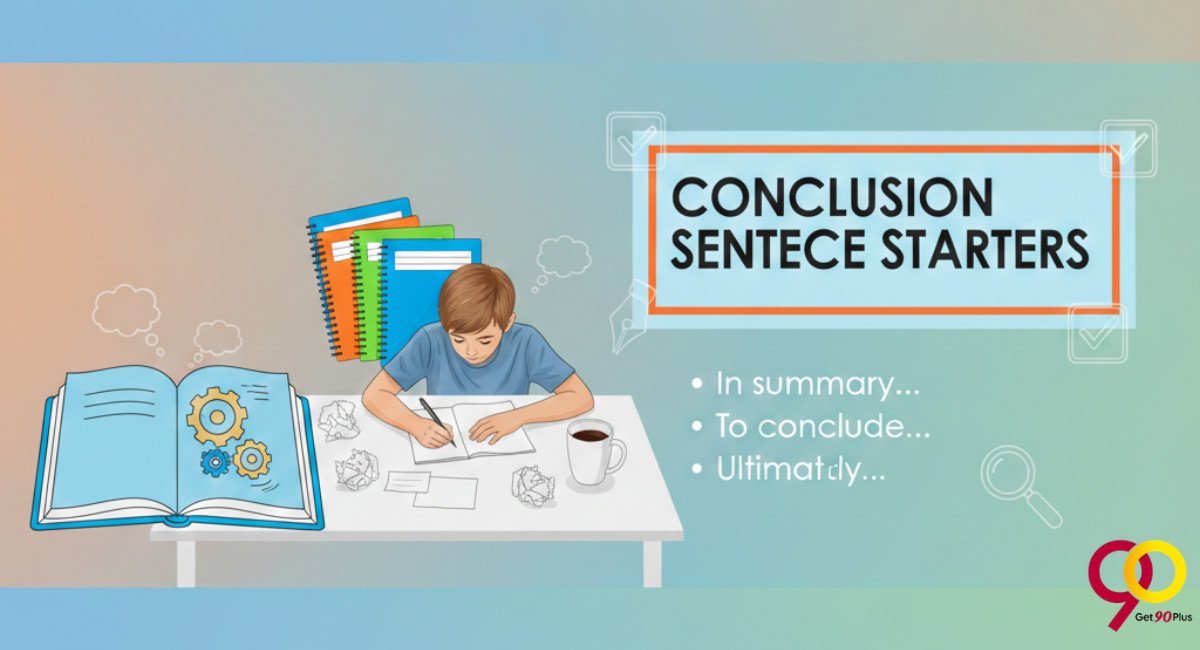
Writing a strong essay is more than presenting information—it’s about guiding the reader smoothly to the end. One of the most critical tools for achieving this is conclusion sentence starters, which help you craft a cohesive wrap up paragraph while reinforcing your thesis statement. By using summary sentence starters, transition words for conclusion, and effective academic conclusion phrases, you can clearly highlight key points and unify your supporting arguments. These starters also reduce reader confusion and improve comprehension. In this article, we explore practical concluding paragraph examples, discipline-specific strategies, and easy-to-use tips for students at all levels to confidently finish essays and research papers with clarity and impact
Key points
- Conclusion sentence starters guide readers through the final paragraph of essays, research papers, and assignments.
- Using summary sentence starters like in summary, to sum up, or in brief improves clarity and cohesion.
- Concluding paragraph examples help students synthesize multiple ideas and reinforce the thesis statement.
- Different disciplines Favor different academic conclusion phrases: soft sciences use hedges; hard sciences rely on boosters and inferential transitions.
- Overused words like “stuff”, “things”, or repetitive “in conclusion” weaken essay endings.
- Transition words for conclusion such as ultimately, as a result, and taken together enhance readability and authority.
- Easy conclusion sentence starters support younger students in learning how to write logical essay endings.
- Advanced starters for high school and college essays help articulate supporting arguments and show critical thinking.
- Proper use of closing sentence starters reduces cognitive load and increases the persuasiveness of the text.
- Artificial intelligence tools can suggest starters but often miss nuanced hedges and academic voice, so careful human editing is crucial.
What Are Conclusion Sentence Starters?
Conclusion sentence starters are words or phrases that signal the ending of an essay, paragraph, or research paper. They help you wrap up your paragraph, restate the argument, and guide the reader to understand the main idea. Using these starters makes your essay flow naturally and avoids abrupt endings. Transition words for conclusion are especially important because they connect your evidence and supporting arguments to your final thoughts.2
In simple terms, conclusion paragraph starters act like signposts. They show the reader that the essay is ending while emphasizing key points. Common examples include in conclusion, to sum up, ultimately, and in summary.31 These phrases also help with cognitive processing: the reader’s brain quickly recognizes that a wrap-up is coming, making your wrap up paragraph easier to follow.64
Key points to remember:
- They clarify that you are ending a section or essay.
- They help restate the thesis statement in a fresh way.
- They strengthen the impact of your final thoughts.
- They improve readability and overall essay structure.
Example: Instead of ending an essay abruptly with “That’s all about climate change,” you could write:
“Ultimately, understanding the effects of climate change is essential to protecting our environment.”
Using proper concluding sentence examples makes your writing look professional and persuasive. Students who master how to start a conclusion often write clearer, more effective essays that earn higher grades.
Why Conclusion Sentence Starters Are Important in Academic Writing
Conclusion sentence starters are vital because they guide the reader through the final thoughts of an essay or research paper. They signal that the discussion is ending and highlight the main idea, allowing readers to easily follow the logical flow of your arguments. Using these starters ensures that your supporting arguments are clearly tied to your thesis statement.2
Without effective words to start a conclusion, essays often feel incomplete or abrupt. Strong starters such as in conclusion, to sum up, or ultimately provide coherence, improve readability, and reinforce the essay’s central message.32 They also reduce reader fatigue by offering mental anchors that prepare the brain for final interpretations.64
Benefits of using conclusion sentence starters:
- Helps summarize key points clearly.
- Emphasizes your wrap up paragraph effectively.
- Enhances logical flow and essay structure.
- Signals closure without introducing new arguments.
For instance, in academic writing, starting a conclusion with “Taking everything into account” signals that the writer is synthesizing the essay’s key ideas.28 Similarly, “In summary” or “Overall” helps the reader focus on the most critical points, making your argument more persuasive and professional.
How Conclusion Sentence Starters Improve Essay Structure and Flow
Conclusion sentence starters play a critical role in shaping the overall structure of an essay. They act as bridges that connect the body of the essay to the final thoughts, ensuring that the reader can follow the progression from evidence to supporting arguments and finally to the thesis statement. Using starters like in conclusion, to sum up, or ultimately provides a natural transition that improves clarity and cohesion.2
By signalling the essay’s ending, these starters help maintain a smooth essay flow. Without them, readers may feel lost or confused about the significance of the preceding points. Strategic use of transition words for conclusion reduces abruptness and strengthens the wrap up paragraph, giving your essay a professional, polished finish.32
Ways conclusion starters enhance essay structure:
- Clarify the logical relationships between ideas.
- Highlight key points and emphasize the most important findings.
- Create a clear, predictable pattern for readers to follow.
- Support cognitive processing by signalling closure and preparing the reader for the final synthesis.65
For example, a student writing an essay on renewable energy could use:
“Taken together, these findings suggest that investing in solar and wind energy is crucial for long-term sustainability.”28
Here, the starter not only signals the end but also synthesizes multiple arguments into one coherent final thought, making the essay more effective and reader friendly.

Best Conclusion Sentence Starters for Essays
Choosing the right conclusion sentence starters can make your essay more persuasive and cohesive. These starters help you restate the thesis statement, summarize evidence, and highlight key points without repeating yourself word-for-word. Common starters like in conclusion, to summarize, and overall are versatile and work across most essay types.2
Using strong concluding paragraph examples also improves the reader’s understanding of your argument. By integrating essay conclusion phrases, you guide readers through your final analysis and leave a lasting impression.32 Thoughtful starters signal that the essay is ending, while reinforcing the supporting arguments that have been discussed.
Top Conclusion Sentence Starters for Essays:
- In conclusion – signals closure clearly and formally.
- To sum up – ideal for summarizing multiple points.
- Ultimately – emphasizes the final significance of your argument.
- In summary – perfect for restating the thesis concisely.
- Taken together – combines ideas into a synthesized final thought.
- As a result – connects findings to implications or consequences.
- Overall – highlights the essay’s general outcome or insight.
Example:
“As a result, the study of climate change policies reveals the urgent need for global cooperation and innovative solutions.”
These starters not only provide clarity but also enhance the essay’s flow and readability, helping USA students write essays that are structured, professional, and persuasive.
Conclusion Sentence Starters for Argumentative Essays
In argumentative essays, conclusion sentence starters are essential for reinforcing your thesis statement and showing how your supporting arguments prove your point. They help the reader clearly see your final position while emphasizing the significance of your evidence. Common starters include ultimately, therefore, and in light of the evidence.2
Using strong academic conclusion phrases ensures that your argument feels complete and persuasive. These starters also help synthesize multiple points, making it easier for the reader to grasp the essay’s overall message and take away the key points.32
Effective Conclusion Sentence Starters for Argumentative Essays:
- Ultimately – emphasizes the final judgment or outcome.
- Therefore – signals a logical deduction from the arguments presented.
- In conclusion – formal, clear closure for academic writing.
- Taking everything into account – synthesizes multiple arguments.
- Based on the evidence presented – reinforces credibility and analytical reasoning.
- As a result – connects claims to consequences or implications.
- In light of the evidence – highlights critical evaluation of the data.
Example:
“Ultimately, stricter environmental regulations are necessary because the evidence clearly demonstrates their effectiveness in reducing pollution.”
By carefully choosing words to start a conclusion, students strengthen their argumentative essays, ensuring that the final paragraph is both convincing and logically connected to the body of the text
Conclusion Sentence Starters for Informative and Expository Essays
In informative and expository essays, conclusion sentence starters help summarize facts, clarify the main idea, and reinforce understanding without introducing new arguments. They guide the reader to see the overall picture and ensure your supporting arguments are clearly tied together. Common starters include in summary, to conclude, and in brief.2
These starters also improve readability by providing a smooth transition from detailed explanations to a final synthesis. Using summary sentence starters effectively highlights the key points and leaves the reader with a clear understanding of the topic.32
Examples of Conclusion Sentence Starters for Informative Essays:
- In summary – recaps main ideas succinctly.
- To conclude – formal and widely accepted in academic writing.
- In brief – condenses long information into a concise final statement.
- Overall – highlights general insights or results.
- Taking everything into account – synthesizes multiple facts or findings.
- As a result – indicates outcomes or consequences of the information presented.
- Final thoughts – offers a reflective wrap-up for the topic.
Example:
“In summary, renewable energy sources such as solar and wind provide sustainable solutions that can significantly reduce global carbon emissions.”
Using the right concluding paragraph examples ensures your expository essay ends clearly, effectively, and professionally, making the information easy to retain for readers.

Strong Conclusion Sentence Starters for Research Papers
In research papers, conclusion sentence starters are crucial for summarizing findings, evaluating methodology, and highlighting broader implications. They guide readers through the wrap up paragraph, reinforcing the thesis statement while connecting evidence to final insights. Common starters include taken together, these findings suggest, and in conclusion.2
Strong starters also signal scholarly authority and ensure the paper adheres to academic conventions. Using academic conclusion phrases correctly helps communicate both certainty and caution, especially when addressing limitations or proposing future research.32
Powerful Conclusion Sentence Starters for Research Papers:
- Taken together – integrates multiple findings into one cohesive statement.
- These findings suggest – emphasizes interpretation of results.
- In conclusion – formal, widely recognized for academic rigor.
- Overall – highlights the general outcome of the research.
- As a result – connects research data to implications.
- Future research should explore – indicates next steps or recommendations.
- Our study demonstrates – asserts key contributions clearly.
Example:
“Taken together, the results indicate that cognitive-behavioral therapy significantly improves stress management among high school students.”28
By mastering concluding sentence examples, students and researchers ensure their papers end with clarity, authority, and a professional academic tone.
Easy Conclusion Sentence Starters for Elementary and Middle School Students
For younger students, simple and clear conclusion sentence starters make essays easier to understand and organize. They help students wrap up paragraphs while highlighting the main idea without confusing readers. Common starters include in conclusion, to sum up, and finally.2
Using these easy starters also teaches students how to structure a concluding paragraph effectively. Short, straightforward phrases guide them to restate key points and connect their supporting arguments back to the thesis statement.32
Simple Conclusion Sentence Starters for Students:
- In conclusion – clear and formal, suitable for school essays.
- To sum up – summarizes ideas in a friendly, understandable way.
- Finally – signals the last point clearly.
- Overall – gives a general wrap-up of ideas.
- As a result – links events or findings to outcomes.
- In brief – condenses ideas for clarity.
- My final thought is – encourages a personal reflection on the topic.
Example:
“Finally, reading every day helps improve your vocabulary, comprehension, and imagination.”
Using these concluding paragraph examples helps younger students practice clear and logical essay endings while reinforcing writing skills early on.
Advanced Conclusion Sentence Starters for High School and College Essays
For high school and college students, advanced conclusion sentence starters elevate writing by adding sophistication and clarity. They help writers synthesize multiple arguments, highlight key points, and reinforce the thesis statement while signaling the end of the essay. Common starters include ultimately, taking everything into account, and these findings indicate.2
These starters also allow for subtle expression of interpretation, caution, or authority, making the essay more persuasive. Using academic conclusion phrases strategically strengthens the wrap up paragraph and guides readers through complex ideas with confidence.32
Examples of Advanced Conclusion Sentence Starters:
- Ultimately – emphasizes the final judgment or outcome.
- Taking everything into account – integrates multiple ideas for synthesis.
- These findings indicate – interprets evidence for broader conclusions.
- In light of the evidence – highlights the significance of analyzed data.
- As a result – shows consequences or implications clearly.
- In conclusion – formal closure with analytical tone.
- Finally – signals the end while reinforcing main arguments.
Example:
“Taking everything into account, the study suggests that implementing renewable energy policies can drastically reduce urban air pollution and enhance public health.”
Using these concluding sentence examples ensures that essays at higher academic levels are coherent, professional, and persuasive, leaving a strong final impression on the reader.
Words to Avoid When Writing a Conclusion
Using the wrong words in a conclusion can weaken your essay and confuse readers. Avoid overused or mechanical starters like “in conclusion” or “to sum up” when used repeatedly, as they can sound bland or formulaic. Instead, focus on phrases that synthesize ideas and reinforce your thesis statement.2
Other words to avoid include vague expressions like “stuff”, “things”, or informal language that undermines academic tone.32 Such choices reduce clarity, diminish the impact of your supporting arguments, and may distract from your main idea.
Words and Phrases to Avoid in Conclusions:
- In conclusion – overused in lower-level essays or repetitive.
- To sum up – basic, may feel mechanical if repeated.
- And so – informal, not suitable for academic writing.
- Stuff / things – vague, non-specific language.
- Basically / actually – conversational filler that weakens authority.
Tip: Replace weak phrases with strong transition words for conclusion like ultimately, taken together, or as a result to enhance clarity and professionalism.28
Example:
Weak: “In conclusion, stuff in this essay is important.”
Strong: “Ultimately, the evidence demonstrates that early reading habits significantly improve academic success.”
By avoiding generic or informal words, your conclusion becomes more effective, polished, and credible
How to Write a Powerful Conclusion Paragraph
A powerful conclusion paragraph clearly restates the thesis statement, summarizes key points, and leaves the reader with meaningful final thoughts. Effective conclusions use concluding sentence examples to guide the reader through the wrap up paragraph while maintaining clarity and cohesion.2
Strong conclusions also integrate transition words for conclusion like therefore, in brief, or taking everything into account to create smooth flow. They reinforce the main idea and show how the evidence supports your supporting arguments, leaving a lasting impression.32
Steps to Write a Strong Conclusion Paragraph:
- Restate the Thesis: Use varied language to remind readers of your main argument.
- Summarize Key Points: Highlight the most important evidence or arguments.
- Synthesize Ideas: Show how your points combine to support your overall message.
- Include Final Thoughts: End with reflective or forward-looking statements.
- Use Strong Sentence Starters: Include in conclusion, ultimately, or as a result.
Example:
“Taken together, the research illustrates that integrating technology in classrooms enhances student engagement, fosters collaboration, and improves overall learning outcomes.”
By following these steps and using conclusion paragraph starters effectively, students can craft paragraphs that are both persuasive and cohesive.
Examples of Effective Conclusion Sentence Starters
Using the right conclusion sentence starters can make your essay or research paper feel polished and professional. Effective starters help you restate the thesis, summarize key points, and connect the supporting arguments logically. They also improve readability and make your wrap up paragraph more impactful.2
Here are some of the most effective starters, suitable for different types of essays:
Examples of Conclusion Sentence Starters:
- In conclusion – formal and widely recognized.
- To sum up – summarizes main ideas clearly.
- Ultimately – emphasizes the final judgment or significance.
- Taken together – synthesizes multiple findings or arguments.
- As a result – connects evidence to outcomes or implications.
- In summary – concise and professional for academic writing.
- Overall – highlights the general insight or outcome.
- These findings suggest – ideal for research papers to indicate interpretation.
- Final thoughts – good for reflective or personal essays.
- Taking everything into account – integrates all arguments into a cohesive statement.
Example in Context:
“Ultimately, the study shows that active learning strategies improve student engagement and retention, reinforcing the importance of interactive teaching methods in modern classrooms.”
By using these concluding paragraph examples strategically, students can create endings that feel authoritative, clear, and satisfying, ensuring that readers leave with a strong understanding of the essay’s message.

Conclusion
Mastering conclusion sentence starters is essential for students aiming to write clear, persuasive, and professional essays. Whether you are crafting an informative essay, an argumentative paper, or a research report, the right starters help you summarize key points, restate your thesis statement, and provide a smooth wrap up paragraph that leaves a lasting impression. Using phrases like ultimately, taken together, and in brief not only guides your reader but also demonstrates your ability to synthesize complex information effectively.
Avoid overused and mechanical phrases such as “in conclusion” or vague terms like “stuff” and “things”, as they weaken your essay’s authority. Instead, adopt both transition words for conclusion and academic conclusion phrases that fit your essay type, whether simple starters for middle school students or advanced synthetic phrases for high school and college assignments. By carefully selecting concluding paragraph examples and integrating your supporting arguments, your conclusion can clarify your main idea and reinforce your message with confidence.
Remember, a strong conclusion also invites reflection, proposes implications, or encourages future inquiry. Students who master these sentence starters gain a clear advantage in academic writing, enhancing readability, coherence, and overall impact. Start practicing today by revising your last essay using the conclusion sentence starters discussed here, and watch your writing transform into a more confident, structured, and compelling piece of work.
FAQs
Q: What are conclusion sentence starters?
A: They are phrases that open a conclusion, helping you summarize key points and reinforce your thesis statement.
Q: Why are concluding paragraph examples important?
A: They provide templates for crafting clear and structured endings, guiding readers through your wrap up paragraph.
Q: Can I use “in conclusion” in every essay?
A: It’s acceptable, but overuse can feel mechanical. Mix with transition words for conclusion like ultimately or taken together.
Q: What’s the difference between easy and advanced conclusion sentence starters?
A: Easy starters suit younger students (e.g., finally, to sum up), while advanced starters synthesize ideas and show critical thinking (e.g., as a result, these findings indicate).
Q: How do academic conclusion phrases enhance research papers?
A: They clarify key points, indicate certainty or caution, and guide readers through final interpretations.
Q: Are there words I should avoid in conclusions?
A: Yes. Avoid vague words like stuff, things, and overused phrases like in conclusion without variation.
Q: How can I start a conclusion in an argumentative essay?
A: Use starters like ultimately, as a result, or taking everything into account to reinforce your argument.
Q: Do transition words for conclusion improve readability?
A: Absolutely. Words like in summary and finally help connect ideas and reduce cognitive load.
Q: How can AI tools help with conclusion sentence starters?
A: AI can suggest starters, but it often misses nuanced hedges and academic voice, so human editing is crucial.
Q: Can students mix multiple starters in one conclusion?
A: Yes, combining phrases like taken together with overall can enhance flow and emphasize synthesis.
Thank you for reading! We’d love to hear your thoughts. Which conclusion sentence starter is your Favorite, and how do you usually end your essays? Share your experiences in the comments below and don’t forget to share this guide with your friends—help others improve their writing too! Your feedback helps us create more helpful, student-friendly content every week.
sources
- “We may conclude that:” a corpus-based study of stance-taking in conclusion sections of RAs across cultures and disciplines – PMC, accessed February 18, 2026, https://pmc.ncbi.nlm.nih.gov/articles/PMC10196383/
- Move Analysis of Conclusion Section of Aerospace Research Article – Global Journal of Human-Social Science, accessed February 18, 2026, https://socialscienceresearch.org/index.php/GJHSS/article/download/103661/37327/52764
- THE NATURE OF RHETORICAL MOVES IN CONLUSION SECTIONS OF INTERNATIONAL RESEARCH JOURNAL ARTICLES – Repository – UNUSA, accessed February 18, 2026, http://repository.unusa.ac.id/10942/1/The%20Nature%20of%20Rhetorical%20Moves%20in%20Conlusion%20Sections%20of%20International%20Research%20Journal%20Articles.pdf
- An exploration of metadiscourse usage in book review articles across three academic disciplines: a contrastive analysis of corpus-based research approach – IDEAS/RePEc, accessed February 18, 2026, https://ideas.repec.org/a/spr/scient/v126y2021i4d10.1007_s11192-020-03822-w.html
- A Cross-disciplinary Study of Metadiscourse Markers in Research Articles (Research Paper), accessed February 18, 2026, https://journalscmu.sinaweb.net/article_214986.html?lang=en
- The Power of Transition Words: How they connect and clarify your academic writing – Enago, accessed February 18, 2026, https://www.enago.com/academy/transition-words/
- (PDF) Disciplinary Variations in Framing Research Articles in the Social Sciences and Humanities – ResearchGate, accessed February 18, 2026, https://www.researchgate.net/publication/371738410_Disciplinary_Variations_in_Framing_Research_Articles_in_the_Social_Sciences_and_Humanities
- Frame markers in academic discourse: a cross-disciplinary analysis of introduction and summarisation strategies – ResearchGate, accessed February 18, 2026, https://www.researchgate.net/publication/397857895_Frame_markers_in_academic_discourse_a_cross-disciplinary_analysis_of_introduction_and_summarisation_strategies
- Specialized terminology reduces the number of citations of scientific papers | Proceedings B | The Royal Society, accessed February 18, 2026, https://royalsocietypublishing.org/rspb/article/288/1948/20202581/86122/Specialized-terminology-reduces-the-number-of
- A corpus-based analysis of stance markers in upper and lower proficiency level argumentative essays by Saudi learners – Frontiers, accessed February 18, 2026, https://www.frontiersin.org/journals/education/articles/10.3389/feduc.2025.1589004/full
- Macrostructures and rhetorical moves in research articles in nanotechnology – PMC, accessed February 18, 2026, https://pmc.ncbi.nlm.nih.gov/articles/PMC11794315/
- A Comparative Study of Metadiscourse Markers in the Abstract Sections of Research Articles Written – ERIC, accessed February 18, 2026, https://files.eric.ed.gov/fulltext/EJ1357248.pdf
- Analysing the Metadiscourse Markers in the Conclusion Sections of Academic Research Articles: A Corpus-Based Study – SMARC JOURNALS, accessed February 18, 2026, https://journals.smarcons.com/index.php/jess/article/view/101
- Metadiscourse Markers in Academic Oral Presentations: A Corpus Analysis – Knowledge Words Publications, accessed February 18, 2026, https://kwpublications.com/papers_submitted/7673/metadiscourse-markers-in-academic-oral-presentations-a-corpus-analysis.pdf
- A corpus-based study of metadiscourse features in Chinese-English simultaneous interpreting – PMC, accessed February 18, 2026, https://pmc.ncbi.nlm.nih.gov/articles/PMC10668828/
- Full article: A corpus-based study of English editorials: register variation, metadiscoursal markers, and syntactic complexity – Taylor & Francis, accessed February 18, 2026, https://www.tandfonline.com/doi/full/10.1080/23311983.2025.2606764
- Interactional Metadiscourse Markers in English Research Article Abstracts Written by Non-Native Authors: A Corpus-Based Contrastive Study – Redalyc, accessed February 18, 2026, https://www.redalyc.org/journal/2550/255076325008/html/
- Hedging practices in soft science research articles: A corpus-based analysis of Indonesian authors – Taylor & Francis, accessed February 18, 2026, https://www.tandfonline.com/doi/full/10.1080/23311983.2023.2249630
- Boosters in academic discourse: contrastive analysis concerning their use in theses from the fields of social sciences and natural – Revistas Científicas Complutenses, accessed February 18, 2026, https://revistas.ucm.es/index.php/CLAC/article/download/82691/4564456570894/4564456727983
- Building Your Academic Vocabulary: Words That Make Your Writing Shine – Sourcely, accessed February 18, 2026, https://www.sourcely.net/post/building-your-academic-vocabulary-words-that-make-your-writing-shine
- accessed February 18, 2026, https://www.researchgate.net/publication/222607236_Research_articles_in_applied_linguistics_Moving_from_results_to_conclusions#:~:text=A%20total%20of%20twenty%20RAs,%2DDeductions%20from%20the%20Research).
- accessed February 18, 2026, https://search.proquest.com/openview/7e06d929cf430ccce7af596947e8ddd5/1?pq-origsite=gscholar&cbl=4413477#:~:text=For%20example%2C%20in%20Yang%20and,%3A%20Deductions%20from%20the%20research).
- Move combinations in the conclusion section of applied linguistics research articles | John Benjamins, accessed February 18, 2026, https://www.jbe-platform.com/content/journals/10.1075/prag.22070.kaw
- Move–Bundle Connection in Conclusion Sections of Research Articles Across Disciplines | Applied Linguistics | Oxford Academic, accessed February 18, 2026, https://academic.oup.com/applij/article/44/3/527/6759387?login=true
- accessed February 18, 2026, https://www.teljournal.org/article_53729.html#:~:text=A%20notable%20work%20for%20conclusion,%3Aa)%20indicating%20significances%2Fadvantage
- Research articles in applied linguistics: Moving from results to conclusions – ResearchGate, accessed February 18, 2026, https://www.researchgate.net/publication/222607236_Research_articles_in_applied_linguistics_Moving_from_results_to_conclusions
- Results and Conclusion Sentence Starters – KS Blogs, accessed February 18, 2026, https://blogs.ksbe.edu/jostenge/files/2014/09/Results-Conclusion-Sentence-Starters.pdf
- Guidelines for Writing an Academic Work at a Graduate Level – HEC Montréal, accessed February 18, 2026, https://www.hec.ca/en/cfla/english/document/guidelines_academic_work.pdf
- RHETORICAL MOVES VARIATIONS OF RESEARCH ARTICLE DISCUSSION SECTIONS PUBLISHED IN REPUTABLE JOURNALS, accessed February 18, 2026, https://ojs.fkip.ummetro.ac.id/index.php/english/article/viewFile/5615/pdf
- Relations between Reading and Writing: A Longitudinal Examination from Grades 3 to 6, accessed February 18, 2026, https://pmc.ncbi.nlm.nih.gov/articles/PMC6112820/
- How to Write a Conclusion, With Examples | Grammarly, accessed February 18, 2026, https://www.grammarly.com/blog/writing-tips/how-to-write-a-conclusion/
- (PDF) A Corpus based analysis of the application of “concluding transition signals” in academic texts – ResearchGate, accessed February 18, 2026, https://www.researchgate.net/publication/348269017_A_Corpus_based_analysis_of_the_application_of_concluding_transition_signals_in_academic_texts
- Full article: A Corpus based analysis of the application of “concluding transition signals” in academic texts – Taylor & Francis, accessed February 18, 2026, https://www.tandfonline.com/doi/full/10.1080/23311983.2020.1868223
- (PDF) Transition Words in the Research Output of the Senior High School Students, accessed February 18, 2026, https://www.researchgate.net/publication/389890879_Transition_Words_in_the_Research_Output_of_the_Senior_High_School_Students
- Frequency Analysis of Transition Words in Students’ Paragraphs – ResearchGate, accessed February 18, 2026, https://www.researchgate.net/publication/374698195_Frequency_Analysis_of_Transition_Words_in_Students’_Paragraphs
- A Corpus based analysis of the application of “concluding transition signals” in academic texts – Taylor & Francis, accessed February 18, 2026, https://www.tandfonline.com/doi/pdf/10.1080/23311983.2020.1868223
- How to write the discussion section of a scientific article – Redalyc.org, accessed February 18, 2026, https://www.redalyc.org/journal/3030/303060470003/html/
- How to Write the Conclusion in Research Papers (with Examples) – Paperpal, accessed February 18, 2026, https://paperpal.com/blog/researcher-resources/how-to-write-a-conclusion-for-research-papers
- The rise and fall of rationality in language – PNAS, accessed February 18, 2026, https://www.pnas.org/doi/10.1073/pnas.2107848118
- Structural Priming: A Critical Review – PMC, accessed February 18, 2026, https://pmc.ncbi.nlm.nih.gov/articles/PMC2657366/
- What Fires Together, Wires Together: The Effect of Idiomatic Co-Occurrence on Lexical Networks – MDPI, accessed February 18, 2026, https://www.mdpi.com/2226-471X/9/3/105
- Extended lexical frames in academic journal writing, accessed February 18, 2026, https://dr.lib.iastate.edu/bitstreams/d9eec5e4-ef4b-4739-bb73-861ade169850/download
- Hard science, soft science: A political history of a disciplinary array – Steven Shapin, accessed February 18, 2026, https://shapin.scholars.harvard.edu/file_url/230
- (PDF) To Put It Differently: A Cross-Disciplinary Investigation of Reformulation Markers in Student Essays – ResearchGate, accessed February 18, 2026, https://www.researchgate.net/publication/351573339_To_Put_It_Differently_A_Cross-Disciplinary_Investigation_of_Reformulation_Markers_in_Student_Essays
- Soft Sciences vs Hard Sciences: What’s the Misconception? – The College Voice, accessed February 18, 2026, https://thecollegevoice.org/2024/12/04/soft-sciences-vs-hard-sciences-whats-the-misconception/
- STEM Is Not a Monolith: A Preliminary Analysis of Variations in STEM Disciplinary Cultures and Implications for Change | CBE—Life Sciences Education, accessed February 18, 2026, https://www.lifescied.org/doi/10.1187/cbe.19-02-0038
- Frame markers in academic discourse: a cross-disciplinary analysis of introduction and summarisation strategies – IDEAS/RePEc, accessed February 18, 2026, https://ideas.repec.org/a/pal/palcom/v12y2025i1d10.1057_s41599-025-06269-7.html
- How to write a research journal article in engineering and science – SFU Mathematics and Statistics Web Server, accessed February 18, 2026, http://people.math.sfu.ca/~stockie/research/cfdgroup/Socolofsky2004.pdf
- Comparative study of interactional metadiscourse markers in the discussion section of soft and hard science research articles, accessed February 18, 2026, https://journals.yu.edu.jo/jjmll/Issues/vol13no22021/Nom5.pdf
- 4 Ways to Incorporate Reflection in Science Lessons – Edutopia, accessed February 18, 2026, https://www.edutopia.org/article/student-reflection-science-lessons/
- Article The passive voice in scientific writing. The current norm in science journals – Academic Resource Center, accessed February 18, 2026, https://arc.ucr.edu/sites/default/files/2021-09/The%20passive%20voice%20in%20scientific%20writing.%20The%20current%20norm%20in%20science%20journals%20%282014%29.pdf
- A Review of Strategies for Enhancing Clarity and Reader Accessibility of Qualitative Research Results – PMC, accessed February 18, 2026, https://pmc.ncbi.nlm.nih.gov/articles/PMC7055402/
- Creative Writing on the Natural World” Lesson Plan – Concord Museum, accessed February 18, 2026, https://concordmuseum.org/wp-content/uploads/2023/10/A-Word-for-Nature-Lesson-Early-Spring-2023-Rebrand.pdf
- Nature Energy Style Manual | PDF | Policy | Climate Change Mitigation – Scribd, accessed February 18, 2026, https://www.scribd.com/document/900880318/Nature-Energy-Style-Manual
- Full article: Requiem for impact factors and high publication charges – Taylor & Francis, accessed February 18, 2026, https://www.tandfonline.com/doi/full/10.1080/08989621.2021.1909481
- Guide to writing your academic report, accessed February 18, 2026, https://www1.bio.ku.dk/english/research/fbs/documents/Guide_to_writing_your_academic_report.pdf
- The structure of a paper | Study – University of Ottawa, accessed February 18, 2026, https://www.uottawa.ca/study/academic-support-mentoring/academic-writing-help/structure-paper
- (PDF) WRITING A SCIENTIFIC ARTICLE: FOCUSED DISCUSSION AND RATIONAL CONCLUSIONS – ResearchGate, accessed February 18, 2026, https://www.researchgate.net/publication/349109169_WRITING_A_SCIENTIFIC_ARTICLE_FOCUSED_DISCUSSION_AND_RATIONAL_CONCLUSIONS
- Emerging signals of declining forest resilience under climate change – PMC, accessed February 18, 2026, https://pmc.ncbi.nlm.nih.gov/articles/PMC9385496/
- Generalization bias in large language model summarization of scientific research | Royal Society Open Science, accessed February 18, 2026, https://royalsocietypublishing.org/rsos/article/12/4/241776/235656/Generalization-bias-in-large-language-model
- Metadiscourse Patterns in Human-Written vs. Generative AI-Authored Research Abstracts: A Comparative Corpus-Based Analysis, accessed February 18, 2026, https://egarp.lt/index.php/aghel/article/view/484
- Why Does ChatGPT “Delve” So Much? Exploring the Sources of Lexical Overrepresentation in Large Language Models – ACL Anthology, accessed February 18, 2026, https://aclanthology.org/2025.coling-main.426.pdf
- Understanding Reader Perception Shifts upon Disclosure of AI Authorship – arXiv, accessed February 18, 2026, https://arxiv.org/html/2510.24011v1
- Communicative Interaction Between Writer and Reader – ScholarWorks@GVSU, accessed February 18, 2026, https://scholarworks.gvsu.edu/cgi/viewcontent.cgi?article=2237&context=mrj
- View of Transition Words in Academic Writing – Transactions on Maritime Science, accessed February 18, 2026, https://www.toms.com.hr/index.php/toms/article/view/75/66
- Recognizing Transitions or Signal Words – Cal Poly Pomona, accessed February 18, 2026, https://www.cpp.edu/ramp/program-materials/transitions-signal-words.shtml
- Do frequency and frequency-related measures signal turn completion? An exploratory corpus study – Frontiers, accessed February 18, 2026, https://www.frontiersin.org/journals/psychology/articles/10.3389/fpsyg.2025.1610179/full
- Information distribution patterns in naturalistic dialogue differ across languages – PMC – NIH, accessed February 18, 2026, https://pmc.ncbi.nlm.nih.gov/articles/PMC11358167/
- Word frequency and cognitive effort in turns-at-talk: turn structure affects processing load in natural conversation – Frontiers, accessed February 18, 2026, https://www.frontiersin.org/journals/psychology/articles/10.3389/fpsyg.2024.1208029/full
- Effective Transitions: Definition & Examples | Vaia, accessed February 18, 2026, https://www.vaia.com/en-us/explanations/english/essay-writing-skills/effective-transitions/
- Full article: Perceptions of Technology, Curriculum, and Reading Strategies in One Middle School Intervention Program – Taylor & Francis Online, accessed February 18, 2026, https://www.tandfonline.com/doi/full/10.1080/19404476.2019.1565600
- THE ABILITY OF PBI STUDENTS IN USING TRANSITION SIGNALS IN PARAGRAPH WRITING, accessed February 18, 2026, https://repository.ar-raniry.ac.id/12645/1/Riska%20Rianti%2C%20150203028%2C%20FTK%2C%20PBI%2C%20081218347245.pdf
- Sentence openers in academic writing: A comparison between seminar texts and students’ reflective writing papers – Academia.edu, accessed February 18, 2026, https://www.academia.edu/38667969/Sentence_openers_in_academic_writing_A_comparison_between_seminar_texts_and_students_reflective_writing_papers
- the use of transition signals in efl academic writing context: a corpus study – Academia.edu, accessed February 18, 2026, https://www.academia.edu/35286446/THE_USE_OF_TRANSITION_SIGNALS_IN_EFL_ACADEMIC_WRITING_CONTEXT_A_CORPUS_STUDY
- Investigating the Instruction and Usage Frequency of Transition Markers in Grammar Textbooks: Focusing on English for Academic Purposes Books (Research Paper), accessed February 18, 2026, https://journalscmu.sinaweb.net/article_171431.html
- Analyzing Academic Essays Written by EFL Students Focusing on Transition Signals – Journal of Language Teaching and Research, accessed February 18, 2026, https://jltr.academypublication.com/index.php/jltr/article/download/10048/8146/31974
- Full article: Frame markers in Qatari university students’ Arabic and English argumentative writing: a corpus-based study of metadiscourse and metalinguistic understanding – Taylor & Francis, accessed February 18, 2026, https://www.tandfonline.com/doi/full/10.1080/09500782.2025.2608793
- Transition Words in The Research Output of The Senior High School Students – Scribd, accessed February 18, 2026, https://www.scribd.com/document/858847973/Transition-Words-in-the-Research-Output-of-the-Senior-High-School-Students
- Corpus-Based Comparative Study of Hedging in Academic Writing by Native and Non-Native English Writers – ResearchGate, accessed February 18, 2026, https://www.researchgate.net/publication/400126756_Corpus-Based_Comparative_Study_of_Hedging_in_Academic_Writing_by_Native_and_Non-Native_English_Writers
- Hedging Strategies in Non-Science Theses: A Corpus- Based Analysis of Discussion Sections – Journal 2 Universitas PGRI Semarang, accessed February 18, 2026, https://journal2.upgris.ac.id/index.php/eternal/article/download/1059/517
- Rhetorical moves: Understand how writing works – UVic Online Academic Community, accessed February 18, 2026, https://onlineacademiccommunity.uvic.ca/gradwriters/academic-writing-tips-tricks-and-exercises/
- Corpus-based Study of the Rhetorical Organization and Lexical Realization of Scientific Research Abstracts – Aston Publications Explorer, accessed February 18, 2026, https://publications.aston.ac.uk/id/eprint/43402/1/BLAKE_JOHN_2021pdfa.pdf
- Referring to sources – Academic Phrasebank – The University of Manchester, accessed February 18, 2026, https://www.phrasebank.manchester.ac.uk/referring-to-sources/
- Identification of sentence stems characteristic of Chinese learner English writing – PMC, accessed February 18, 2026, https://pmc.ncbi.nlm.nih.gov/articles/PMC11947701/
- Sentence-Starter Scaffolds Propel Argument Writing – MiddleWeb, accessed February 18, 2026, https://www.middleweb.com/44557/sentence-starters-help-propel-argument-writing/
- Examining the Impact of a Cognitive Strategies Approach on the Argument Writing of Mainstreamed English Learners in Secondary Sc – ERIC, accessed February 18, 2026, https://files.eric.ed.gov/fulltext/EJ1373799.pdf
- Incorporating peer feedback in academic writing: a systematic review of benefits and challenges – PMC, accessed February 18, 2026, https://pmc.ncbi.nlm.nih.gov/articles/PMC11628301/
- From novice to expert: the impact of peer review interaction on authors’ academic growth, accessed February 18, 2026, https://pmc.ncbi.nlm.nih.gov/articles/PMC12832880/
- Frequency Analysis of Transition Words in Students’ Paragraphs – SSRN, accessed February 18, 2026, https://papers.ssrn.com/sol3/papers.cfm?abstract_id=4605501
- A Corpus-Based Investigation of Occurrences and Functions – ACL Anthology, accessed February 18, 2026, https://aclanthology.org/2023.paclic-1.57.pdf
- Cross-disciplinary variation in metadiscourse: A corpus-based analysis of Russian-authored research article abstracts – Training, Language and Culture, accessed February 18, 2026, https://rudn.tlcjournal.org/archive/6(3)/6(3)-04.pdf
- (PDF) Cross-disciplinary variation in metadiscourse: A corpus-based analysis of Russian-authored research article abstracts – ResearchGate, accessed February 18, 2026, https://www.researchgate.net/publication/363760723_Cross-disciplinary_variation_in_metadiscourse_A_corpus-based_analysis_of_Russian-authored_research_article_abstracts
- The conclusion sections in applied linguistics international journal articles written by Indonesian authors – Politeknik Negeri Bali, accessed February 18, 2026, https://ojs2.pnb.ac.id/index.php/JASL/article/view/543
Yang’s and Allison’s Conclusion Model MOVES STEPS | Download Table – ResearchGate, accessed February 18, 2026, https://www.researchgate.net/figure/Yangs-and-Allisons-Conclusion-Model-MOVES-STEPS_tbl1_274812443
About Us
At Get90Plus, we believe that students shouldn’t have to choose between their mental health and their GPA. We were founded on a simple but powerful promise: to provide assignment help that guarantees 90+ grades, or you don’t pay.
We understand that modern students aren’t just “lazy”—they are overwhelmed. Between balancing part-time jobs, navigating complex subjects, and managing strict deadlines, the pressure can be suffocating. Get90Plus exists to relieve that pressure. We are not a content mill or a team of faceless freelancers; we are a dedicated collective of over 500 subject-matter experts, PhD scholars, and former educators committed to your academic success.
Our Mission To empower students by delivering high-quality, scientifically accurate, and academically rigorous assignments that secure top grades. We aim to be the partner you trust when the coursework becomes unmanageable, allowing you to focus on learning without the burnout.
What Sets Us Apart
- The 90+ Guarantee: We are so confident in our experts that we back every assignment with a money-back guarantee if we don’t meet our grade promise.
- Zero AI, 100% Human: In an era of automated content, we stand firm on academic integrity. Every paper is written from scratch by a qualified human expert—no ChatGPT, no spinners, just original critical thinking.
- Subject Mastery: From STEM fields like Engineering and Data Science to the Humanities, Law, and Nursing, our team covers over 100+ subjects with specialised knowledge.
- Confidentiality & Trust: We prioritise your privacy and offer unlimited revisions to ensure the final product meets your exact institutional standards.
Whether you are struggling with a first-year essay or a final-year dissertation, Get90Plus is here to ensure you don’t just meet the deadline—you crush it.