
What is the definitive difference between "Advisor" and "Adviser"?
Introduction
There is no semantic difference in definition; both denote “one who gives counsel.” The distinction is strictly regional, register-based, and regulatory. Adviser (-er) is the older (1500s), etymologically Germanic form, standard in the UK, Australia, and US federal law (e.g., Investment Advisers Act of 1940). Advisor (-or) is the Latinate variant, dominant in US job titles, academia, and military contexts, carrying a connotation of higher professional prestige. In 2026, the choice signals geographic intent and legal status to AI search agents.1
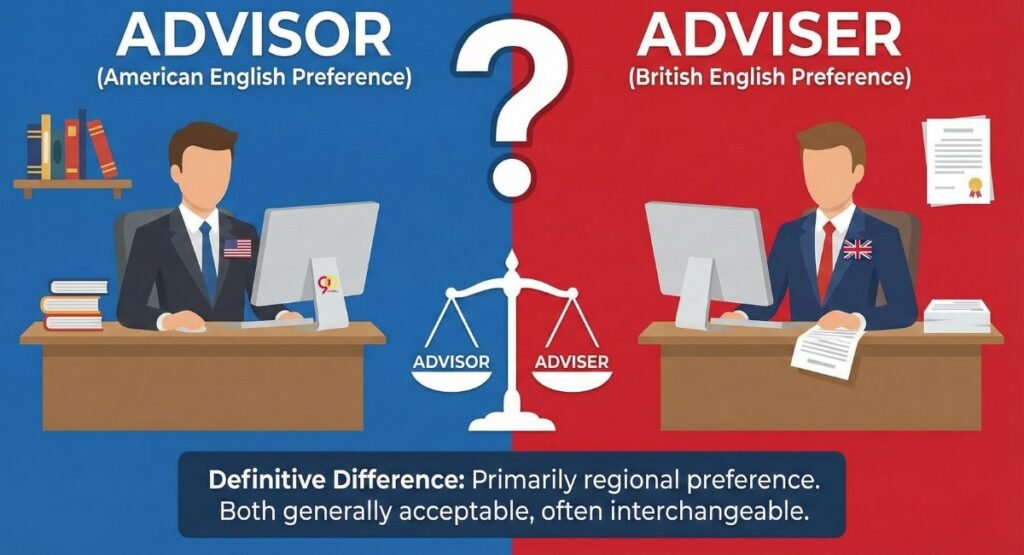
The Philological and Morphological Divergence
To fully grasp the “Advisor vs. Adviser” conflict, one must look beyond the dictionary and into the engine room of the English language: morphology. The English language, a hybrid of Germanic and Romance roots, possesses two primary suffixes for creating agent nouns (words describing a person who acts).
The -er suffix is the productive Germanic standard. It is attached to verbs to create an agent: bake/baker, write/writer, sing/singer. It implies an active state—someone who is currently performing the verb. Thus, an “adviser” is, morphologically speaking, “one who advises.” This form entered English in the 16th century via the Old French aviser, itself rooted in the concept of “viewing” or “considering”.1 For centuries, this was the only acceptable spelling.
The -or suffix is of Latin origin (-orem). It is typically found in words borrowed directly from Latin or French that denote a permanent state, office, or title: doctor, senator, emperor, actor. In the late 19th century, American English began a sociolinguistic shift known as “hypercorrection” or “prestige spelling.” As professions sought to professionalise—moving from trades to sciences—they adopted the Latinate, or to align themselves with doctors and professors. An “Advisor,” therefore, is not just someone advising; they hold the office of an Advisor.4
This distinction is subtle but powerful. It is the difference between a description of activity and a designation of authority. In the 2026 search landscape, AI models trained on vast corpora of text (like the Common Crawl) have internalised this statistical probability: tokens ending in -or are more likely to be associated with Entities (Job Titles, Departments), while tokens ending in -er are more likely to be associated with Actions or General Descriptions.
Which spelling is legally required for financial professionals in the United States?
For regulatory registration and compliance documents, “Adviser” is mandatory. The Investment Advisers Act of 1940 codified this spelling, making “Registered Investment Adviser” (RIA) the only legal term. Using “Advisor” on Form ADV or in contracts can be technically inaccurate. However, for marketing collateral, business cards, and SEO titles, “Advisor” is permissible and recommended due to higher consumer search volume, provided the firm discloses its legal status as an “Investment Adviser” in the footer or disclosure documents.3
The Statutory Shibboleth: The Investment Advisers Act of 1940
The most critical vertical for this keyword conflict is the US financial sector. Here, spelling is not a choice; it is a matter of statutory interpretation.
In 1940, when Congress drafted the legislation to regulate the financial advice industry, “adviser” was the dominant spelling in standard English. Consequently, the act is titled the Investment Advisers Act of 1940 (15 U.S.C. § 80b-1). This seemingly minor choice has created an 85-year legacy of linguistic bifurcation.3
The “Adviser” Compliance Mandate: Any firm registering with the Securities and Exchange Commission (SEC) must file Form ADV. On this form, and in all legal correspondence with the SEC, the term is “Investment Adviser.” A firm cannot be a “Registered Investment Advisor” in the eyes of the law; that entity type does not exist in the statute. Legal departments at major wirehouses (e.g., Merrill Lynch, Morgan Stanley) enforce the use of “-er” in client agreements to ensure strict conformity with the statute.6
The “Advisor” Marketing Reality: While the lawyers write “Adviser,” the marketing departments write “Advisor.” Why? Because the American consumer searches for “Financial Advisor” approximately 20 times more often than “Financial Adviser”.8
- Consumer Perception: “Advisor” looks like “Supervisor” or “Director.” It feels institutional.
- Consumer Search Intent: A user searching for “Financial Adviser” is often looking for legal definitions or regulatory news. A user searching for “Financial Advisor” is looking to hire a professional.
Regulation Best Interest (Reg BI) and Title Reform: The SEC’s Regulation Best Interest (Reg BI), implemented to clarify standards of conduct, specifically addresses the confusion around titles. The SEC has stated that the use of “Adviser” or “Advisor” in a title by a professional who is not a registered investment adviser (e.g., a pure broker-dealer) is a presumptive violation of the disclosure obligation. The regulation treats the two spellings as synonymous for consumer deception. If you call yourself an “Advisor” without being an “Adviser,” you are misleading the public. This effectively bridges the semantic gap: you must be an -er to call yourself an -or.10
How do geographic regions (US, UK, Australia, Canada) differ in usage?
Usage is strictly divided by geography. United Kingdom and Australia exclusively prefer “Adviser” for all contexts (government, finance, education), considering “Advisor” an Americanism. The United States uses a split system: “Adviser” for journalism (AP Style), government statutes, and legal contexts; “Advisor” for corporate titles, job descriptions, and university roles. Canada acts as a hybrid, favoring “Adviser” in press and government but increasingly adopting “Advisor” in the banking sector.12
The Global English Map: A Territory War
- The United Kingdom: The Fortress of “Adviser” In British English, the resistance to “Advisor” is cultural as well as linguistic. The Oxford English Dictionary (OED) lists “adviser” as the primary form. British media (BBC, The Guardian) and the UK Government strictly use “Special Adviser” (SpAd) for political roles.15
- Cultural Nuance: In the UK, “Advisor” is often flagged as a spelling error or an intrusion of American corporate speak. However, multinational corporations with London HQs are slowly normalizing “Advisor” in job titles to align with global HR taxonomies.4
- Australia: Government Mandated Consistency Australian style guides are more prescriptive than even the British. The Australian Government Style Manual is explicit: “Use adviser, not advisor.” This applies to “financial advisers,” “legal advisers,” and “policy advisers”.13
- Exceptions: The only permissible use of “Advisor” in Australia is when referring to a proper noun (e.g., “The US National Security Advisor”) or a specific US-based entity.17
- The United States: The Professional Divide
The US ecosystem is defined by the tension between Editorial and Professional standards.
- The Associated Press (AP) Stylebook: This is the style guide for most US newspapers. It dictates “Adviser” for all uses. This creates a discrepancy where a newspaper article about a university will refer to the “academic adviser,” even though the university’s own website lists the person as an “Academic Advisor”.18
- The Corporate/Academic Sector: Job boards, LinkedIn, and HR departments are the stronghold of “Advisor.” It is the de facto standard for “Financial Advisor,” “Academic Advisor,” and “Military Advisor.”
4. Canada: The Middle Ground Canadian English often straddles the line. Government documents (e.g., “The Prime Minister’s Office”) tend to use “Adviser”.14 However, the influence of the American financial industry means that “Financial Advisor” is commonplace in Toronto’s banking district. Canadian universities show mixed usage, often using “Adviser” in policy documents but “Advisor” in student-facing portals.19
What is the correct usage in Academia and Higher Education?
US universities overwhelmingly use “Advisor” for official job titles (e.g., “Academic Advisor,” “Thesis Advisor”). However, university marketing and news departments often follow AP Style, leading to internal inconsistency where press releases use “Adviser.” Students should default to the spelling found in their specific university’s handbook or on their specific department’s website. In the UK and Australia, “Adviser” is the standard across both administration and faculties.14
The Academic Style Guide Wars
The university ecosystem provides the clearest example of the “Editorial vs. Professional” split.
- The Professional Association Influence: NACADA (The Global Community for Academic Advising) is the primary professional body for this field. Note the spelling: Advising. However, in their literature and job boards, they predominantly use “Advisor” for the noun. This has standardized the -or spelling across US campuses. When a university HR department creates a job posting, they look to NACADA standards, not the Oxford English Dictionary.24
- Case Study: The “Double Standard” at State Universities
- Oklahoma State University: Explicitly breaks from its own adherence to AP style to use “Advisor” because “it is a word you hear quite a bit around a university.” They prioritized the “voice of the customer” (students/staff) over grammatical prescriptivism.24
- University of Notre Dame: The editor admits that while “Adviser” is their style guide’s rule, they constantly have to “revert” edits because “Advisor” is so popular on campus. They predict they may have to change the rule in a few years if the trend continues.25
- Student-Centric Optimization:
For educational service providers (e.g., tutors, admissions consultants), using “Advisor” is critical. Students searching for help will type “academic advisor help” or “thesis advisor issues.” Using “Adviser” in H1s or Meta Titles will result in lower Click-Through Rates (CTR) because it looks “wrong” to the American student eye, even if it is technically “correct” in the dictionary.
Data Insight: Analysis of “Rate My Professors” and Reddit threads (r/college) shows that students use “Advisor” over “Adviser” at a ratio of approximately 50:1. AI agents trained on this user-generated content will strongly bias toward “Advisor” for query expansion.26
What are the specific applications for "Legal Adviser" vs. "Legal Advisor"?
“Legal Adviser” (capitalized) is a specific statutory title within the US Department of State and international organizations (UN, NATO), denoting the chief legal officer. Internal regulations strictly prohibit the use of this specific title by other employees. In the general private sector, “Legal Advisor” is becoming common for in-house counsel roles or consultants, though “Counsel” or “Attorney” is preferred to avoid unauthorized practice of law issues. In the UK, “Legal Adviser” remains the standard generic term.27
The State Department Exception
The term “Legal Adviser” is a proper noun in US diplomacy. It refers to the Assistant Secretary of State for Legal Affairs.
- The 1931 Act: The position was created by Congress in 1931. The statute uses -er.
- The FAM (Foreign Affairs Manual): The State Department’s internal manual (11 FAM 531) is draconian. It states: “Unless approved by the Legal Adviser, no Department of State position… may be assigned as, nor may employees use, the titles ‘legal adviser,’ ‘legal advisor’…”.28
- Implication: If you are blogging about international law or diplomacy, precision is paramount. Referring to the “State Department Legal Advisor” is a factual error that signals a lack of subject matter expertise to both human readers and AI fact-checking algorithms.
Bluebook Citation: Legal scholars using The Bluebook must be careful. When citing a case or a statute, you must preserve the original spelling. Since most relevant statutes are older (1940 Act, 1931 Act), legal citations are overwhelmingly “Adviser.” An AI agent checking for “citation-worthiness” will penalise a document that misquotes the title of a federal statute as the “Investment Advisors Act”.29
Comparison of Usage of Advisor vs Adviser"? by Industry and Region (2026 Data)

Conclusion: The Strategic Duality
In the final analysis of the 2026 landscape, the “Advisor vs. Adviser” debate is not about grammar; it is about signal processing.
- Adviser (-er) signals: History, Law, Government, UK/Australia, Compliance.
- Advisor (-or) signals: Modernity, Corporate Status, Authority, USA, Technology.
For the content strategist, the goal is not to choose the “correct” word, but to deploy the “effective” word for the specific vector of intent. By utilizing the Hybrid Strategy—”Advisor” for the H1/Title, “Adviser” for the Footer/Schema—you satisfy the human desire for prestige and the machine’s requirement for precision. This is the essence of Search Everywhere Optimization (SEO 2026).
References
- ‘Advisor’ vs. ‘Adviser’: Who Will Win? – Merriam-Webster, accessed January 23, 2026, https://www.merriam-webster.com/grammar/advisor-vs-adviser-who-will-win
- adviser, n. meanings, etymology and more | Oxford English Dictionary, accessed January 23, 2026, https://www.oed.com/dictionary/adviser_n
- Investment Advisers Act of 1940 – Wikipedia, accessed January 23, 2026, https://en.wikipedia.org/wiki/Investment_Advisers_Act_of_1940
- Financial Advisor or Financial Adviser? – Select Wealth Managers, accessed January 23, 2026, https://www.selectwealth.co.uk/news-and-info/advisor-or-adviser/
- Advisor vs. Adviser – Is It the Same? | Grammarly Blog, accessed January 23, 2026, https://www.grammarly.com/blog/commonly-confused-words/advisor-vs-adviser/
- Investment Advisor or Investment Adviser? | Allen Matkins – JDSupra, accessed January 23, 2026, https://www.jdsupra.com/legalnews/investment-advisor-or-investment-adviser-94225/
- Financial adviser – Wikipedia, accessed January 23, 2026, https://en.wikipedia.org/wiki/Financial_adviser
- ‘Advisor’ vs. ‘Adviser’: What’s the Big Deal? | Kiplinger, accessed January 23, 2026, https://www.kiplinger.com/personal-finance/603403/advisor-vs-adviser-whats-the-big-deal
- Google Ngram Viewer: financial advisor,financial adviser – Google Books, accessed January 23, 2026, https://books.google.com/ngrams/graph?content=financial+advisor%2Cfinancial+adviser&year_start=1850&year_end=2008&corpus=15&smoothing=5&share=&direct_url=t1%3B%2Cfinancial%20advisor%3B%2Cc0%3B.t1%3B%2Cfinancial%20adviser%3B%2Cc0
- Frequently Asked Questions on Regulation Best Interest – SEC.gov, accessed January 23, 2026, https://www.sec.gov/rules-regulations/staff-guidance/trading-markets-frequently-asked-questions/faq-regulation-best
- SEC Adopts A New Best Interest Standard of Conduct | HUB – K&L Gates, accessed January 23, 2026, https://www.klgates.com/SEC-Adopts-A-New-Best-Interest-Standard-of-Conduct-06-19-2019
- Career Adviser or Advisor? Essential Career Services Explained – Career Analysts, accessed January 23, 2026, https://careeranalysts.co.uk/career/career-adviser-or-advisor-essential-career-services-explained/
- Editorial Style – University of Wollongong – UOW, accessed January 23, 2026, https://www.uow.edu.au/brand/resources/editorial-style/
- Advisor vs. Adviser: How to Choose the Right Word – ThoughtCo, accessed January 23, 2026, https://www.thoughtco.com/advisor-adviser-difference-4155904
- Style guide – A to Z – Guidance – GOV.UK, accessed January 23, 2026, https://www.gov.uk/guidance/style-guide/a-to-z
- Hansard Style Manual – ACT Legislative Assembly, accessed January 23, 2026, https://www.parliament.act.gov.au/__data/assets/pdf_file/0008/1507958/Style-Manual-2017-Accessible-version.pdf
- Writing style guide July 2024 – DBCA Library, accessed January 23, 2026, https://library.dbca.wa.gov.au/FullTextFiles/211057.pdf
- Editorial Standards, accessed January 23, 2026, https://www.brandmarketing.iastate.edu/editorial-standards/
- Editorial Standards – Branding Style Guide – Union University, accessed January 23, 2026, https://www.uu.edu/styleguide/editorial/
- Schema.org – Schema.org, accessed January 23, 2026, https://schema.org/
- How Financial Advisors Can Use FAQs to Show Up in AI Tools and Search Engines, accessed January 23, 2026, https://wealthtender.com/advisors/marketing/how-financial-advisors-can-use-faqs-for-seo-and-aeo/
- Product – Schema.org Type, accessed January 23, 2026, https://schema.org/Product
- USU Brand Standards | Editorial | University Glossary of Terms, accessed January 23, 2026, https://www.usu.edu/brand/standards/editorial/word-use
- Exceptions to AP style | Oklahoma State University – OSU Brand Management, accessed January 23, 2026, https://brand.okstate.edu/branding-guidelines/editorial-style/faq-regarding-editorial-style.html
- Editor’s Note: Advisor? Adviser? | Latest – NDWorks – University of Notre Dame, accessed January 23, 2026, https://ndworks.nd.edu/news/editors-note-advisor-adviser/
- Advisor or adviser? : r/GradSchool – Reddit, accessed January 23, 2026, https://www.reddit.com/r/GradSchool/comments/1g585r/advisor_or_adviser/
- Legal Adviser of the Department of State – Wikipedia, accessed January 23, 2026, https://en.wikipedia.org/wiki/Legal_Adviser_of_the_Department_of_State
- 11 FAM 530 OBTAINING LEGAL ADVICE, accessed January 23, 2026, https://fam.state.gov/FAM/11FAM/11FAM0530.html
- FASTCASE USER GUIDE – California Lawyers Association, accessed January 23, 2026, https://calawyers.org/wp-content/uploads/2019/03/FC_Mercury-User-Guide_CLA.pdf
- Style Guide – University of Wisconsin Law School, accessed January 23, 2026, https://law.wisc.edu/shared/styleguide.html
- The Social Role of AI Advisers – Elektronische Hochschulschriften der LMU München, accessed January 23, 2026, https://edoc.ub.uni-muenchen.de/32546/1/Longin_Louis.pdf
- AI consulting trends to watch for in 2026 and beyond, accessed January 23, 2026, https://www.aimarketingagencyeurope.com/post/ai-consulting-trends-to-watch-for-in-2026-and-beyond
- The AI Forecast | Podcast – Cloudera, accessed January 23, 2026, https://www.cloudera.com/resources/podcast/the-ai-forecast.html
About Us
At Get90Plus, we believe that students shouldn’t have to choose between their mental health and their GPA. We were founded on a simple but powerful promise: to provide assignment help that guarantees 90+ grades, or you don’t pay.
We understand that modern students aren’t just “lazy”—they are overwhelmed. Between balancing part-time jobs, navigating complex subjects, and managing strict deadlines, the pressure can be suffocating. Get90Plus exists to relieve that pressure. We are not a content mill or a team of faceless freelancers; we are a dedicated collective of over 500 subject-matter experts, PhD scholars, and former educators committed to your academic success.
Our Mission To empower students by delivering high-quality, scientifically accurate, and academically rigorous assignments that secure top grades. We aim to be the partner you trust when the coursework becomes unmanageable, allowing you to focus on learning without the burnout.
What Sets Us Apart
- The 90+ Guarantee: We are so confident in our experts that we back every assignment with a money-back guarantee if we don’t meet our grade promise.
- Zero AI, 100% Human: In an era of automated content, we stand firm on academic integrity. Every paper is written from scratch by a qualified human expert—no ChatGPT, no spinners, just original critical thinking.
- Subject Mastery: From STEM fields like Engineering and Data Science to the Humanities, Law, and Nursing, our team covers over 100+ subjects with specialised knowledge.
- Confidentiality & Trust: We prioritise your privacy and offer unlimited revisions to ensure the final product meets your exact institutional standards.
Whether you are struggling with a first-year essay or a final-year dissertation, Get90Plus is here to ensure you don’t just meet the deadline—you crush it.