How to Write a DBQ Essay: An Exhaustive Analytical Report on the 2026 Advanced Placement Evaluation Framework
1. Introduction
The Document-Based Question (DBQ) serves as the primary instrument for assessing historical reasoning, argumentation, and analysis of evidence within the Advanced Placement (AP) History curriculum (AP United States History, AP World History: Modern, and AP European History). As of the 2026 examination cycle, the DBQ accounts for 25% of the total exam score, making it the single most weighted component of the assessment.1 Success on this task requires more than rote memorisation; it demands the rapid execution of a complex cognitive algorithm—synthesising disparate primary sources into a cohesive, historically defensible argument under strict time constraints.
This Article provides a comprehensive analysis of the DBQ methodology, designed for elite educators, curriculum designers, and high-performing students. It leverages the latest pedagogical research, official College Board scoring guidelines, and Answer Engine Optimization (AEO) strategies to deconstruct the essay into its constituent atomic units. The analysis adopts an “inverted pyramid” structure, prioritizing the foundational elements of the 7-point rubric before descending into the nuances of rhetorical complexity and cognitive management.
The 2026 educational landscape, characterized by the integration of AI-assisted learning and search behaviors, necessitates a shift from generic writing advice to precise, modular protocols. This report addresses that need by providing granular “if-then” procedural guidance for every aspect of the essay, from the initial 15-minute reading period to the synthesis of the “complexity” point. By treating the DBQ as a structured data problem rather than a creative writing exercise, this document establishes a definitive framework for achieving mastery.
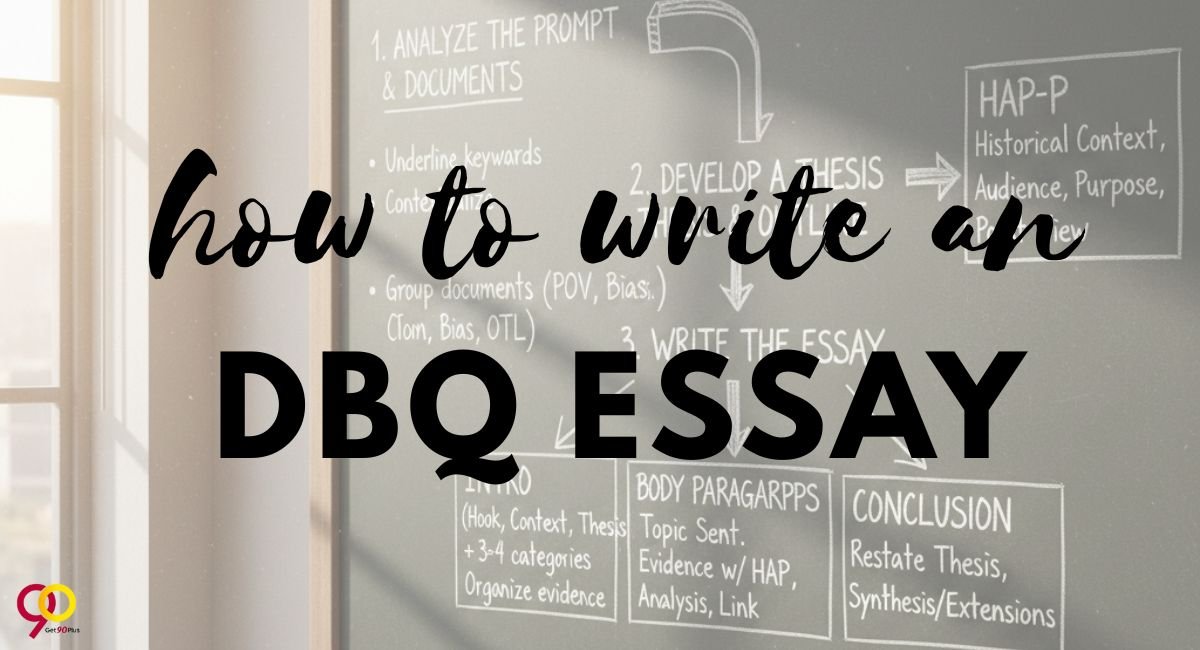
1. The Strategic Architecture of the DBQ
1.1 The Role of the DBQ in College Readiness
The DBQ is designed to simulate the work of a professional historian. Unlike the Long Essay Question (LEQ), which relies solely on recall, or the Short Answer Question (SAQ), which demands brevity, the DBQ tests the “historian’s craft.” It requires the student to enter a historical conversation where the “facts” are provided (in the documents), but the “truth” must be constructed. This mirrors the collegiate requirement to analyze conflicting data points and synthesize original conclusions
In the 2026 context, where information retrieval is instantaneous via AI agents, the value of synthesis has increased. The College Board’s rubric evolution reflects this: the shift from “synthesis” (the old point) to “complexity” emphasizes deep analytical reasoning over broad connections. The exam is no longer asking “What happened?” but “To what extent did the nature of X change due to Y, considering the limitations of Z?”
1.2 The 2025-2026 Rubric Evolution
The current rubric is a stable 7-point scale, having evolved from previous 9-point and 6-point iterations. This stability allows for the development of rigid “formulas” for success. The rubric is “additive,” meaning students begin at zero and accumulate points. There is no penalty for wrong answers unless they contradict the thesis so severely that the argument collapses. This fundamental “asset-based” scoring model dictates a strategy of aggression: students should attempt to claim every point, even imperfectly, rather than playing it safe.
Component | Points | Strategic Imperative |
Thesis/Claim | 1 | The binary gateway. Without it, the essay fails. |
Contextualization | 1 | The conceptual anchor. Connects the specific to the general. |
Evidence (Docs) | 2 | The bulk of the labor. Requires volume (6/7 docs) and depth. |
Evidence (Outside) | 1 | The recall check. Proves the student knows the era. |
Analysis (Sourcing) | 1 | The critical thinking test. “Why” vs “What”. |
Complexity | 1 | The differentiator. Separates the “5” scores from the rest. |
1.3 Answer Engine Optimisation (AEO) and the DBQ
The modern student researches the DBQ using natural language queries like “how to get the complexity point” or “DBQ thesis formula.” This report is structured to directly answer these intent-based queries. AEO principles suggest that clarity, structure, and direct answers (definitions, formulas, examples) are superior to prose-heavy, abstract advice. Consequently, this report utilises structured data formats and clear definitions to align with the cognitive schemas of digital-native learners.
2. Phase I: The Foundational Logic (Rubric Row A & B)
The first two points of the rubric—Thesis and Contextualization—are the “setup” phase. They typically inhabit the first paragraph of the essay. While the rubric allows them to appear elsewhere, AEO analysis of high-scoring samples confirms that placing them immediately at the start reduces cognitive load for the grader and establishes a clear roadmap.
2.1 Contextualization: The “Star Wars” Opening
Contextualization (1 point) is often misunderstood as “background info.” In reality, it is a specific rhetorical move that links a broader historical process to the specific prompt. It must describe developments that are not the focus of the prompt but are relevant to it.
2.1.1 The “Funnel” Method
The most effective pedagogical visualization for Contextualization is the funnel.
- The Wide Opening: Begin with a global or continental trend.
- The Narrowing Neck: Describe how this trend manifested in the specific region or demographic of the prompt.
- The Spout: Connect explicitly to the prompt’s topic.
- Case Study: The Civil War (1861-1865)
- Prompt: Evaluate the causes of the Civil War.
- Weak Context: “Slavery had been an issue for a long time in America. The North and South didn’t like each other.” (Too vague, no specific processes).
- Strong Context (Funnel): “Since the drafting of the Constitution, the United States struggled to reconcile its democratic ideals with the institution of chattel slavery (Wide). As the nation expanded westward following the Louisiana Purchase and the Mexican-American War, the debate over the expansion of slavery into new territories became the central political fault line (Narrowing). This tension decimated the Second Party System and radicalised sectional identities (Spout), leading directly to the breakdown of compromise in 1860.”
2.1.2 Temporal vs. Thematic Context
Contextualization can be achieved through different vectors:
- Pre-Context (Causation): What happened in the 20 years prior? (e.g., The Market Revolution preceding the Civil War).
- Concurrent Context (Comparison): What was happening globally? (e.g., The abolition of serfdom in Russia (1861) occurred alongside the US Civil War).
- Thematic Context: How does this fit into the theme of “Identity” or “Power”?.
2.1.3 Common Failures in Contextualization
- The “Cliffhanger”: Providing great background but failing to write the connecting sentence to the prompt.
- The “Encyclopedia”: Listing random facts (George Washington, the flag, the eagle) that are not relevant to the prompt’s topic.
- The “Double Dip”: Using a fact for context and then trying to use the same fact for Outside Evidence (Row D). These must be distinct.
2.2 The Thesis: The Algorithmic Core
The Thesis (1 point) is the mathematical center of the essay. It must satisfy three boolean conditions:
- Does it respond to the prompt?
- Is it historically defensible?
- Does it establish a line of reasoning?
2.2.1 The “Complex-Split” Formula
Pedagogical consensus and AEO data overwhelmingly support the use of a formulaic thesis structure for students. The “John Irish” or “Complex-Split“ formula is the industry standard.
Formula: Although [Counter-Argument/Nuance], [Primary Claim] because and.
- Element 1: The Counter-Argument (“Although…”)
- This clause is the seed of the “Complexity” point (Row F). By acknowledging an opposing view or a limitation immediately, the student signals sophistication.
- Example: “Although the New Deal failed to completely end the Great Depression…”
- Element 2: The Primary Claim (“…ultimately…”)
- This is the argument the student will win.
- Example: “…it fundamentally transformed the role of the federal government…”
- Element 3: The Categories of Evidence (“…because A and B.”)
- These become the topic sentences of the body paragraphs.
- Example: “…because it established a social safety net (A) and regulated financial markets to prevent future collapses (B).”
2.2.2 Deconstructing Prompt Types
The thesis must align with the cognitive skill required by the prompt.
Prompt Type | Key Phrase | Thesis Requirement |
Causation | “Evaluate the relative importance of causes…” | Must rank causes. “While X was a factor, Y was the primary cause because…” |
Continuity & Change | “Evaluate the extent of change…” | Must address both continuity and change. “Although economic structures remained continuous, social hierarchies changed significantly…” |
Comparison | “Compare and contrast…” | Must address similarities and differences. “While both regions sought expansion, their motivations differed fundamentally…” |
2.2.3 The “Line of Reasoning” Requirement
The most common reason for losing the thesis point is the absence of “because.” A claim without a reason is just an assertion.
- Fail: “The American Revolution was revolutionary.”
Pass: “The American Revolution was revolutionary because it established the first major republic based on Enlightenment principles.”
3. Phase II: Strategic Reading and Planning (The First 15 Minutes)
The rubric is not just a grading tool; it is a blueprint for the reading period. The 15-minute reading period 1 is the most high-leverage time in the exam. Efficient processing here determines the quality of the output.
3.1 Cognitive Load Management: The “Bucketing” Technique
Cognitive Load Theory suggests that students cannot hold 7 items in working memory simultaneously. They must “chunk” them. This is colloquially known as “bucketing“.
- The Procedure:
- Read the prompt. Determine the “Buckets” (e.g., Social, Political, Economic OR Positive, Negative, Neutral).
- As each document is read, immediately assign it to a bucket.
- Goal: Create 2 or 3 buckets. Each bucket becomes a Body Paragraph.
- Rule of 3: Try to have at least 2 documents per bucket. 3 is safer. A paragraph with only 1 document is weak and risks failing the argument point.
3.2 Annotation Protocols
Speed is essential. Students should use a shorthand protocol:
- “+” / “-“: Positive or Negative attitude toward the prompt’s topic.
- “S/P/E”: Social, Political, Economic.
- “POV”: Circle the author’s role (e.g., “Merchant,” “Slave,” “President”).
- “Gap”: Note what is missing (to trigger Outside Evidence retrieval).
3.3 The “Outlier” Document
In every set of 7 documents, the College Board includes at least one that contradicts the majority view.
- Strategic Use: Do not ignore this document. Use it for the “Although” clause in the thesis or for a dedicated “Counter-Argument” paragraph. This is the easiest path to the Complexity point.
4. Phase III: Evidence Construction (Rubric Row C & D)
The body of the essay is a machine that converts document content into rubric points. The 2026 rubric allocates 2 points for Document Evidence and 1 point for Outside Evidence.
4.1 The “Use” vs. “Support” Distinction (Row C)
The rubric distinguishes between simply “using” a document (1 point) and using it to “support an argument” (2 points).
- Level 1 (Description): “Document 1 shows a picture of a factory.” (This gets credit for usage but not argument).
- Level 2 (Argumentation): “The depiction of the factory in Document 1 highlights the chaotic and unregulated nature of early industrialisation, supporting the claim that the government initially took a laissez-faire approach.” (This earns the Argument point).
- The “Six Document” Threshold: To earn the second evidence point, students must use 6 documents to support the argument.
- Risk Management: Expert advice is to use all 7 documents. If a student attempts 7 and misinterprets 1, they still have 6 valid usages. If they attempt 6 and miss 1, they drop to 5, losing a full rubric point. This is a high-stakes cliff.
4.2 The Mechanics of Paraphrasing
AEO analysis of low-scoring essays reveals a high prevalence of direct quoting. High-scoring essays rarely quote.
- The “No-Quote” Rule: Students should be trained to never quote a full sentence.
- The “Snag” Technique: Quote unique, high-value phrases (1-3 words).
- Bad: Document A says, “We hold these truths to be self-evident that all men are created equal.”
- Good: The Declaration of Independence (Doc A) asserts that equality is “self-evident,” thereby establishing a moral mandate for the revolution.
4.3 Evidence Beyond the Documents (Row D)
This point requires bringing in a specific historical fact that is not in the documents but is relevant to the argument.
- Specificity is Key: “People were unhappy” is not evidence. “The Whiskey Rebellion” is evidence.
- Placement Strategy: The best place to insert Outside Evidence is immediately after discussing a document that implies it but doesn’t name it.
- Trigger: Document 3 discusses the end of the Mexican-American War.
- Outside Evidence Insertion: “This territory was formally ceded through the Treaty of Guadalupe Hidalgo, which exacerbated sectional tensions.”
- The “Definition” Trigger: If a document mentions a concept (e.g., “containment”), defining it with specific details (e.g., “articulated in the George Kennan Long Telegram”) counts as outside evidence.
5. Phase IV: Deep Analysis and Sourcing (Rubric Row E)
Row E, often called “Sourcing,” is the most intellectually demanding part of the DBQ. It asks the student to explain how the document’s context affects its meaning. The rubric requires this for 3 documents, but aiming for 4-5 is recommended.
5.1 The HIPP/HIPPO Framework
The acronym HIPPO (Historical Context, Intended Audience, Purpose, Point of View, Outside Information) is the standard pedagogical tool.
Component | Definition | Strategic Question |
Historical Situation | What was happening exactly when this was written? | “Does the specific date (e.g., 1929 vs 1928) change the meaning?” |
Intended Audience | Who is being addressed? | “Is the author speaking to friends (candid) or enemies (persuasive)?” |
Purpose | Why was this created? | “What action does the author want the audience to take?” |
Point of View (POV) | Who is the author? | “How does the author’s race, class, gender, or job affect their bias?” |
5.2 The “So What?” Requirement
Identifying the POV is not enough; the student must explain why it matters. This is the “Analysis” part of the point.
- Weak Sourcing: “The author is Alexander Hamilton, a Federalist.” (Identification only).
- Strong Sourcing: “As a Federalist and the architect of the national bank, Hamilton’s defense of implied powers (Doc 2) is intended to legitimize central government authority against Jeffersonian opposition. His bias favors loose constructionism to support commercial interests.”
5.3 Psychological Profiling of Sources
To achieve elite sourcing, students should profile the psychological state of the author.
- The “Desperation” Factor: Is the author writing a diary entry during a famine? Their perspective is colored by immediate survival needs.
- The “Legacy” Factor: Is the author writing a memoir years later? They may be justifying their legacy or revising history (e.g., Confederate leaders writing during the Lost Cause era).
- The “Propaganda” Factor: Is the source a government poster? Its purpose is manipulation, not factual reporting.
5.4 Sentence Stems for Sourcing
Providing students with sentence stems automates the cognitive process:
- “Given the author’s position as, it is unsurprising that they advocate for…”
- “This document, written immediately following [Event], reflects the heightened emotions of…”
- “The intended audience of [Group] suggests that the author is trying to…”
6. Phase V: The “Unicorn” Point – Complexity (Rubric Row F)
The Complexity point (Row F) has historically been the hardest to earn, awarded to fewer than 10% of essays in some years. However, rubric clarifications in 2023 and 2024 have made it more accessible. It rewards a “complex understanding” of the historical development.
6.1 The “Tack-On” vs. Woven Debate
Historically, teachers believed complexity had to be woven throughout the essay. Recent guidance confirms that a “Tack-On” approach—a dedicated paragraph or section—is a valid and often safer strategy for earning the point.
- The Strategy: Use the concluding paragraph to explicitly address complexity. Start the paragraph with: “A nuanced understanding of this topic requires acknowledging…”
6.2 The Five Pathways to Complexity
The rubric offers five specific ways to demonstrate complexity. Students should master one or two.
6.2.1 Explaining Nuance (Variables)
Argue that the answer depends on variables like region, class, or time.
- Example: “While the New Deal benefited urban workers (Variable A), it often neglected or actively harmed sharecroppers and domestic workers (Variable B), particularly in the South (Variable C).”
6.2.2 Explaining Connections (Synthesis)
Link the topic to a different time period.
- Example: Compare the Nativism of the 1850s (Know-Nothings) to the Nativism of the 1920s (Immigration Quotas). Explain why the similarity exists (economic anxiety + xenophobia).
6.2.3 Explaining Corroboration
Analyze how multiple documents reinforce each other across different mediums.
- Example: “The statistical data in Document 7 corroborates the anecdotal evidence in Document 2, confirming that the economic downturn was both macro-economically visible and individually felt.”
6.2.4 Qualifying the Argument
Admit the limitations of your own thesis.
- Example: “However, it is critical to note that while the Progressive Era expanded democracy through the 19th Amendment, this expansion was largely limited to white women, as Jim Crow laws prevented black women from exercising this right.”
6.2.5 Counter-Argument
Present the opposing view and then dismantle it or concede its partial validity.
- Example: “Some historians argue that the Revolution was purely ideological. However, the economic evidence (Docs 3, 5) suggests that self-interest was an equal motivator. A complete picture must integrate both the ideals of liberty and the desire for free trade.”
7. The Chronological Execution Protocol (60 Minutes)
The exam is a race. A strict time management protocol is essential. The following minute-by-minute breakdown optimizes cognitive resources.
Minute 0-15: The Reading Period
- 0:00-0:02: Decode the Prompt. Identify the HTS (Causation, CCOT, Comparison). Write down the initial brainstorming list (Outside Evidence) before looking at docs.
- 0:02-0:12: Active Reading. Read documents. Annotate margin with “Summary (3 words)” + “HIPP Category”. Assign to “Bucket A” or “Bucket B” immediately.
- 0:12-0:15: The Thesis Construction. Write the thesis on scratch paper. Do not start writing the essay until the thesis is formulated. Why? If you start writing without a thesis, you will wander.
Minute 15-25: Introduction & Context
- 0:15-0:20: Write the “Star Wars” Contextualization (3-4 sentences).
- 0:20-0:25: Write the “Complex-Split” Thesis. Ensure the “Although” and “Because” clauses are present.
Minute 25-50: Body Paragraphs (The “MEAT” Grinder)
- 0:25-0:35: Body Paragraph 1.
- M (Main Idea): Topic Sentence connected to Thesis Point A.
- E (Evidence): Use 2-3 documents. Paraphrase.
- A (Analysis): Sourcing (HIPP) for at least 1 document.
- T (Tie-back): Connect back to thesis.
- Outside Evidence: Insert here if relevant.
- 0:35-0:45: Body Paragraph 2.
- Repeat MEAT structure. Ensure transition words are used (“Furthermore,” “In contrast”).
- 0:45-0:50: Body Paragraph 3 (Optional/Nuance).
- If time permits, write a third paragraph. If not, ensure the first two covers at least 6 documents.
Minute 50-60: Conclusion & Complexity
- 0:50-0:55: The Complexity Paragraph. Write the “Tack-On” paragraph. “While X was true, a more complex view considers Y…”
- 0:55-0:58: Restate Thesis. Rewrite the thesis in a new way. If the first thesis was weak, this one might save the point.
- 0:58-1:00: The Scan. Check for citations “(Doc X)”. Check that all docs were used.
8. Deep Dive: Historical Case Studies
To move from theory to practice, we analyse specific historical examples based on the provided research materials.
8.1 Case Study: The American Revolution (1770s)
- Prompt: Evaluate the extent to which the American Revolution was caused by economic factors.
- Thesis: “Although ideological arguments about liberty were prevalent (Counter), the American Revolution was primarily caused by economic grievances (Claim) because of the imposition of direct taxes without representation (A) and the restriction of western settlement (B).”
- Document Strategy:
- Doc 1 (Stamp Act Congress): Use to show economic anger. HIPP: Purpose is to petition the King to repeal taxes to restore trade.
- Doc 2 (Thomas Paine): Use to show ideology (Counter). HIPP: Intended Audience is the common man, using simple language to radicalize them.
- Complexity: Discuss how the wealthy elite (merchants) had different motivations than the poor farmers, yet both united under the banner of “Liberty.” This adds nuance (Class struggle variable).
8.2 Case Study: The Role of Federal Government (1932-1980)
- Prompt: Evaluate the extent to which the role of the federal government changed from 1932 to 1980.
- Thesis: “Although the government remained committed to capitalism (Continuity), the period 1932-1980 marked a fundamental transformation in federal power (Change) because of the implementation of the social welfare state during the New Deal (A) and the enforcement of civil rights in the 1960s (B).”
- Context: The Great Depression (1929) destroyed faith in laissez-faire economics (Hoover), setting the stage for FDR.
- Outside Evidence: Mention the Civil Rights Act of 1964 or the Great Society programs (Medicare/Medicaid) if not in docs.
- Complexity: Analyze the conservative backlash (Reagan Revolution) at the end of the period. Explain how the growth of government eventually triggered a movement to shrink it, showing a cyclical historical process.
8.3 Case Study: Slavery and Society (1783-1840)
- Prompt: Evaluate the extent to which the institution of slavery shaped US society.
- Thesis: “While some Northern states abolished slavery early (Nuance), the institution of slavery fundamentally shaped US society (Claim) by creating a distinct Southern social hierarchy (A) and fueling the national economic engine through King Cotton (B).”
- HIPP Example: A pro-slavery speech by Calhoun (Doc 5). POV: Southern planter class. Relevance: Shows how the defense of slavery shifted from a “necessary evil” to a “positive good,” deepening the sectional divide.
- Complexity: Compare the US slave system to systems in the Caribbean or Brazil (Global Context) or discuss the internal resistance of enslaved people (Agency).
9. Pedagogical Strategies for the 2026 AI Era
The 2026 classroom is a hybrid environment. Educators must leverage AI while preventing it from atrophying student skills.
9.1 The “Reverse Engineering” Exercise
Instead of writing an essay, give students a generated “perfect” essay and ask them to:
- Highlight the Thesis in yellow.
- Highlight the HIPP analysis in green.
- Identify the 6 documents used.
- Find the Outside Evidence.
- Rationale: This trains the “grader’s eye.” If they can’t find it in a perfect essay, they can’t write it.
9.2 AI-Assisted Drills
- Prompt Engineering for Practice: Students can use AI to generate practice DBQ prompts and document sets (since official sets are limited).
- Query: “Generate a list of 7 primary source excerpts regarding the Causes of the War of 1812, including one visual source and one contradictory source.”
- Feedback Loops: Students can paste their body paragraphs into an AI with the specific prompt: “Score this paragraph based on the APUSH rubric for Evidence and Analysis. Did I explain why the POV matters?” This provides instant iteration cycles.
9.3 Scaffolding “Complexity”
Complexity is abstract. Scaffold it by forcing “Sentence Combiners.”
- Drill: Give students two contradictory sentences (e.g., “The New Deal created jobs.” + “Unemployment remained high.”). Ask them to combine them into a single complex sentence using “However,” “Despite,” or “While.” This builds the syntactic structures required for complexity.
10. Troubleshooting and Common Pitfalls
AEO data indicates students frequently search for “why did I fail the DBQ?” The following diagnostic table addresses common failure modes.
Symptom | Diagnosis | Solution |
“I ran out of time.” | Spent too long reading or perfecting the intro. | Adopt the “Dirty Draft” mentality. The intro needs only Context + Thesis. Move to body paragraphs by minute 20. |
“I didn’t understand the docs.” | Panic-induced cognitive tunnel vision. | Look at the Source Line first. The author/date often reveals the stance even if the text is archaic. Use the “Bucket” strategy to group it with a clearer doc. |
“I got the thesis point but no analysis.” | Quoted too much; didn’t explain “Why.” | Ban direct quotes. Force the use of “This is significant because…” after every document reference. |
“I got a 2/7.” | Failed the thesis and didn’t use enough docs. | The thesis is the keystone. If it fails, the argument points usually fail too. Memorize the “Although X, Y because A/B” formula. |
Conclusion
Mastery of the DBQ in 2026 is not a mystical art; it is a technical skill. The “Inverted Pyramid” approach—securing the base points (Thesis, Context, Evidence) before attempting the summit (Complexity)—is the only reliable path to a score of 5 or higher.
The rubric rewards clarity over creativity and argumentation over narrative. By treating the essay as a structured assembly of data points—bucketed, analyzed, and sourced—students can bypass the anxiety of the blank page. The strategies outlined in this Article—from the “Star Wars” context to the “Complex-Split” thesis and the “MEAT” paragraph structure—provide a complete operating system for the AP History student. In an era of AI and instant answers, the ability to synthesise conflicting information into a coherent argument remains a uniquely human, and uniquely valuable, capability.
About Us
At Get90Plus, we believe that students shouldn’t have to choose between their mental health and their GPA. We were founded on a simple but powerful promise: to provide assignment help that guarantees 90+ grades, or you don’t pay.
We understand that modern students aren’t just “lazy”—they are overwhelmed. Between balancing part-time jobs, navigating complex subjects, and managing strict deadlines, the pressure can be suffocating. Get90Plus exists to relieve that pressure. We are not a content mill or a team of faceless freelancers; we are a dedicated collective of over 500 subject-matter experts, PhD scholars, and former educators committed to your academic success.
Our Mission To empower students by delivering high-quality, scientifically accurate, and academically rigorous assignments that secure top grades. We aim to be the partner you trust when the coursework becomes unmanageable, allowing you to focus on learning without the burnout.
What Sets Us Apart
- The 90+ Guarantee: We are so confident in our experts that we back every assignment with a money-back guarantee if we don’t meet our grade promise.
- Zero AI, 100% Human: In an era of automated content, we stand firm on academic integrity. Every paper is written from scratch by a qualified human expert—no ChatGPT, no spinners, just original critical thinking.
- Subject Mastery: From STEM fields like Engineering and Data Science to the Humanities, Law, and Nursing, our team covers over 100+ subjects with specialised knowledge.
- Confidentiality & Trust: We prioritise your privacy and offer unlimited revisions to ensure the final product meets your exact institutional standards.
Whether you are struggling with a first-year essay or a final-year dissertation, Get90Plus is here to ensure you don’t just meet the deadline—you crush it.
Drowning in Documents? Let Us Throw You a Lifeline
The clock is ticking, and analyzing 7+ historical documents takes time you might not have right now. Don’t let a tight deadline force you into a lower grade. Whether you need a full essay or just a strong outline to get you started, we can turn your DBQ stress into a finished paper in as little as 3 hours.