Persuasive Speech Topics: 200+ Powerful, Interesting, and Easy Ideas for Every Audience
In the contemporary landscape of public discourse, the ability to persuade is not merely a soft skill; it is a fundamental instrument of leadership and change. Whether one is a university student defending a thesis, a corporate executive pitching a strategic pivot, or a civic leader advocating for policy reform, the capacity to influence beliefs and mobilise action is paramount. However, the efficacy of any persuasive endeavour hinges critically on the initial selection of the topic. A well-chosen topic acts as a fulcrum, allowing the speaker to leverage evidence and emotion to shift the heavy weight of audience opinion. Conversely, a poorly selected subject—one that is derivative, irrelevant, or logically indefensible—renders even the most eloquent delivery impotent.
This comprehensive guide serves as a definitive resource for navigating the complex architecture of persuasive speech. It moves beyond superficial lists to offer a deep pedagogical exploration of rhetorical strategy, audience psychology, and argumentation theory. By synthesising insights from classical rhetoric with modern data on communication anxiety and audience engagement, this report aims to equip the reader with a nuanced understanding of how to craft messages that resonate. The stakes in persuasive speaking are high; successful speeches have the power to alter trajectories, whether in a single classroom or across a nation.
Readers will gain more than just a repository of ideas. They will acquire a theoretical framework for evaluating the viability of a topic, balancing the rhetorical triangle of ethos, pathos, and logos, and structuring arguments for maximum impact. This guide is designed for a diverse spectrum of speakers—from the novice seeking a “safe” topic to build confidence, to the advanced orator looking to tackle complex bioethical dilemmas or geopolitical shifts. By integrating current data on trending issues such as artificial intelligence regulation, climate crisis mitigation, and the evolving dynamics of remote work, we ensure that the topics proposed are not only rhetorically sound but also culturally urgent.
Quick Takeaways
- Success relies on balancing Ethos (credibility), Pathos (emotion), and Logos (logic) to create a holistic argument that appeals to the whole person.
- The most effective topics sit at the intersection of the speaker’s genuine passion and the audience’s inherent interests or pain points.
- Utilizing proven structures like Monroe’s Motivated Sequence (Attention, Need, Satisfaction, Visualisation, Action) significantly increases conversion rates from passive listening to active agreement
- In 2025, persuasive speech requires robust data; for example, arguing on climate change is fortified by citing that 2024 was the warmest year on record.
- Up to 93% of communication effectiveness can be attributed to non-verbal cues; mastering vocal variety and body language is as crucial as the script itself.
- Public speaking anxiety affects 75% of the population; reframing this physiological arousal as excitement rather than fear is a scientifically backed coping mechanism.
- A topic’s complexity must match the demographic; a speech on “Pension Reform” requires a different approach for college students compared to industry professionals.
What Is a Persuasive Speech?
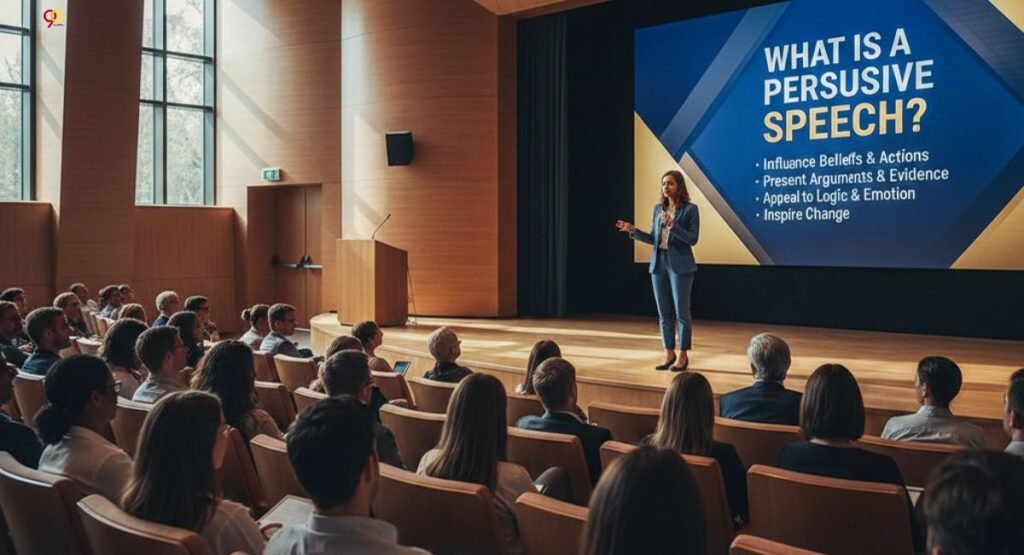
At its core, a persuasive speech is a strategic communication effort designed to alter the audience’s mental state or behavioural patterns. Unlike informative speaking, which functions to transfer knowledge—answering the “what” and “how”—persuasive speaking addresses the “why” and “should.” It is inherently argumentative and subjective, moving the audience from a state of neutrality or opposition toward a specific conclusion or course of action. The speaker assumes the role of an advocate, utilising rhetorical devices to bridge the gap between their position and the audience’s current reality.
To understand the mechanics of persuasion, one must look to the foundational principles established by Aristotle, which remain the bedrock of communication theory today. The Rhetorical Triangle comprises three distinct yet interconnected modes of appeal:
- Logos (The Appeal to Reason): This is the intellectual substance of the speech. It relies on consistency, logic, and evidence. In a modern context, logos is represented by statistics, case studies, and deductive reasoning. For instance, arguing that “Remote work increases productivity” requires citing data such as the 3% rise in remote job postings in Q4 2025 or employee satisfaction surveys.
- Ethos (The Appeal to Credibility): This refers to the speaker’s character and authority. An audience is more likely to be persuaded by someone they perceive as competent, trustworthy, and benevolent. Ethos is established not only through credentials but through the fair treatment of counterarguments and a confident delivery style. As noted in communication research, a speaker’s “reputation” and “expertise” are pre-determined, but their “trustworthiness” is established in real-time.
- Pathos (The Appeal to Emotion): This is the most potent and dangerous mode of persuasion. By tapping into the audience’s hopes, fears, extensive sympathies, or anger, a speaker can bypass logical resistance. For example, a speech on animal welfare that describes the specific suffering of a caged animal utilises pathos to elicit a visceral response that logic alone cannot achieve.
The synergy of these three elements is what distinguishes a persuasive speech from a mere lecture or a rant. A speech heavily weighted on logos may be boring; one reliant solely on pathos may seem manipulative; and one dependent entirely on ethos may appear arrogant. The art lies in the balance.
Real-Life Examples of Persuasive Speeches
Persuasive discourse is ubiquitous, appearing in various forms across different sectors of society. Understanding these contexts helps in tailoring the approach to the specific constraints and expectations of the environment.
- Academic Speeches: In an educational setting, persuasive speeches often focus on policy changes within the institution or intellectual debates regarding curriculum. A student might argue, “Standardised tests should be abolished in favour of holistic admissions,” utilising data on the socioeconomic bias inherent in testing to support a policy of equity. Another common academic topic is the debate over tuition, where a speaker might posit, “College education should be free,” citing statistics on how low-income enrollment doubled at the University of Michigan following a free tuition promise.
- Political Speeches: Political persuasion is perhaps the most visible form. Here, the goal is often to secure votes or mobilise support for legislation. A campaign speech advocating for “Lowering the voting age to 16” rests on the argument that youth will bear the brunt of long-term policy decisions, particularly regarding climate change and national debt. 15 Conversely, a speech on “Gun Control” might navigate the complex tension between constitutional rights and public safety statistics, aiming to sway undecided voters.
- Social Advocacy Speeches: These speeches aim to correct societal wrongs or advance human rights. For example, the movement for Gender Pay Equity in sports utilises persuasive speaking to highlight the disparity between male and female athletes’ compensation, despite comparable performance metrics or revenue generation in certain contexts. Similarly, advocacy regarding Digital Privacy seeks to persuade citizens to demand stricter regulations on data harvesting, arguing that privacy is a fundamental human right in the digital age.
Goals of a Persuasive Speech
While the broad aim is “persuasion,” the specific objectives can be categorised into three distinct goals, often referred to as propositions:
- Influence Beliefs (Propositions of Fact): The speaker attempts to prove that something is true or false. These speeches often deal with controversial interpretations of reality. For Example: “Social media addiction is a public health crisis.” This speech would use medical data to convince the audience that the phenomenon meets the clinical definition of a crisis.
- Change Attitudes (Propositions of Value): The speaker aims to alter the audience’s judgment of a subject’s worth, morality, or aesthetic quality. For Example: “Animal testing is morally indefensible.” This relies heavily on ethical reasoning and pathos, arguing that the suffering of sentient beings outweighs scientific utility.
- Inspire Action (Propositions of Policy): The speaker seeks to motivate the audience to take a specific step or support a specific policy. For Example: “We must implement a four-day workweek.” This speech moves beyond whether the idea is “good” to outlining how it should be implemented and urging the audience to lobby their employers or representatives.
Choosing the right topic is often the hardest part of writing a persuasive speech. Many students spend hours scrolling through lists but still feel unsure about what will work best. If you’re struggling to move from ideas to a complete speech, getting structured guidance can save time and effort. With expert support, you can turn any topic into a strong, well-developed argument.
What Makes a Good Persuasive Speech Topic?
The selection of a topic is not merely a matter of personal preference; it is a strategic decision that dictates the available rhetorical avenues. A high-quality persuasive speech topic exhibits four non-negotiable characteristics:
- Clear Stance: The topic must be arguably binary or multi-faceted. If a reasonable person cannot disagree with the premise, it is not persuasive. For instance, “Health is important” is a truism, not an argument. “Universal healthcare is the only ethical system” is a clear stance.
- Emotional Appeal (Pathos potential): The topic should touch on human needs, values, or sympathies. Topics that are purely technical or dry (e.g., “The efficiency of different stapler springs”) rarely succeed in a persuasive context unless connected to a larger human narrative.
- Logical Argument Potential (Logos availability): There must be accessible, credible evidence to support the claim. A topic like “Ghosts exist” fails this test because empirical evidence is scant, making it difficult to build a logos-based argument. Conversely, “Climate change requires immediate intervention” is supported by massive datasets, such as the 2024 global temperature records.
- Audience Relevance: The topic must matter to the specific people in the room. A speech on “Pension reform in France” may be fascinating, but is likely irrelevant to a class of American high school students unless the speaker draws a direct parallel to their future.
Bad vs Good Persuasive Speech Topics (Examples)
To illustrate the nuance between a weak topic and a strong one, we can analyse the transformation of broad subjects into argumentative claims.
A weak persuasive topic in exercise often states a general fact, such as exercise is good for your health. While true, this claim is widely accepted and leaves little room for persuasion. A stronger topic takes a clear position and calls for action, for example arguing that employers should be legally required to provide 30 minutes of paid exercise time daily. This transforms the topic into a policy debate with measurable impact.
Many students choose internet-related topics that focus on background information, such as the history of the internet. This approach informs rather than persuades. A strong, persuasive topic argues that the internet should be regulated as a public utility to guarantee net neutrality. This stance is specific, debatable, and allows the speaker to influence opinions on regulation and digital rights.
Statements like teachers work hard are value-based but obvious, making them weak persuasive topics. A more effective approach is to argue that teacher salaries should be tied to student performance metrics. This topic is controversial, invites multiple viewpoints, and encourages the use of evidence to support a clear policy recommendation.
Factual claims, such as vegetables are healthy do not create meaningful persuasion because they are already accepted. A stronger persuasive topic proposes a solution, such as arguing that schools should ban processed meats from cafeterias to combat childhood obesity. This topic is actionable and allows the speaker to persuade an audience on public health policy.
Saying that NASA explores space simply describes an activity and lacks persuasive depth. A stronger topic would argue that governments should prioritise ocean exploration over Mars colonisation. This value- and policy-driven argument encourages audiences to weigh costs, benefits, and long-term priorities.
Common Mistakes Students Make When Choosing Topics
In the academic environment, students frequently fall into predictable traps that undermine their speeches before they even begin.
- The “Too Broad” Trap: Selecting a topic like “The Environment” or “World Peace” is fatal. These subjects are too vast to cover in a standard 5-10 minute speech. The speaker ends up making generalisations rather than persuasive arguments. The fix is to narrow the scope: instead of “The Environment,” choose “Banning single-use plastic straws in our city”.
- The “Conspiracy” Trap: Choosing topics that are controversial but lack credible evidence (e.g., “The Earth is Flat” or “The Moon Landing was faked”). These topics erode the speaker’s ethos immediately. Without reputable sources, the argument collapses into conjecture.
- The “Preaching to the Choir” Trap: Selecting a topic where the audience already agrees (e.g., telling a group of environmentalists that pollution is bad). This removes the challenge of persuasion. A better approach is to argue a specific method of solving the problem that might be controversial within that group (e.g., arguing for nuclear power to an environmentalist group).
- The “Audience-Inappropriate” Trap: Failing to gauge the demographic. Discussing the intricacies of 401(k) tax codes to a middle school audience guarantees disengagement. The topic must align with the audience’s maturity, interests, and immediate concerns.
How to Choose the Best Persuasive Speech Topic (Step-by-Step Guide)
Step 1 – Understand Your Audience
Audience analysis is the first step in rhetorical strategy. Who are they? What do they value? What do they fear?
- Demographics: Age, gender, education level, cultural background.
- Psychographics: Attitudes, beliefs, political leanings. For example, if speaking to a group of new parents, a speech on “The dangers of screen time for toddlers” 30 will resonate deeply. If speaking to tech enthusiasts, the same topic might be received defensively unless framed around “Digital wellness features.” Understanding the audience allows you to select the “rhetorical key” that unlocks their receptivity.
Step 2 – Identify Your Purpose
Clarify the specific goal. Are you trying to get them to do something (Policy), believe something (Fact), or feel something (Value)?
- Action: “Donate to the Red Cross.”
- Belief: “Nuclear energy is safe.”
- Value: “Integrity is more important than success.” Knowing the purpose helps filter out topics that don’t fit the assignment or the occasion. If the goal is a “Call to Action,” you need a topic with a tangible solution, like “Voting reform” or “Recycling habits”.
Step 3 – Pick a Topic You Care About
Authenticity is a component of ethos. When a speaker is genuinely passionate about a topic, it manifests in their micro-expressions, vocal tone, and energy levels. This enthusiasm is contagious (a phenomenon known as emotional contagion). If you are indifferent to “Tax Reform,” your audience will be too. Choose a topic that sparks a reaction in you—anger, joy, curiosity, or hope.
Step 4 – Ensure Enough Evidence Exists
Before finalising a topic, conduct a “feasibility study.” Run a quick search to ensure there is high-quality, credible evidence available. A topic like “Telepathy” might be fascinating, but if the only sources are tabloid blogs, you will fail to build logos. Conversely, a topic like “The benefits of the four-day workweek” is supported by recent corporate trials, economic data, and employee surveys, providing ample material for a substantial argument.
Step 5 – Refine Your Topic Into a Clear Claim
Move from the general to the specific.
- General Subject: Social Media.
- Focus: Social media and mental health.
- Specific Claim (Thesis): “Government regulation is necessary to force social media companies to remove addictive algorithms that target teenagers.” This refined claim provides a roadmap for the speech. It predicts the arguments (addiction mechanisms, mental health impact, regulatory solutions) and sets a clear boundary for what will be discussed.
How to Create a Winning Persuasive Speech?
Structure of a Persuasive Speech
A persuasive speech requires a robust architectural frame to hold the weight of the arguments. The standard structure—Introduction, Body, Conclusion—serves distinct psychological functions in the persuasion process.
- Introduction: Its primary job is to disrupt the audience’s distraction and establish the “Need.” It must hook the listener, establish the speaker’s credibility (ethos), and clearly state the proposition.
- Body: This is the engine of the speech. It delivers the logos and pathos. The organisation of the body is critical; it can follow patterns like Problem-Solution, Cause-Effect, or Comparative Advantage.
- Conclusion: Its function is to solidify the memory of the argument and trigger the action. It should not merely summarise but escalate the emotional urgency of the appeal.
The Persuasive Speech Outline (Template)
Attention-Grabber Techniques
The first 30 seconds are crucial. If the audience is lost here, they are rarely recovered.
- The Startling Statistic: “Did you know that 2024 was the warmest year since global records began in 1850?” This immediately establishes magnitude.
- The Narrative Hook: “Imagine walking into a classroom where every student is silent, eyes glued to a screen, unable to make eye contact. This is the reality of the social media generation.” Stories create immediate empathy.
- The Rhetorical Question: “How many of you would willingly take a drug that increases anxiety and depression? Yet, we use social media for three hours a day.”
Thesis Statement
The thesis is the “North Star” of the speech. It must be a single, declarative sentence.
- Example: “To ensure the economic survival of the next generation, we must make public college tuition-free.”
Supporting Arguments
The body is typically divided into 2-3 main points, each supported by evidence.
- Argument 1 (The Problem): Student debt is delaying major life milestones (buying homes, starting families).
- Argument 2 (The Solution): Free tuition has been proven to increase enrollment and graduation rates in pilot programs.
- Argument 3 (The Benefit): An educated workforce boosts the entire economy, offering a return on investment for taxpayers.
Counterarguments & Rebuttals
Ignoring the opposition is a sign of weakness. Addressing it is a sign of confidence (ethos).
- Counterargument: “Critics argue that free college is too expensive for the taxpayer.”
- Rebuttal: “However, studies show that for every dollar invested in higher education, the economy gains $7 in return through higher tax revenues and lower social service costs.”
Call to Action
The speech must end with a directive.
- Specific: “I want you to take out your phones right now, scan this QR code, and sign the petition to the school board.”
- Vague (Avoid): “We should all care more about this.”
For policy speeches, the most effective structural template is Monroe’s Motivated Sequence. It mirrors the psychology of decision-making.
The first step of a persuasive speech is to grab the audience’s attention and make them want to listen. This can be done through a powerful visual, a shocking statistic, or an emotional example. For instance, showing a picture of a turtle trapped in plastic instantly creates an emotional response and sets the tone for the topic of recycling.
Once the audience is engaged, the speaker must show that a real problem exists and that it affects them personally. In a recycling speech, this could be done by explaining that microplastics are now found in human blood and drinking water. This step makes the issue feel urgent and relevant rather than distant or abstract.
After clearly defining the problem, the speaker should offer a practical and believable solution. For example, proposing a ban on single-use plastics in the cafeteria gives the audience a clear way to address the recycling issue. This step reassures listeners that the problem is solvable.
In the visualization step, the speaker helps the audience imagine the results of taking action—or failing to act. This can include positive and negative scenarios, such as picturing a clean, litter-free campus compared to one overwhelmed by plastic waste. Visualization strengthens emotional impact and reinforces the importance of the solution.
The final step of a persuasive speech is to give a clear, immediate call to action. Instead of ending vaguely, the speaker should tell the audience exactly what to do, such as signing a recycling pledge at the back of the room. This turns persuasion into real-world action.
How to Deliver a Compelling, Persuasive Speech?
The human voice is an instrument of persuasion. Vocal variety—the modulation of pitch, tone, volume, and rate—keeps the audience’s brain engaged. A monotone voice signals low energy and low belief in the topic.
- The Pause: Silence is loud. Pausing before a key point builds suspense; pausing after allows it to sink in.
- Volume: Lowering your voice can force the audience to lean in and listen more closely, creating intimacy. Raising it signals passion and urgency.
- Rate: Speed up to show excitement; slow down to emphasise gravity.
Body language conveys your attitude toward the audience and the topic.
- Eye Contact: This is the primary method of establishing trust. Aim for “sustained eye contact”—looking at one person for a full thought before moving to the next. Scanning the room like a lighthouse creates no connection.
- Gestures: Use “open” gestures (palms visible) which evolutionary psychology suggests signals safety and honesty. Avoid “closed” gestures like crossed arms (defensiveness) or hands in pockets (hiding something).
- Posture: Stand with feet shoulder-width apart (“The Power Stance”). This provides physical stability which translates to psychological confidence.
Using Visual Aids Effectively
Slides (PowerPoint/Keynote) should be visual anchors, not teleprompters.
- The 5×5 Rule: No more than 5 lines of text, with 5 words per line.
- Imagery: Use high-quality images or graphs to represent data. If arguing about “Global Warming,” a line graph shooting upward is more persuasive than a bullet point saying “it’s getting hotter”.
- Interaction: Turn the screen black (blank slide) when you want the audience to look at you, not the screen.
Overcoming Stage Fright
Glossophobia (fear of public speaking) affects nearly 75% of people. It is a physiological “fight or flight” response.
- Reappraisal: Research suggests that reframing anxiety as “excitement” is more effective than trying to “calm down.” Both states are high-arousal; the difference is the mindset.
- Preparation: Anxiety often stems from uncertainty. Knowing your speech cold reduces cognitive load.
- Visualisation: Athletes use visualisation to improve performance; speakers can visualise a successful delivery to prime the brain for success.
How to Practice for Maximum Impact
- Record Yourself: Watch the video to identify unconscious tics (swaying, “um/ah” fillers).
- The Mirror Test: Practice in front of a mirror to check facial expressions. Are you smiling when talking about something happy? Frowning when discussing a problem?
Distraction Training: Practice while the TV is on or while standing on one leg. If you can deliver the speech under stress, the actual presentation will feel easier.
200+ Persuasive Speech Topics by Category
These topics are perennial favourites because they are rich in data, highly debated, and affect a broad cross-section of society.
- Should college education be free?
- Analysis: This topic allows for strong economic and social arguments. Proponents cite that free college increases the skilled workforce and reduces debt-induced economic stagnation. Evidence from the University of Michigan shows that a free tuition promise doubled low-income enrollment.16 Opponents argue it subsidises the wealthy and degrades the degree.
- Is social media doing more harm than good?
- Analysis: With mental health crises rising, this is urgent. Data shows adolescents spending >3 hours/day on social media face double the risk of mental health issues. The argument centres on regulation vs. personal responsibility.
- Should students wear school uniforms?
- Analysis: A classic school debate. Pro-uniform arguments rely on safety statistics (schools with uniforms report fewer weapon incidents: 38.9% vs 54.9%) and reduced socioeconomic bullying. Anti-uniform arguments focus on freedom of expression.
- Is remote work the future?
- Analysis: Post-pandemic, this is a massive labour market shift. 98% of remote workers want to continue remotely. The debate involves productivity metrics, commercial real estate collapse, and mental health isolation.
Persuasive Speech Topics for Middle School
Middle school topics should be relatable to thestudents’s daily lives but encourage critical thinking about their environment.
- Should homework be banned on weekends to prevent burnout?
- Should recess be extended to 30 minutes daily?
- Are video games beneficial for hand-eye coordination?
- Should junk food be completely banned from school property?
- Should students be allowed to grade their teachers?
- Should school start later (e.g., 9 AM) to match sleep cycles?.
- Is it ethical to keep large animals in zoos?.
- Should students be paid for getting straight A’s?
- Should cursive writing still be taught?
- Should cell phones be allowed in class for educational purposes?
Persuasive Speech Topics for High School
High school students can handle more complex social and policy issues.
- Should the voting age be lowered to 16? (Argument: Taxation without representation; youth are affected by long-term policies).
- Should financial literacy be a mandatory graduation requirement?
- Is the death penalty a cruel and unusual punishment?
- Should standardised testing (SAT/ACT) be abolished?
- Should comprehensive sex education be mandatory nationwide?
- Should students have an “open campus” for lunch?
- Should military service or civil service be mandatory for 2 years?
- Are beauty pageants harmful to self-esteem?
- Should violent video games be sold only to adults?
- Should schools provide free menstrual products in all bathrooms?
Persuasive Speech Topics for College Students
College topics often bridge the gap into adult responsibilities and systemic critiques.
- Should college athletes be paid salaries? (The “NIL” debate involves billions in revenue vs. the “amateur” ideal).
- Should unpaid internships be illegal under labour laws?.
- Is the cost of tuition artificially inflated by administrative bloat?
- Should Greek life (fraternities/sororities) be abolished due to hazing risks?
- Should diversity quotas be mandated in corporate hiring?
- Is a gap year beneficial for career success? (Arguments focus on maturity and burnout prevention).46
- Should “hate speech” codes on campus be tighter, or do they violate the First Amendment?
- Should all student loans be forgiven by the federal government?.
- Is affirmative action necessary to correct historical injustices in higher ed?
- Should tenure for professors be abolished to improve teaching quality?
Persuasive Speech Topics for Public Speaking Class
These are “meta” topics that work well in a speech class setting.
- Why you should learn a second language for cognitive health.
- Why public speaking should be a core subject in all degrees.
- Why you should donate blood every 56 days.
- Why you should adopt a shelter pet instead of buying from a breeder.
- Why you should vote in local elections (where impact is highest).
Easy & Simple Persuasive Speech Topics (Beginner-Friendly)
- Should homework be banned? (Simple structure: Argument 1: Stress; Argument 2: Lack of family time; Argument 3: Little academic benefit at young ages).
- Should students start school later? (Focus on the biology of teenage sleep rhythm).
- Are video games educational? (Focus on problem-solving and spatial reasoning).
- Why breakfast really is the most important meal of the day.
- Why reading fiction increases empathy more than non-fiction.
- Why everyone should drink 2 litres of water a day.
- Why smoking cigarettes should be illegal in all public spaces.
- Why recycling should be mandatory for all households.
Interesting & Unique Persuasive Speech Topics
- Should humans colonise Mars?
- Argument: It is a necessary insurance policy for the human species against extinction events on Earth. Counter: We should fix Earth first.
- Is reality TV damaging society?
- Argument: It normalises toxic behaviour, narcissism, and unrealistic beauty standards.
- Should voting be mandatory?
- Argument: Compulsory voting (as in Australia) ensures a government that truly reflects the will of the populace, reducingpolarisationn.
- Should we clone extinct animals (e.g., the Woolly Mammoth)?
- Should the penny be eliminated from circulation?
- Is graffiti art or vandalism? (A debate on aesthetics and property rights).
- Should performance-enhancing drugs be allowed in sports if monitored?
- Should we stop actively signalling our location to extraterrestrials (The Dark Forest Theory)?
- Should parents have the legal right to access their children’s social media passwords?
- Is radical honesty always the best policy in relationships?
Funny & Humorous Persuasive Speech Topics
Humour is a fantastic way to lower audience defences. These topics allow for exaggerated pathos and entertaining logos.
- Why pineapple belongs on pizza. (Or why it is a culinary crime).
- Why naps should be mandatory in the workplace. (Citing productivity studies creates a “serious” argument for a funny topic).
- Why coffee is a magical elixir superior to sleep.
- Why cats are actually plotting global domination.
- Why “adulting” is a scam and we should return to kindergarten.
- Why procrastination is actually a sophisticated form of “incubation” for ideas.
- Why you should never trust a skinny chef.
- Why do leggings qualify as formal pants?
- Why Comic Sans is the most misunderstood font. (It is actually highly readable for dyslexic people!).
- Why aliens are likely avoiding Earth because of our reality TV.
Persuasive Speech Topics About Society
- Gender equality: Why the Equal Rights Amendment (ERA) must be ratified.
- Income inequality: Why the CEO-to-worker pay ratio should be capped by law.
- Cancel culture: Is it accountability or mob rule?
- Insight: Research suggests cancel culture can lead to “self-censorship” and social isolation, stifling necessary public discourse and innovation.
- Should prostitution be fully decriminalised to protect workers?
- Should the internet be classified as a public utility?
- Should we have open borders to boost the global economy?
- Is the “American Dream” dead for Millennials and Gen Z?
- Should the government regulate “fake news” or is that censorship?
- Should prisoners have the right to vote? (Civic death vs. rehabilitation).
- Is cultural appropriation a barrier to cultural exchange? (Where is the line between appreciation and theft?)
Social Justice Persuasive Speech Topics
- Racial equality: Why Critical Race Theory is essential for understanding history.
- LGBTQ+ rights: The debate over transgender athletes in sports.
- Nuance: This topic requires navigating fairness vs. inclusion. Arguments for inclusion eemphasisethe mental health and social benefits for trans youth, while arguments against focus on physiological advantages in elite competition.
- Immigration reform: Should there be a pathway to citizenship for all undocumented immigrants?
- Should the US government pay reparations for slavery?
- Should hate speech be protected under the First Amendment?
- Should police departments be defunded and resources reallocated to social work?
- Is the criminal justice system systematically racist?
- Should affirmative action be reinstated in university admissions?
- Should there be a Universal Basic Income (UBI)? (Arguments focus on AI displacement and poverty eradication).
- Is housing a fundamental human right that the government must provide?
Persuasive Speech Topics on Technology
Technology & Innovation
- Should CRISPR gene editing be used on human embryos? (Designer babies vs. disease eradication).
- Should facial recognition technology be banned in public spaces due to privacy and bias concerns?
- Is 5G technology a health risk or the backbone of the future economy?
- Should self-driving cars be the only cars allowed on the road to eliminate human error?
- Should access to the internet be a constitutional right?
Social Media
- Should Section 230 be repealed (making platforms liable for user content)?
- Does social media cause depression? (The data is strong: 46% of adolescents say it worsens body image.
- Should children under 16 be legally banned from having social media accounts?
- Is social media ppolarisationdestroying democratic institutions?
Cybersecurity & Privacy
- Should the government have “backdoor” access to encrypted devices for national security? (Privacy vs. Safety).
- Is digital privacy a myth in 2025? (With 92% of Americans concerned about privacy but few understanding the laws, this is a ripe topic.
- Should companies be prohibited from selling user data to third parties?
- Should we fear the “Internet of Things” as a surveillance network?
Persuasive Speech Topics About Artificial Intelligence (AI)
- Should AI replace human jobs?
- Argument: AI increases efficiency but necessitates a new social contract (like UBI) to manage the displaced workforce.
- Is AI a threat to humanity? (The “Alignment Problem”—can we ensure AI goals match human values?).
- Should AI be regulated by governments?
- Pros: Ensures transparency, prevents bias, protects data.
- Cons: Stifles innovation, creates regulatory arbitrage where companies move to unregulated countries.
- Should AI be allowed to hold copyright for art it creates?.
- Should AI be used in autonomous lethal weapons systems (“Killer Robots”)?
- Should schools ban ChatGPT and AI writing tools, or embrace them?
- Should AI be granted legal personhood rights?
- Is deepfake technology a threat to national security and truth?
- Should there be a mandatory global pause on AI development beyond a certain capability?
- Should AI algorithms be required to be open-source for transparency?
Persuasive Speech Topics on Health & Wellness
Physical Health
- Should vaccination be mandatory for all citizens without exemptions?
- Should sugar be taxed like tobacco? (Combating the obesity epidemic through fiscal policy).
- Is the “Body Positivity” movement inadvertently promoting unhealthy lifestyles?
- Should organ donation be “opt-out” rather than “opt-in”? (This policy change drastically increases donation rates in countries that use it.
- Should alternative medicine (hhomoeopathy etc.) be covered by insurance?
Mental Health Awareness
- Should mental health education be mandatory in K-12 schools?
- Argument: Early intervention gives students tools to manage anxiety, reducing long-term healthcare costs.
- Is therapy still stigmatised in the workplace?
- Should employers be required to offer “mental health days” distinct from sick days?.
- Is social media the primary driver of the teen mental health crisis?
- Should insurance be required to cover mental health equally to physical health (Parity Laws)?.
Healthcare Systems
- Should the US adopt a single-payer healthcare system (Medicare for All)?
- Is healthcare a privilege or a human right?
- Should the government cap the price of life-saving prescription drugs (e.g., Insulin)?
- Should euthanasia (physician-assisted suicide) be legal nationwide? (The right to die with dignity vs. the sanctity of life).
- Should hospitals be legally required to be non-profit organisations?
Persuasive Speech Topics on Environmental Issues
- Climate Change: Is it too late to reverse the damage?
- Data: With 2024 being the warmest year on record and 2025 following suit, the argument shifts from “prevention” to “mitigation and adaptation”.
- Plastic Pollution: Should single-use plastics be banned globally?
- Renewable Energy: Should we transition to 100% nuclear energy as the baseload power? (Nuclear is low-carbon but carries waste/safety stigma).
- Should fracking be banned due to groundwater risks?
- Should the sale of new gas-powered cars be banned by 2035?
- Is veganism the only sustainable diet for a population of 8 billion?.
- Should corporations be forced to pay a carbon tax?
- Should zoos be abolished? (Argument: They are prisons vs. Argument: They are essential arks for conservation).
- Should water resources be privatised?
- Is overpopulation a myth, or the root of all environmental issues?
Persuasive Speech Topics on Politics
- Voting Age: Should it be lowered to 16? (Civic engagement vs. maturity).
- Gun Control: Do strict gun laws actually reduce violent crime?.
- Free Speech: Should hate speech be protected?
- Should the Electoral College be abolished in favour of the popular vote?.
- Should term limits be imposed on Congress and Supreme Court Justices?
- Should corporate lobbying be banned?
- Is the two-party system failing American democracy?
- Should Puerto Rico be granted statehood?
- Should the Senate filibuster be abolished to pass legislation?
- Should voting be conducted online to increase turnout?
Persuasive Speech Topics on Ethics & Moral Dilemmas
- Euthanasia: Should terminally ill patients control the timing of their death?.
- Animal Testing: Is it ethical to sacrifice animals to cure human diseases?
- Argument: The utilitarian argument (human benefit) vs. the rights-based argument (animal autonomy).
- Data Privacy: Is privacy a commodity we sell for free services, or a right?
- Is it ethical to eat meat when plant-based alternatives exist?
- Should we use genetic engineering to create “designer babies”? (Eliminating disease vs. eugenics).
- Is the death penalty morally justifiable in acivilisedd society?
- Should we allow human cloning for organ harvesting?
- Is torture ever justified (e.g., the “ticking time bomb” scenario)?
- Should the rich be allowed to buy better justice (high-priced lawyers)?
- Is it ethical to keep intelligent animals like orcas in captivity?.
Persuasive Speech Topics on Animal Rights & Welfare
- Animal Testing Bans: Should cosmetic testing on animals be banned globally?
- Zoos and Captivity: Are zoos educational tools or animal prisons?
- Veganism: Is it a moral imperative?
- Should sport hunting (trophy hunting) be banned globally?
- Should factory farming be outlawed in favour of regenerative agriculture?
- Do animals have legal rights (Habeas Corpus)?
- Should owning exotic pets (tigers, primates) be illegal?
- Should horse racing and greyhound racing be banned?
- Should marine amusement parks (like SeaWorld) be closed?
- Should fur farming be banned worldwide?
Persuasive Speech Topics on Sports & Athletics
- Pay for College Athletes: Should NCAA athletes receive salaries?.
- Gender Pay Gap in Sports: Should female athletes be paid the same as males?
- Context: The US Women’s Soccer team’s fight for equal pay highlighted the disparity in investment and revenue-sharing models.
- Performance-Enhancing Drugs: Should they be allowed under medical supervision?
- Should esports be considered “real” sports? (They require skill, training, and fill stadiums).
- Should fighting be banned in ice hockey?
- Should heading the ball be banned in youth soccer to prevent CTE?
- Should the Olympics be hosted in a permanent location to reduce waste?
- Is American Football too dangerous to exist in its current form?
- Should sports gambling be legal nationwide?
- Should taxpayer money be used to build sports stadiums for private teams?
Persuasive Speech Topics on Arts & Culture
- Censorship in Art: Should art that offends religious or moral sensibilities be censored?
- Cultural Appropriation: Is it theft or appreciation? (e.g., fashion, music styles).
- Funding for the Arts: Should the government fund art even if it is controversial?
- Is graffiti a legitimate art form or vandalism?
- Should museums return stolen artefacts? (The debate over the Elgin Marbles and Benin Bronzes).
- Are video games the 10th art form?
- Does violence in movies and games cause real-world violence?
- Should music lyrics be censored on the radio?
- Is modern art “real” art, or money laundering?
- Should libraries be replaced by digital archives?
Persuasive Speech Topics on Religion
- Religion in Schools: Should student-led prayer be allowed in public schools?.
- Freedom of Belief vs. Discrimination: Should religious freedom laws allow businesses to refuse service to LGBTQ+ individuals?
- Separation of Church and State: Is it under attack?
- Should religious institutions be taxed like corporations?
- Is religion necessary for a moral society?
- Should creationism be taught alongside evolution in science classes?
- Should the phrase “Under God” be removed from the Pledge of Allegiance?
- Should religious symbols be allowed in government buildings?
- Is atheism a form of faith?
- Should “cults” be illegal, and who defines what a cult is?
Persuasive Speech Topics on Work & Careers
- Four-Day Workweek: Is it the secret to productivity?
- Remote vs Office Work: Is the office obsolete?
- Stats: 25% of workers would take a pay cut to keep remote flexibility
- Unpaid Internships: Are they exploitative labour that favours the wealthy?
- Should the minimum wage be a “living wage” tied to inflation?
- Should gig economy workers (Uber, DoorDash) be classified as employees with benefits?
- Is the “customer is always right” policy damaging tworkers’er mental health?
- Should paid maternity and paternity leave be mandatory?
- Should overtime pay be tax-free?
- Should we abolish the concept of a mandatory retirement age?
- Is “hustle culture” toxic and leading to a burnout epidemic?
Persuasive Speech Topics on Happiness & Life
- Money vs Happiness: Can money buy happiness? (Research suggests yes, up to a certain income threshold for security).
- Minimalism: Does owning less stuff lead to more freedom?
- Work-Life Balance: Is it a myth?
- Is social media stealing our joy by enforcing constant comparison?
- Should we prioritise experiences (travel) over possessions (houses/cars)?
- Is it better to be a generalist (jack of all trades) or a specialist?
- Does true altruism exist, or is all charity self-serving?
- Is success defined by wealth or contribution?
- Should we live for today (YOLO) or save for the future?
- Is ignorance bliss?
Important & Current Persuasive Speech Topics (Trending Issues)
- AI Regulation: The most critical technological debate of the decade.
- Climate Crisis: Moving from “Is it real?” to “How do we survive it?”
- Digital Privacy: The erosion of anonymity in the age of surveillance capitalism.
- Project 2025: Debating the future of US administrative state policies.
- Transgender Rights in Sports: The conflict between inclusion and perceived fairness.
- The Rise of Autocracy: Is global democracy in decline?
- Cryptocurrency: Is it a financial revolution or a Ponzi scheme?
- Space Force: Is the militarisation of space necessary or dangerous?
- Mental Health Crisis: Addressing the post-pandemic surge in anxiety.
Global Supply Chains: The argument for bringing manufacturing back home (reshoring).
How to Turn a Topic Into a Strong Persuasive Argument
Writing a Clear Thesis Statement
A strong thesis is the anchor of your speech. It must be specific, debatable, and forceful.
- Weak: “Pollution is bad.” (Too broad, no argument).
- Strong: “To avert climate catastrophe, the federal government must implement a carbon tax on the top 100 polluting corporations by 2030.” (Specific actor, specific action, specific timeline).
Research & Evidence Tips
Credibility (Ethos) is built on the back of your sources. Use the CRAAP Test to evaluate them:
- Currency: Is the info new? (Using 2024/2025 climate data 25 vs. 2010 data).
- Relevance: Does it support your thesis?
- Authority: Is the source an expert? (NOAA/NASA vs. a random blog).
- Accuracy: Is it supported by other evidence?
- Purpose: Is it biased?
Use a mix of evidence types:
- Statistics: Provide the “Logos” foundation (e.g., numbers, percentages).
- Expert Testimony: Provides “Ethos” (e.g., “According to Dr. Jane Goodall…”).
- Examples/Anecdotes: Provide “Pathos” (e.g., the story of one specific person affected by the issue).
Using Ethos, Pathos, and Logos
- Ethos: Establish your credibility early. “I have researched this topic for three months…” or “As a volunteer at the shelter…”
- Pathos: Use vivid language and storytelling. “Imagine the fear in the eyes of…” rather than “The animal was scared.”
- Logos: Connect your evidence to your claims using logic. “If A is true, and B is true, then C must follow.”
Common Mistakes to Avoid in Persuasive Speeches
Weak Thesis
If the audience has to guess what you are arguing for, you have failed. The thesis should be stated clearly in the introduction.
A persuasive speech without evidence is just an opinion. Opinions are cheap; arguments are valuable. If you claim “Video games cause violence,” you must back it up. (Note: Most research actually suggests they don’t, so be careful with your facts!).
Ignoring Opposing Views
This is called the “Straw Man” fallacy—pretending the other side doesn’t exist or is easily defeated. By acknowledging the strongest counterargument (“Some may say X…”) and then dismantling it with evidence (“However, data shows Y…”), you inoculate the audience against the opposing view.
Logical Fallacies
Avoid these common errors in reasoning:
- Ad Hominem: Attacking the person, not the argument.
- Slippery Slope: Assuming a small step will lead to a catastrophe (e.g., “If we ban straws, soon we’ll ban all fun!”).
Bandwagon: “Everyone believes this, so it must be true.”
By now, you have plenty of persuasive speech ideas to choose from. The real difference comes in how you develop and present your argument. If you want a well-written, structured, and high-quality essay or speech, getting expert help can save you time and improve your results. Our service ensures your work is detailed, clear, and ready to impress.
Conclusion
The journey of creating a persuasive speech begins with a single choice: the topic. Whether you choose to tackle a heavyweight policy issue like Universal Basic Income or a lighthearted cultural debate like Pineapple on Pizza, the principles of persuasion remain constant. You must build credibility (ethos), touch the heart (pathos), and satisfy the mind (logos).
By selecting a topic that resonates with both you and your audience, and by structuring your argument using proven frameworks like Monroe’s Motivated Sequence, you transform a simple assignment into a moment of influence. In an era of information overload, the ability to persuade is a superpower. It allows you to cut through the noise, change minds, and shape the future. Use this guide, explore the 200+ topics provided, and craft a message that matters.
FAQs
- What is the fundamental difference between a persuasive and an informative speech? An informative speech aims to educate the audience on a specific subject (e.g., “How recycling works”), presenting facts without bias. A persuasive speech aims to convince the audience to adopt a belief or take action (e.g., “Why recycling should be mandatory”), using arguments and rhetoric.
- I have no ideas. How do I start choosing a topic? Start with your own passions. What makes you angry? What makes you happy? Look at the “Easy & Simple” or “Student” lists in this guide. Topics like “Should homework be banned?” or “Why naps are good” are excellent starting points because you likely already have an opinion on them.
- Is it okay to use humor in a persuasive speech? Absolutely. Humor (part of pathos) can disarm the audience, making them more receptive to your message. It is especially effective for topics that might otherwise be dry or too intense. A speech like “Why naps should be mandatory” relies on humor to make its serious points about productivity.
- What is the most effective structure for a persuasive speech? For speeches that require the audience to take action (Policy), Monroe’s Motivated Sequence (Attention, Need, Satisfaction, Visualization, Action) is widely considered the gold standard. For speeches about facts or values, a Problem-Solution or Comparative Advantage structure may work better.
- How many sources do I need for a 5-minute speech? Aim for 3-5 credible sources. These should be a mix of statistics (logos) and expert testimony (ethos). Quality is more important than quantity.
- How can I overcome the fear of public speaking? Glossophobia is common. Practice is the best antidote. Reframe your anxiety as “excitement” (a technique called reappraisal), use deep breathing to control physiological symptoms, and visualize a successful outcome.
- What if the audience disagrees with my topic? That is actually ideal for a persuasive speech. Your goal is not necessarily to convert them completely but to move them closer to your perspective. Acknowledge their viewpoint respectfully (establishing ethos), then present your counter-evidence.
- Are controversial topics better? They can be more engaging but carry higher risk. If you choose a controversial topic (e.g., Gun Control, Abortion), you must be extra diligent about using high-quality evidence and avoiding logical fallacies, as the audience’s emotional filter will be high.
- How should I start my speech? Never start with “Today I will talk about…” Instead, use a “hook”: a startling statistic, a provocative rhetorical question, or a brief, emotional story. This grabs attention immediately.
- What exactly is a “Call to Action”? This is the final step of your speech where you tell the audience exactly what to do next. It must be specific and immediate. Examples: “Sign this petition,” “Vote for Prop 12,” or “Buy this brand.”
- Can I use a topic that is overused? Topics like “Legalizing Marijuana” or “Lowering the Drinking Age” are very common. If you choose one, you need a unique angle or new data to make it fresh. Otherwise, the audience may tune out because they think they’ve heard it all before.
- How do I make my speech sound natural and not like I’m reading? Use an outline rather than a full script. This forces you to speak extemporaneously (conversationally) rather than reciting words. Practice looking at the audience, not your notes
- What should I do if I lose my place?Pause. Take a breath. Look at your notes to find your next point, then look back at the audience and continue. The silence will feel longer to you than it does to them.
- How do I cite sources in a speech? You must say them out loud. “According to a 2025 report by NOAA…” or “As Dr. Smith stated in her book…” This builds your credibility in real-time.
- Is it better to use logic or emotion? You need both. Logic (logos) makes your argument valid; emotion (pathos) makes it memorable. A speech with only facts is dry; a speech with only emotion is manipulation. Balance is key.
New Posts
-
26 Mar 2026Costco Essay
-
22 Mar 2026Ways to Make an Essay Longer
-
19 Mar 2026How to make an essay longer?
-
10 Mar 2026Concluding Sentence Starters
-
05 Mar 2026Who Made Homework? Shocking Facts You Must Know
-
28 Feb 2026How to Make Time Go Faster at School: Powerful Strategies
-
28 Feb 2026Who Designates the Process for Transferring Command: Key Insights
-
19 Feb 2026The Result of the Beecher Article? 5 Shocking Facts
-
19 Feb 2026What is One Way a Command Economy Affects the Lives of Private Citizens? 7 Critical Impacts in 2025
-
18 Feb 2026Conclusion Sentence Starters: 10 Ultimate Tips for Success
-
15 Feb 2026What is Verbal Irony Examples: 7 Critical Tips for Students
-
13 Feb 2026How an Investor Makes Money Off Debt: 10 Powerful Methods
-
13 Feb 2026Sentence Starters for Essays: 10 Critical Tips for Success
-
11 Feb 2026What Is Incident Coordination? Ultimate Strategies Explained
-
11 Feb 2026What restriction would the government impose in a closed economy?
-
10 Feb 2026What Is Conflict of Commitment? 10 Essential Rules for Success
-
09 Feb 2026Key Reason Why International Collaborations Can Be Challenging:
-
05 Feb 2026What is management of conflicts of interest? Ultimate Facts
-
05 Feb 2026What is Common Feature of a Financial Institution? Key Traits
-
04 Feb 2026How to Generate IEEE Citations
-
03 Feb 2026How Many Pages is 2000 Words? 10 Critical Facts
-
03 Feb 2026How long is an essay
-
02 Feb 2026Informative speech topics
-
02 Feb 2026Persuasive Speech Examples: 9 Critical Strategies That Work
-
01 Feb 202628+ Powerful Reasons Why Homework Should Be Banned
-
29 Jan 2026Things to do in class when bored?
-
29 Jan 2026Who Invented Homework?
-
29 Jan 2026The Definitive Architecture of Self Life Writing
-
29 Jan 2026Rhetorical Analysis Essay Example
-
29 Jan 2026Advisor vs. Adviser
-
28 Jan 2026How to Write an Explanatory Essay
-
28 Jan 2026Engaging and Fun 100+ Informative Essay Topics
-
26 Jan 2026How to Write a DBQ Essay | Exhilarated Tips for 90+
-
24 Jan 2026Persuasive Speech Topics: 200+ Powerful, Interesting, and Easy Ideas for Every Audience
Keep Reading Related Posts