
things to do in class when bored - Best 7 Smart Ideas
Introduction
In the modern education system of 2026, academic boredom in the classroom is still a very common and serious problem. Many students feel bored during lessons, and this boredom can negatively affect both academic performance and mental well-being. This article is written for students, educators, and learning strategists who want clear and practical answers to a very common question: things to do in class when bored.
Instead of giving shallow or generic tips, this article explains why students feel bored in class in a clear and simple way. It looks closely at the brain, emotions, and teaching methods that cause students to lose focus. We explain how boredom is connected to brain activity, motivation levels, and classroom structure, using easy language that anyone can understand.
After explaining the causes, this article provides a detailed and research-backed list of things to do in class when bored. These strategies include simple mental techniques, quiet physical actions that do not disturb the class, and productive distractions that help students stay mentally active while remaining respectful. The goal is to help students take control of their attention instead of feeling stuck or disengaged.
By combining insights from more than 100 recent academic studies—including key research on the Control-Value Theory of Achievement Emotions and the brain’s Default Mode Network—this guide becomes a complete and reliable resource. Overall, it serves as a practical and authoritative guide for anyone looking for effective things to do in class when bored while improving focus, learning, and classroom engagement.
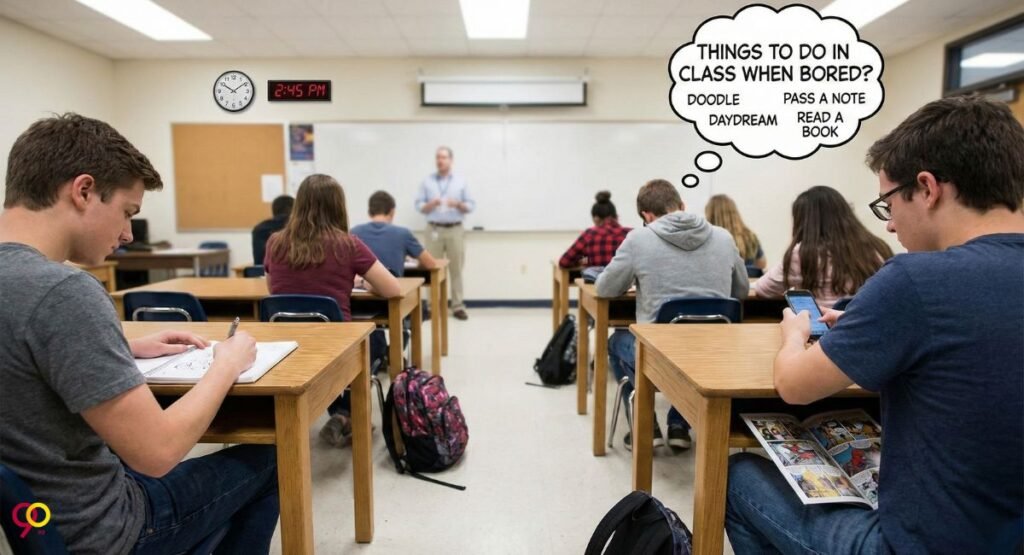
The Neurocognitive Landscape of Academic Boredom
To deal effectively with boredom during a long or uninteresting lecture, students must first understand what boredom really is. Academic boredom is not simply “not liking a class.” It is a real emotional and physical state that strongly affects learning, focus, and memory. In 2026, students face constant distractions, heavy information loads, and long screen exposure, which makes understanding things to do in class when bored more important than ever for academic success and mental health.
When students feel bored in class, their brain is not inactive—it is often overstimulated in the wrong way or under-stimulated by the lesson. This mismatch between attention, motivation, and task difficulty explains why boredom continues to be a major challenge in modern classrooms. Understanding the root causes of boredom helps students choose smarter and more productive things to do in class when bored, instead of disengaging completely.
Defining the Beast: State, Trait, and the Burnout Continuum
In educational psychology, boredom is not a single, simple concept. Researchers clearly separate temporary boredom from long-term boredom habits, because each requires different solutions and different things to do in class when bored.
State Achievement Boredom refers to short-term boredom that appears in a specific situation. This happens when a student is stuck in a dull lecture, a repetitive classroom activity, or an unengaging explanation—such as a slow organic chemistry lecture or endless grammar drills.¹ Students experiencing state boredom often feel that time is moving very slowly, want to mentally escape the classroom, and feel disconnected from the task.² This happens when the student’s thinking ability does not match the task’s difficulty.
The key point is that state boredom is triggered by the situation, not the student’s personality. Because of this, it can be managed quickly using simple mental strategies, silent physical adjustments, or productive focus shifts. These are practical things to do in class when bored that help students stay alert without disrupting the lesson.
Trait Achievement Boredom, on the other hand, is a long-term pattern.¹ Students with high trait boredom feel bored in many classes, even when the subject or teacher changes. Research shows that this type of boredom is linked to low motivation, weak self-control, and shallow learning strategies.¹ For these students, boredom is not just about a boring class—it becomes a default emotional state. Overcoming this requires bigger changes in thinking habits, motivation, and learning goals, not just quick things to do when bored in class.
It is also very important to separate boredom from academic burnout. While both involve disengagement and poor performance, they are not the same. Burnout is caused by long-term stress, pressure, and overload, leading to emotional exhaustion, cynicism, and feelings of failure.³ Boredom usually comes from too little stimulation or repetitive stimulation, while burnout comes from too much demand.
However, the two are connected. Long-term boredom that is never addressed can slowly lead to burnout. A 2025 study showed that boredom in core subjects like mathematics and English strongly predicted higher burnout and lower engagement.⁵ This proves that finding effective things to do in class when bored is not a small issue—it is a key strategy for protecting long-term academic mental health.
The Control-Value Theory of Achievement Emotions
One of the strongest and most useful theories for understanding classroom boredom is Pekrun’s Control-Value Theory of Achievement Emotions.¹ This theory explains exactly why students feel bored and how they can change that feeling using smart cognitive strategies instead of passive distraction. It provides a scientific foundation for choosing effective things to do in class when bored.
The theory is based on two mental judgments: Control and Value.
Appraisal of Control refers to how much control a student feels they have over the learning task. Boredom appears at both extremes:
High Control / Low Challenge: When a task is too easy, such as a high-ability student sitting in a very basic class, boredom appears because the brain is underused.⁷ In this case, students need things to do in class when bored that increase challenge, such as rewriting notes in a new structure or creating advanced questions.
Low Control / High Challenge: When material feels too difficult, students may shut down mentally and label the class as “boring” to protect their self-esteem.⁷ Here, boredom hides confusion. Helpful things to do when bored in class include breaking content into smaller parts or focusing on understanding one key idea.
Appraisal of Value refers to how important the student thinks the lesson is. Even when a task is at the right difficulty level, boredom will still occur if the student sees no personal relevance.⁶ If the content feels useless for future goals, boredom becomes unavoidable.
Theoretical Implications for Intervention:
According to the Control-Value Theory, the solution to boredom is not entertainment—it is mental adjustment. If boredom comes from low challenge, students should raise the difficulty themselves by transforming the material, summarising it creatively, or mentally teaching it to someone else. If boredom stems from low value, students must actively seek personal meaning, real-world applications, or career connections. Research confirms that when students feel more control and more value, boredom drops significantly.¹
This means that effective things to do in class when bored are not distractions—they are powerful tools for engagement, focus, and academic resilience.
The Default Mode Network and Attentional Failure
From a brain perspective, a bored student’s mind is not “off”—it is often too active in the wrong way. When a lecture or classroom activity fails to fully engage the brain’s Task-Positive Network (TPN)—the network responsible for focus, attention, and problem-solving—the brain automatically shifts to the Default Mode Network (DMN).
The DMN is the part of the brain that handles mind-wandering, daydreaming, and self-focused thinking. While this network is useful for creativity, reflection, and consolidating personal identity, it is harmful during class. When the DMN takes over, the brain experiences “attentional decoupling”, which means the ears hear the lecture but the higher brain areas do not process it fully.² This results in incomplete notes, gaps in understanding, and weaker learning outcomes.
This disengaged state also affects the body. Trying to focus on a boring lecture can raise cortisol levels and lower dopamine activity, which is crucial for memory and learning.¹⁰ Students who are bored often feel low energy and negative emotion at the same time, which hurts both learning new information and remembering it later.⁶
The good news is that the brain can be redirected. Strategies discussed in later sections act directly on these neural patterns. They either:
Reactivate the Task-Positive Network (TPN) with active learning methods, such as summarizing, asking questions, or creating mental maps.
Occupy the Default Mode Network (DMN) with productive distractions, like doodling or note redesign, which prevent full mind-wandering while still allowing the student to process what the teacher says.
By understanding how the DMN and TPN interact, students can choose effective things to do in class when bored that keep their brain engaged, improve attention, and boost learning—even during dull lectures.
Cognitive Engineering: Transforming Passive Listening into Active Synthesis
When a classroom feels boring or makes students sleepy, top learners use “cognitive engineering”—intentionally applying mental strategies to force the brain back into focus. Passive listening is the main reason students feel bored, while active thinking and synthesis are the key cures. Learning things to do in class when bored can start with these cognitive techniques.
The Cornell Note-Taking System: A Meta-Analysis of Efficiency
Copying words from slides or the board is a low-level mental task that encourages boredom. To prevent this, students should use note-taking systems that require constant thinking and engagement. The Cornell Note-Taking System, created by Walter Pauk at Cornell University, is one of the best methods for this purpose. ¹²
How it works:
- Note-Taking Column (Right): Record main ideas during the lecture.
- Cue Column (Left): Write questions or keywords during or immediately after class.
- Summary Section (Bottom): Write a short summary of the page’s content. ¹³
Why does it fight boredom:
- Forces deep processing instead of passive writing.
- The Cue Column makes the student evaluate and question the material, engaging the prefrontal cortex and preventing mind-wandering in the DMN.
- The Summary Section uses the testing effect, strengthening memory more than rereading. ¹⁵
Benefits compared to linear note-taking:
- Cognitive Mode: Active / Synthesis (instead of passive transcription)
- Brain Network: Engages Task-Positive Network (TPN) instead of DMN
- Retention Rate: +40% improvement in long-term memory¹⁴
- Engagement Level: High, because students must constantly ask questions
Using the Cornell method is a strong way to apply things to do in class when bored, turning notes into a mental workout rather than a mechanical task.
Mind Mapping and Neuro-Associative Learning
For students who feel bored with linear notes, Mind Mapping is a creative alternative that works with the brain’s natural associative patterns. Developed by Tony Buzan, it places a central idea in the middle of the page, with branches radiating out to related subtopics. ¹⁶
Neuroscience behind it:
- Uses Dual Coding Theory, meaning the brain learns better when combining words with visuals, colours, or icons.
- Creates two memory traces, doubling the hooks for later recall. ¹⁶
How it fights boredom:
- Linear notes can be predictable and dull. Mind maps require constant decision-making:
- Where should this idea go?
- Is it a main branch or a sub-branch?
- How does it connect to previous points?
- This keeps cognitive arousal high and prevents the DMN from taking over.
Research outcomes:
- Mind mapping improves retention and critical thinking compared to linear notes. ¹⁷
- Students using mind maps remembered 10–15% more information after one week than those using traditional notes.¹⁶
- The non-linear layout allows students to see connections and the “big picture”, keeping them actively engaged.
Mind mapping is a practical technique among things to do in class when bored, especially for students who need visual and interactive ways to stay alert.
Collaborative Cognition: The Power of Shared Notetaking
In the 2026 digital classroom, note-taking doesn’t have to be a solo, boring task. Collaborative note-taking using tools like Google Docs or Notion allows multiple students to work on the same notes at once, turning a dull activity into an engaging social exercise. ¹⁹
Strategies to stay engaged:
- Rotational Scribing: Each student takes turns being the “scribe.” Knowing peers rely on your notes increases accountability and focus. ²⁰
- Role-Based Notetaking: Assign different tasks to each student:
- Key Dates
- Definitions
- Questions or Confusions
This keeps students focused and prevents overload. ²⁰
- Real-Time Annotation: Students can add comments, ask questions, or debate points in real-time without interrupting the lecture. ²¹
Benefits:
- Reduces individual cognitive load, allowing deeper understanding. ²²
- Breaks monotony with strategies like “Pause and Partner”, where students stop to compare and synthesise notes with peers. ²³
- Encourages active listening and social learning, making collaborative note-taking one of the most effective things to do in class when bored.
The Art of Productive Distraction: Doodling and Micro-Creativity
When a lecture offers no real challenge or value, and mental reframing no longer works, smart students shift to productive distraction. This is not laziness or poor behaviour. Instead, it is a controlled attention strategy that helps the brain stay balanced and alert. Learning the right things to do in class when bored can protect focus, memory, and mental energy when the lesson itself fails to do so.
The Andrade Protocol: Doodling as an Attentional Anchor
For many years, doodling was seen as proof that a student was not paying attention. This belief changed after a groundbreaking study by Professor Jackie Andrade at the University of Plymouth.
The Evidence:
In Andrade’s experiment, participants listened to a very boring mock telephone message. One group was asked to shade shapes (simple doodling) while listening, while the other group only listened. The results were clear and surprising. The doodling group performed much better on the attention task and later remembered 29% more information than the group that did not doodle.²⁴
How It Works:
Andrade introduced the idea of the “attentional anchor.” When a task is boring, the brain looks for stimulation. If no external stimulation is available, the brain activates the Default Mode Network, leading to daydreaming. Daydreaming uses a large amount of mental energy and reduces the brain’s ability to process the lecture.
Doodling, however, is a low-effort visual task. It uses just enough mental energy to keep the brain busy, but not enough to block listening.⁹ In simple terms, doodling keeps the brain lightly engaged so it does not completely drift away. This makes doodling one of the most effective things to do in class when bored.
How to Use the Andrade Protocol:
- Use simple shading or repetitive patterns
- Avoid detailed drawings or realistic images
- Keep movements automatic and mindless
The goal is simple movement that supports focused listening, not artwork that steals attention.
Zentangle and Structured Mindfulness
Zentangle builds on doodling but adds structure and mindfulness. It involves drawing repeating patterns to create visually pleasing designs and is often described as “yoga for the brain.” This method has strong benefits for classroom focus and emotional regulation.²⁹
Brain Benefits:
Studies using EEG scans show that Zentangle increases activity in theta, alpha, beta, and gamma brain waves. These patterns are linked to calm focus, creativity, and efficient learning.³⁰ Unlike random doodling, Zentangle encourages mindfulness, which lowers stress and cortisol levels that interfere with learning.³⁰
How to Use Zentangle in Class:
- Draw a small grid in the margins of your notes
- Fill each box with a simple repeated pattern (lines, dots, waves)
- Use it during slow or repetitive parts of the lecture
This method serves two purposes at once. It works as an attentional anchor, like doodling, and it reduces stress, keeping the brain in the best state for learning.³² Zentangle is a powerful example of things to do in class when bored that support both focus and mental well-being.
The Neuroscience of Sketching: Dual Coding in Action
Beyond abstract patterns, sketching lecture-related ideas can significantly improve learning. This technique connects visual thinking with verbal information, making learning stronger and more engaging.
The Picture Superiority Effect:
Research shows that information learned through images is remembered better than information learned only through words.³³ When students draw diagrams or symbols while listening, they engage in generative drawing, which strengthens memory. A 2018 study titled “The Surprisingly Powerful Influence of Drawing on Memory” found that drawing information led to much better recall than writing alone.³⁴
How to Apply This Strategy:
- Turn spoken explanations into drawings
- Sketch processes, timelines, or symbolic representations
- Use metaphors for abstract ideas
For example, draw the water cycle during a science lecture or represent a philosophical idea using symbols. This forces the brain to convert information from words into images, a process called transcoding, which requires deep thinking and completely disrupts boredom. ³³
Sketching is one of the most powerful things to do in class when bored because it transforms passive listening into active learning and makes even dull lectures mentally engaging.
Physiological Optimization: Biohacking the Classroom
The mind does not work on its own. It is closely connected to the body. Very often, what students describe as “boredom” is actually a physical signal—such as tiredness, poor posture, dehydration, or low blood flow. In 2026, high-performing students use simple biological strategies to keep their brains alert, even while sitting for long periods. These body-based strategies are some of the most overlooked but effective things to do in class when bored.
Stealth Ergonomics: Posture and Cognitive Load
The physical setup of most classrooms includes hard chairs, fixed desks, and limited movement, which strongly contributes to mental fatigue. Poor posture reduces blood flow, creates discomfort, and acts as a constant distraction that drains attention.³⁵
The Ergonomic–Cognitive Connection:
Research clearly shows that body comfort affects learning. A 2017 study published in the American Journal of Public Health found that students using ergonomic furniture experienced a 30% reduction in physical discomfort, which directly improved focus and classroom participation.³⁶ On the other hand, uncomfortable seating causes restlessness and fidgeting, which teachers often mistake for boredom or ADHD.³⁵
What students can do (without special furniture):
- The Ischial Anchor: Sit on your “sitting bones” (ischial tuberosities) instead of slouching. This keeps the spine aligned and reduces fatigue.
- The 90–90–90 Rule: Keep hips, knees, and ankles at roughly 90-degree angles, with feet flat on the floor. Thisstabilisess the body and improves body awareness.³⁷
- Scapular Retraction: Gently pull the shoulders back and down from time to time. This opens the chest, improves breathing, increases oxygen to the brain, and reduces drowsiness caused by low oxygen levels.³⁷
Correcting posture is a quiet but powerful example of things to do in class when bored, because it directly improves alertness without distracting others.
Isometric Kinetics: Invisible Classroom Workouts
Sitting still for long periods slows circulation and allows blood to pool in the legs, which reduces alertness. To fix this silently, students can use isometric exercises, which activate muscles without visible movement.
Activating the “Second Heart”:
The calf muscles help pump blood back to the heart and brain and are often called the body’s “second heart.”
- Stealth Calf Raises: While seated, keep toes on the floor and lift the heels as high as possible. Squeeze the calves, then lower. Doing this 20–30 times improves blood flow to the brain and increases alertness.³⁸
Preventing Gluteal Amnesia:
Long periods of sitting cause the glute muscles to shut down, leading to lower back pain and reduced energy.
- Glute Squeezes: Tighten the glute muscles for 10–15 seconds, then release. This keeps muscles active and signals the nervous system to stay alert.³⁷
Core Activation:
- Seated Leg Extensions: If the desk hides your legs, straighten one leg and hold it parallel to the floor. This activates the quadriceps and core muscles, creating a mild physical effort that wakes up a sleepy nervous system.³⁹
These invisible movements are highly effective things to do in class when bored, especially when energy levels drop.
Hydration Dynamics: Fluid Balance and Executive Function
Dehydration quietly destroys focus. By the time a student feels thirsty, they are often already 1–2% dehydrated, which is enough to reduce cognitive performance.
What the research shows:
Studies show that even mild dehydration harms short-term memory, attention, and visual–motor coordination.⁴⁰ Research on children found that well-hydrated students performed much better on tasks requiring focus and self-control.⁴¹ In adults, mild dehydration is linked to increased anxiety and fatigue.⁴²
Why hydration matters:
Water is essential for making neurotransmitters and hormones. Dehydration reduces brain volume and forces the brain to work harder to achieve the same mental output.⁴² This makes learning feel harder and more boring.
Strategic Sipping:
Keeping a water bottle on the desk is part of the boredom protocol. Taking small sips provides a brief mental reset and a sensory stimulus that increases alertness. Hydration is one of the simplest but most effective things to do in class when bored.
The Sleep–GPA Correlation: Circadian Rhythms and Learning
Many students label a class as “boring” when the real issue is sleep deprivation. A tired brain cannot process information efficiently.
The sleep–learning connection:
A large multi-university study published in Proceedings of the National Academy of Sciences found a strong linear relationship between sleep duration and GPA. Students who slept less than six hours per night experienced a consistent grade decline.⁴⁴
Why sleep matters for memory:
Sleep is when the brain transfers memories from short-term storage in the hippocampus to long-term storage in the neocortex. Without enough sleep, this process fails. A sleep-deprived student is like a computer trying to save files on a full hard drive—new information simply doesn’t stick, making lectures feel confusing and pointless.⁴⁴
Sleep hygiene rules to reduce classroom boredom:
- Blue Light Blockade: Avoid screens at least one hour before bed to prevent melatonin disruption.⁴⁵
- Consistency: Wake up at the same time every day, including weekends. Sleeping in causes “social jetlag,” which makes weekday classes harder to focus on.⁴⁶
Preparing the body the night before is one of the most powerful long-term things to do in class when bored, because it prevents boredom before it even begins.
Ludic Learning: Cognitive Games for Skill Acquisition
When a lecture repeats material a student has already mastered—such as a basic review session—the time does not have to be wasted. Instead, it can be used for “ludic learning,” which means learning through structured play. These activities are not random distractions. They are intentional mental games that strengthen skills directly linked to academic success. Used correctly, they are smart and strategic things to do in class when bored, especially when the lecture adds no new value.
Linguistic Strategy: Word Ladders and Anagrams
Language-based games keep the brain’s verbal and linguistic systems active, even when the lecture itself is being ignored. This helps maintain reading, writing, and thinking speed.
Word Ladders (also called Doublets):
This game was created by Lewis Carroll. The goal is to change one word into another by altering one letter at a time, with every step forming a real word.
- Example: Change HEAD into TAIL
(HEAD → HEAL → TEAL → TEIL → TAIL)⁴⁷
Cognitive benefits:
- Improves vocabulary access
- Strengthens sound-based (phonological) processing
- Trains executive planning by forcing the brain to think ahead several moves⁴⁸
Anagram Extraction:
Choose a long word from the lecture slides, such as “Constitutional.” Try to form as many smaller words as possible using its letters, such as “station,” “tuition,” or “lion.”
Why it works:
This game activates pattern recognition and combinatorial thinking, both of which are key for problem-solving and language mastery.⁴⁹ It is a quiet and effective example of things to do in class when bored that still sharpen academic skills.
Spatial Reasoning: Dots, Boxes, and Grids
Spatial reasoning is especially important in STEM subjects, including mathematics, physics, and engineering. Simple pen-and-paper games can quietly train these abilities during unchallenging lectures.
Dots and Boxes:
A grid of dots is drawn, such as a 10×10 grid. Players take turns drawing one line between two nearby dots. If a player completes a square, they claim it and take another turn.
Strategic value:
- Requires long-term planning and visualising future outcomes
- Advanced play involves intentionally giving up boxes to gain control later⁵⁰
Learning benefit:
This game builds intuition for graph theory, spatial structure, and logical consequence chains.⁴⁹ It is one of the most intellectually rich things to do in class when bored without needing technology.
Ultimate Tic-Tac-Toe:
This is an advanced version of classic Tic-Tac-Toe. A large 3×3 grid is drawn, and inside each square is a smaller 3×3 Tic-Tac-Toe board. To win a large square, a player must win the smaller game inside it.
The key rule is that the position played in the small grid determines where the opponent must play next in the large grid.
Why it matters:
This turns a simple game into a complex strategy task that requires:
- Global and local thinking
- Inhibition control
- Multi-layered planning⁵¹
It is a strong mental workout and a productive option among things to do in class when bored.
Social Deduction and Collaborative Play
If another student nearby is also bored, quiet collaborative games can build social connection and improve Theory of Mind, which is the ability to understand how others think and feel.
Consequences (Collaborative Storytelling):
Players take turns writing parts of a story, folding the paper to hide previous sections, and passing it on. The traditional structure includes:
- Adjective (Male)
- Name (Male)
- Adjective (Female)
- Name (Female)
- Where they met
- What he said
- What she said
- The consequence⁴⁸
Why it helps:
This activity strengthens creativity, narrative logic, and language flow, even though it appears playful on the surface.
Hangman (Academic Edition):
Play Hangman using only course-related vocabulary. This turns revision into a game and reinforces technical terms in a low-stress way.⁵³
This method is especially useful before exams and is one of the most efficient things to do in class when bored, while still preparing academically.
The Digital Frontier: Managing Attention in Virtual Spaces

After 2020, online and virtual learning became a permanent part of education. By 2026, Zoom fatigue will be recognised as a real psychological condition, not just a complaint. Feeling bored, tired, or mentally drained in online classes is common, and it requires different solutions than boredom in physical classrooms. Learning the right things to do in class when bored is even more important in virtual environments.
Deconstructing Zoom Fatigue: Causes and Countermeasures
Researchers at Stanford University identified four major causes of Zoom fatigue that are unique to video-based learning and do not usually occur in face-to-face classes.⁵⁴ Each cause has a clear, evidence-based solution.
Key causes of Zoom fatigue and how to fix them:
- Excessive Eye Contact
- What happens: Seeing many faces staring directly at you simulates intense social confrontation or forced intimacy. The brain interprets this as stress.
- Solution: Reduce the window size and avoid full-screen mode so faces appear smaller and less threatening.⁵⁵
- The Mirror Effect
- What happens: Constantly seeing your own face increases self-criticism and public self-awareness, draining mental energy.
- Solution: Hide self-view by right-clicking your video and selecting “Hide Myself.” This significantly reduces cognitive load.⁵⁴
- Reduced Mobility
- What happens: Staying within the camera frame forces unnatural stillness, which increases fatigue.
- Solution: Take audio-only breaks when possible. Turn off the camera briefly to stand, stretch, or change posture.⁵⁴
- High Cognitive Load
- What happens: Interpreting facial expressions, tone, and gestures through pixelated video requires extra mental effort.
- Solution: Use the 20-20-20 rule—every 20 minutes, look away from the screen for 20 seconds at something 20 feet away.⁵⁵
Applying these fixes transforms online boredom into manageable engagement and adds powerful tools to your list of things to do in class when bored during virtual lectures.
The Myth of Multitasking: Switch Costs and GPA
Online classes make multitasking extremely tempting. Opening new tabs, checking messages, or scrolling social media feels harmless—but neuroscience shows this is a mistake. The brain cannot multitask on meaningful tasks; it can only switch rapidly between them.
The Switch Cost:
Every time a student switches from the lecture to a text message or another tab, the brain pays a “switch cost.” This includes slower thinking, more errors, and lost context. The brain must reload the lecture content each time, reducing understanding and retention.⁵⁶
What research shows:
- The mere presence of a phone on the desk lowers available mental capacity, even if it is not used (the brain drain hypothesis).⁵⁷
- Phone multitasking is a strong negative predictor of GPA.⁵⁷
- A 2015 study showed that even receiving a notification—without opening it—disrupts focus and lowers performance.⁵⁸
The Smart Multitasking Protocol:
If multitasking is unavoidable during a boring online lecture, it must be cross-modal, not competitive.
- Manual tasks (such as squeezing a stress ball, knitting, or simple repetitive movements) interfere far less with listening.
- Linguistic tasks (reading articles, texting, social media) directly compete with lecture comprehension.
Because the brain uses different channels for manual and language processing, only cross-modal multitasking allows limited overlap without destroying attention.⁹ This distinction is critical when choosing things to do in class when bored online.
Digital Hygiene in the Age of Answer Engines
By 2026, Answer Engines and AI-based tools have changed how students access information. While these tools are powerful, overusing them during class can weaken the brain’s natural memory systems.
Key digital hygiene strategies:
- The Testing Effect:
Instead of immediately Googling or asking an AI for an answer during a boring lecture, first try to recall it from memory. The effort required to retrieve information strengthens memory far more than passive searching.¹⁵ - Digital Minimalism:
Use website blockers or focus tools during class time. Removing distractions externally preserves executive function and keeps attention available for learning.⁵⁹
Practising digital restraint is one of the most important things to do in class when bored, especially in virtual settings where distractions are only one click away.
Conclusion: The Autotelic Student
In the end, boredom should not be seen as a punishment or a dead end. Boredom is a signal, not a sentence. It is feedback from the brain and nervous system showing that something is out of balance between the student’s mind and the learning environment. Most students respond to this signal by shutting down, daydreaming, or escaping into distractions. The elite student responds differently—by taking control.
Throughout this guide, we have shown that boredom can be managed, redirected, and even used as a tool. By applying the strategies discussed—such as adjusting control and value using Pekrun’s theory, activating the body through small physiological movements, and using creative attentional anchors like the Andrade Protocol—students gain practical and powerful things to do in class when bored. These techniques turn passive time into active engagement, even when the classroom environment is far from ideal.
Instead of waiting for motivation to appear, the student learns to create motivation. Instead of depending on the lecture to be interesting, the student learns how to make the experience meaningful. This transforms the classroom into a personal training ground for focus, self-discipline, and cognitive strength. The student is no longer a victim of boredom but an active manager of attention and energy.
This mindset defines the autotelic student—a learner who finds value in the process itself, not just in grades or external rewards. An autotelic student can stay focused, curious, and mentally sharp even in boring or repetitive situations. In the competitive academic world of 2026 and beyond, this ability to use smart things to do in class when bored will separate students who merely cope from those who truly master their learning.
Sources
- EJ892639 – Boredom in Achievement Settings: Exploring Control-Value Antecedents and Performance Outcomes of a Neglected Emotion, Journal of Educational Psychology, 2010-Aug – ERIC, accessed January 27, 2026, https://eric.ed.gov/?id=EJ892639
- Bored Out of Their Minds | Harvard Graduate School of Education, accessed January 27, 2026, https://www.gse.harvard.edu/ideas/ed-magazine/17/01/bored-out-their-minds
- The impact of academic burnout on academic achievement: a moderated chain mediation effect from the Stimulus-Organism-Response perspective – Frontiers, accessed January 27, 2026, https://www.frontiersin.org/journals/psychology/articles/10.3389/fpsyg.2025.1559330/full
- Factors associated with academic burnout and its prevalence among university students: a cross-sectional study, accessed January 27, 2026, https://pmc.ncbi.nlm.nih.gov/articles/PMC10163855/
- The happy learner: Effects of academic boredom, burnout, and engagement – PMC – NIH, accessed January 27, 2026, https://pmc.ncbi.nlm.nih.gov/articles/PMC9872023/
- Profiles of control, value and achievement emotions in primary school mathematics lessons, accessed January 27, 2026, https://pmc.ncbi.nlm.nih.gov/articles/PMC12319179/
- Boredom in Achievement Settings : Exploring Control- Value Antecedents and Performance Outcomes of a Neglected Emotion – KOPS, accessed January 27, 2026, https://kops.uni-konstanz.de/bitstreams/273e2c28-ea3e-4472-ab8c-33cac0baa888/download
- The control-value theory of achievement emotions : an integrative approach to emotions in education, accessed January 27, 2026, https://d-nb.info/1093175664/34
- What Does Doodling do? – JACKIE ANDRADE – Damian Gordon, accessed January 27, 2026, https://www.damiantgordon.com/Courses/PSIC/doodling.pdf
- Educational Research and Reviews – a conceptual research of college students’ boredom, learning attitude, academic achievement, and behavior, accessed January 27, 2026, https://academicjournals.org/journal/ERR/article-full-text/7EF874070527
- Bored and exhausted? Profiles of boredom and exhaustion at work and the role of job stressors | Burnout Assessment Tool, accessed January 27, 2026, https://burnoutassessmenttool.be/wp-content/uploads/2024/02/Bored-and-exhausted_-Profiles-of-boredom-and-exhaustion-at-work-and-the-role-of-job-stressors.pdf
- The Cornell Note Taking System – Learning Strategies Center, accessed January 27, 2026, https://lsc.cornell.edu/how-to-study/taking-notes/cornell-note-taking-system/
- SELF REGULATED LEARNING SKILL FOR FEBRUARY: The Cornell Note Taking Method- Streamlining Learning and Memory Retention – IHU – Innovative Learning and Teaching, accessed January 27, 2026, https://cilt.ihu.edu.tr/en/the-cornell-note-taking-method-streamlining-learning-and-memory-retention
- In-Depth Analysis of the Cornell Note-Taking Method: A Systematic Approach to Enhancing Learning Efficiency – Oreate AI Blog, accessed January 27, 2026, https://www.oreateai.com/blog/indepth-analysis-of-the-cornell-notetaking-method-a-systematic-approach-to-enhancing-learning-efficiency/4e9875ecef5db1a632063762cc517a83
- The Effect of Passive and Active Education Methods Applied in Repetition Activities on the Retention of Anatomical Knowledge – NIH, accessed January 27, 2026, https://pmc.ncbi.nlm.nih.gov/articles/PMC7383800/
- How Mind Mapping Transforms Memory Retention Without Study Methods | Ahead App Blog, accessed January 27, 2026, https://ahead-app.com/blog/mindfulness/how-mind-mapping-transforms-memory-retention-without-study-methods
- Assessing the efficacy of mind mapping as a learning technique to enhance information retrieval in nursing students – NIH, accessed January 27, 2026, https://pmc.ncbi.nlm.nih.gov/articles/PMC11639541/
- Examining the Effectiveness of Traditional Teaching and Mind Mapping in School Education – IJIP, accessed January 27, 2026, https://ijip.in/wp-content/uploads/2025/03/18.01.177.20251301.pdf
- Collaborative Note Taking | Faculty Resources | PLU, accessed January 27, 2026, https://www.plu.edu/faculty-resources/faculty-development/teaching-learning-resources/teaching-at-plu/collaborative-note-taking/
- Note-taking | Center for the Advancement of Teaching Excellence | University of Illinois Chicago, accessed January 27, 2026, https://teaching.uic.edu/cate-teaching-guides/inclusive-equity-minded-teaching-practices/note-taking/
- Fostering Student Engagement Through Collaborative Note-Taking – Notre Dame Learning, accessed January 27, 2026, https://learning.nd.edu/resource-library/fostering-student-engagement-through-collaborative-note-taking/
- Three Proven Strategies to Supercharge Digital Note-Taking in Physician Assistant/Associate Education – PMC – NIH, accessed January 27, 2026, https://pmc.ncbi.nlm.nih.gov/articles/PMC12617307/
- 3 Collaborative Strategies to Build Up Students’ Note-Taking Skills – Edutopia, accessed January 27, 2026, https://www.edutopia.org/article/collaborative-note-taking-strategies/
- Andrade (doodling) – Simply Psychology, accessed January 27, 2026, https://www.simplypsychology.org/andrade-doodling.html
- Doodlers, Beware – Newsroom | University of St. Thomas, accessed January 27, 2026, https://news.stthomas.edu/doodlers-beware/
- PEARL What Does Doodling do? – University of Plymouth, accessed January 27, 2026, https://pure.plymouth.ac.uk/ws/portalfiles/portal/39086792/Andrade_Doodling%20author%20version.pdf
- What does a doodle do? It boosts your memory and concentration | BPS, accessed January 27, 2026, https://www.bps.org.uk/research-digest/what-does-doodle-do-it-boosts-your-memory-and-concentration
- 4 Surprising Benefits of Doodling in the Classroom – Learning Liftoff, accessed January 27, 2026, https://learningliftoff.com/students/gifted-students/benefits-of-doodling-in-classroom/
- The Power of Zentangle – The Be Kind People Project, accessed January 27, 2026, https://thebekindpeopleproject.org/blog/2025/04/29/the-power-of-zentangle/
- The effect of Zentangle on cognitive focus, emotional well‐being, and stress levels: A neural perspective – PubMed Central, accessed January 27, 2026, https://pmc.ncbi.nlm.nih.gov/articles/PMC11338741/
- Zentangle Art to Improving Mental Health: A Scoping Review – Journal of Universitas Airlangga, accessed January 27, 2026, https://e-journal.unair.ac.id/PROMKES/article/download/64695/31302/366134
- Zentangle – Women’s Brain Health Initiative, accessed January 27, 2026, https://womensbrainhealth.org/think-tank/zentangle
- Doodling Makes Learning More Sticky for Students – MiddleWeb, accessed January 27, 2026, https://www.middleweb.com/38609/doodling-makes-learning-more-sticky-for-students/
- Does Drawing While Listening Help Focus and Memory? – Whole Child Counseling, accessed January 27, 2026, https://www.wholechildcounseling.com/post/does-drawing-while-listening-help-memory-and-attention
- Can ergonomic furniture improve student concentration? – Gymba, accessed January 27, 2026, https://gymba-ergonomics.com/fi/2025/08/26/can-ergonomic-furniture-improve-student-concentration/
- The Science Behind Ergonomic Classrooms: How Proper Furniture Boosts Student Learning and Well-Being, accessed January 27, 2026, https://schoolfurniture.ca/blogs/chalkboard-talk/the-science-behind-ergonomic-classrooms-how-proper-furniture-boosts-student-learning-and-well-being
- 4 Desk Exercises to Sneak Into Your Workday, accessed January 27, 2026, https://www.workdaywarriors.com/4-super-stealthy-desk-exercises-that-no-one-will-know-youre-doing/
- 23 Desk Exercises at Work to Relieve Tension & Boost Focus – Pliability, accessed January 27, 2026, https://pliability.com/stories/desk-exercises-at-work
- 6 Sneaky Ways to Use Your Study Breaks for Quick Fitness – CollegeXpress, accessed January 27, 2026, https://www.collegexpress.com/articles-and-advice/student-life/blog/6-sneaky-ways-to-use-your-study-breaks-for-quick-fitness/
- Effects of Water Provision and Hydration on Cognitive Function among Primary-School Pupils in Zambia: A Randomized Trial | PLOS One – Research journals, accessed January 27, 2026, https://journals.plos.org/plosone/article?id=10.1371/journal.pone.0150071
- Water consumption affects cognitive function in children – American Society for Nutrition, accessed January 27, 2026, https://nutrition.org/water-consumption-affects-cognitive-function-in-children/
- Effects of hydration status on cognitive performance and mood – PubMed, accessed January 27, 2026, https://pubmed.ncbi.nlm.nih.gov/24480458/
- Hydration and Cognition in the General Population – Gatorade Sports Science Institute, accessed January 27, 2026, https://www.gssiweb.org/sports-science-exchange/article/hydration-and-cognition-in-the-general-population
- Nightly Sleep Is Key to Student Success – News – Carnegie Mellon University, accessed January 27, 2026, https://www.cmu.edu/news/stories/archives/2023/february/nightly-sleep-is-key-to-student-success
- Why You Should Make a Good Night’s Sleep a Priority – Harvard Summer School, accessed January 27, 2026, https://summer.harvard.edu/blog/why-you-should-make-a-good-nights-sleep-a-priority/
- College students: getting enough sleep is vital to academic success – American Academy of Sleep Medicine, accessed January 27, 2026, https://aasm.org/college-students-getting-enough-sleep-is-vital-to-academic-success/
- Word Ladders – Pencil and Paper Games, accessed January 27, 2026, http://www.papg.com/show?1TN0
- Pen & paper games – Coram Beanstalk, accessed January 27, 2026, https://www.beanstalkcharity.org.uk/making-the-most-out-of-pen-paper-games
- Fun Pen and Paper Games to Cure Boredom, accessed January 27, 2026, https://www.whatdowedoallday.com/pen-and-paper-games/
- Best Pencil and Paper Games for Endless Entertainment – Hatching Dragons, accessed January 27, 2026, https://www.hatching-dragons.com/blog/best-pencil-and-paper-games-for-endless-entertainment
- Easy Pen and Paper Games – The Tabletop Family, accessed January 27, 2026, https://thetabletopfamily.com/easy-pen-and-paper-games/
- 10 Pen and Paper Games | My Baba, accessed January 27, 2026, https://www.mybaba.com/pen-and-paper-games/
- accessed January 27, 2026, https://www.mybaba.com/pen-and-paper-games/#:~:text=Hangman%205years%2B%20%2F%202%2B%20player,letter%20on%20the%20corresponding%20dash.
- Four causes for ‘Zoom fatigue’ and their solutions | Stanford Report, accessed January 27, 2026, https://news.stanford.edu/stories/2021/02/four-causes-zoom-fatigue-solutions
- Zoom Fatigue and How to Prevent It – PMC – NIH, accessed January 27, 2026, https://pmc.ncbi.nlm.nih.gov/articles/PMC10198405/
- Multitasking: Switching costs – American Psychological Association, accessed January 27, 2026, https://www.apa.org/topics/research/multitasking
- Cell phone use distracts young adults from academic work with limited benefit to self-regulatory behavior – NIH, accessed January 27, 2026, https://pmc.ncbi.nlm.nih.gov/articles/PMC9547567/
- Studies on the impact of cellphones on academics | Coxsackie-Athens Central School District, accessed January 27, 2026, https://www.cacsd.org/article/1698443
- Smartphones, media multitasking and cognitive overload – SCUP, accessed January 27, 2026, https://www.scup.com/doi/10.18261/njdl.20.1.1
About Us
At Get90Plus, we believe that students shouldn’t have to choose between their mental health and their GPA. We were founded on a simple but powerful promise: to provide assignment help that guarantees 90+ grades, or you don’t pay.
We understand that modern students aren’t just “lazy”—they are overwhelmed. Between balancing part-time jobs, navigating complex subjects, and managing strict deadlines, the pressure can be suffocating. Get90Plus exists to relieve that pressure. We are not a content mill or a team of faceless freelancers; we are a dedicated collective of over 500 subject-matter experts, PhD scholars, and former educators committed to your academic success.
Our Mission To empower students by delivering high-quality, scientifically accurate, and academically rigorous assignments that secure top grades. We aim to be the partner you trust when the coursework becomes unmanageable, allowing you to focus on learning without the burnout.
What Sets Us Apart
- The 90+ Guarantee: We are so confident in our experts that we back every assignment with a money-back guarantee if we don’t meet our grade promise.
- Zero AI, 100% Human: In an era of automated content, we stand firm on academic integrity. Every paper is written from scratch by a qualified human expert—no ChatGPT, no spinners, just original critical thinking.
- Subject Mastery: From STEM fields like Engineering and Data Science to the Humanities, Law, and Nursing, our team covers over 100+ subjects with specialised knowledge.
- Confidentiality & Trust: We prioritise your privacy and offer unlimited revisions to ensure the final product meets your exact institutional standards.
Whether you are struggling with a first-year essay or a final-year dissertation, Get90Plus is here to ensure you don’t just meet the deadline—you crush it.