
Who Invented Homework? The Definitive Analysis of Educational History, Pedagogical Efficacy, and the 2026 AI Paradigm Shift
1. Introduction
The question of “Who invented homework?” does not lead to a single inventor or a specific calendar date but rather reveals a complex evolution of educational philosophy that mirrors the societal needs of different eras. Contrary to the pervasive internet myth attributing the invention to a punitive Italian teacher named Roberto Nevilis in 1095 or 1905, homework is not the brainchild of one individual.1 Instead, it is a practice that coalesced through three distinct historical phases: the rhetorical exercises of Ancient Rome, the nationalist state-building of 18th-century Prussia, and the industrial standardisation of the 19th-century United States.
From a strictly historical perspective, Pliny the Younger (c. 61–113 AD) provides the earliest recorded evidence of assigning at-home tasks to students, specifically to practice public speaking and rhetoric outside the formal ludus.2 However, the mandatory, systemic homework familiar to modern students is a product of the Prussian Volksschulen (People’s Schools), championed by philosopher Johann Gottlieb Fichte to instil discipline and national loyalty following military defeats.2 This model was subsequently imported to the United States by educational reformer Horace Mann in the 1840s, integrating it into the fabric of the American Common School movement.5
This article provides an exhaustive analysis of homework’s origins, its contentious legislative history (including the 1901 California ban), its pedagogical efficacy as measured by meta-analyses, and its precarious future in the age of Generative AI.
The Roberto Nevilis Hoax
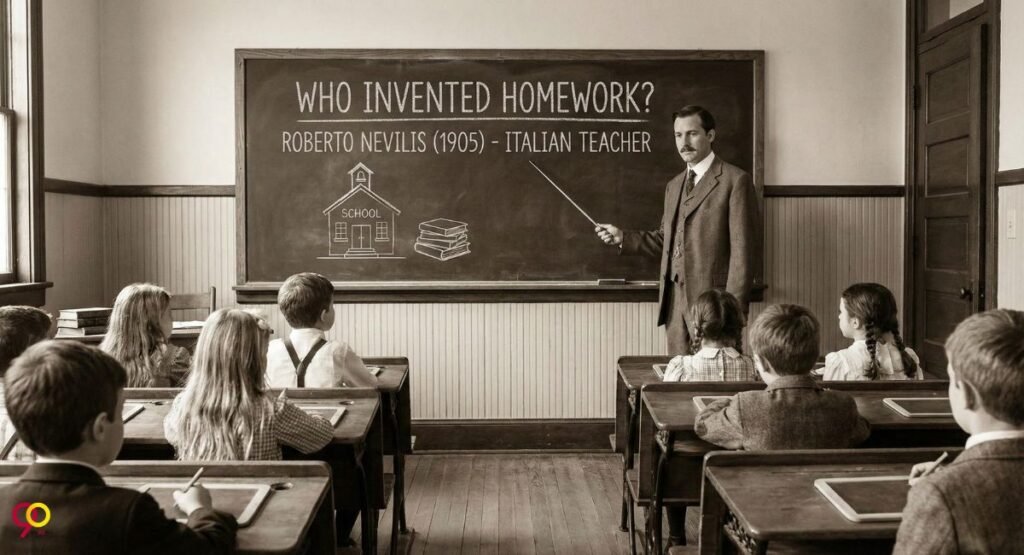
In the information ecosystem of the 2020s, truth is often obscured by viral misinformation that satisfies the algorithm’s demand for simple answers. The legend of Roberto Nevilis is the primary impediment to understanding the true history of homework.
The Fabrication of Roberto Nevilis
A persistent meme circulates across social media platforms, blogs, and even some educational sites, claiming that an Italian teacher named Roberto Nevilis invented homework. The details of this claim fluctuate wildly, with dates alternating between 1095 and 1905.2 This discrepancy of 810 years is the first indicator of fabrication, yet the myth persists because it offers a convenient villain for frustrated students.
The Anachronism of 1095
The claim that Nevilis invented homework in 1095 places the event in the late 11th century. Historical analysis renders this impossible.
In 1095, Europe was on the brink of the First Crusade. Formal, secular schooling for children did not exist. Education was the exclusive domain of the church (monastic schools) or the aristocracy (tutors). A classroom setting where a teacher could assign “homework” as a standardized punishment for a group of students is historically anachronistic.2
Medieval education focused on oral recitation and memorization under direct supervision. The material conditions for homework—affordable paper, writing instruments, and lighting at home—were absent for much of the population.
The Implausibility of 1905
The alternative date, 1905, is equally fallacious but for different reasons.
Existing Legislation: By 1905, homework was already so ubiquitous and controversial in the United States that the state of California had passed a law banning it for students under 15 years old in 1901.8 It is logically impossible for Nevilis to invent a practice in 1905 that was already being legislated against four years prior.
The myth often cites homework as a punishment invented by Nevilis. While homework has been used punitively, its origins are rooted in skill acquisition (Rome) and national discipline (Prussia), not ad-hoc retribution.1
Ancient Pedagogy: Pliny the Younger and the Roman Tradition
To identify the true “inventor” of the concept of working at home to supplement classroom instruction, we must look to the rhetorical traditions of the Roman Empire. Here, homework was not a mechanism of control, but a privilege of the elite class aspiring to public office.
Pliny the Younger (61 – c. 113 AD)
Pliny the Younger, a prominent lawyer, author, and magistrate of Ancient Rome, provides the earliest credible documentation of homework-like practices. His contributions are found in his extensive correspondence, which details the educational habits of his circle.3
The Pedagogical Philosophy: Otium vs. Negotium
Roman society drew a sharp distinction between Negotium (public affairs/work) and otium (leisure). For the Roman elite, otium was not idleness, but time to be filled with intellectual self-improvement. Pliny advocated for using this private time to practice the skills learned in the ludus (school).11
Pliny is often associated with the sentiment, “It is better to have no work to do than to work at nothing”.12 This reflects a philosophy where “work” (independent study) was preferable to vacuous idleness.
Pliny encouraged his followers to engage in the translation of Greek texts into Latin and the drafting of speeches during their time at home. This was “generative” homework—creating new content—rather than the passive completion of worksheets.2
Quintilian and the Institutio Oratoria
Pliny’s teacher, Marcus Fabius Quintilianus (c. 35 – c. 100 AD), formalised these expectations. In his seminal work Institutio Oratoria (Institutes of Oratory), Quintilian laid out the curriculum for the perfect orator.13
Quintilian argued that the classroom was insufficient for mastering the complex art of rhetoric. He required students to memorise passages, practice delivery (voice and gesture), and compose arguments in their private time.2
The purpose of these assignments was strictly reinforcement of the day’s lessons. Quintilian believed that “repetition and practice were believed to help students gain confidence and mastery”.2
The Distinct Nature of Roman Homework
It is crucial to distinguish Roman homework from the modern iteration:
Voluntary/Elitist: It was aimed at a tiny fraction of the population—wealthy males preparing for political careers. The output was often a speech or a recitation, not a written document to be graded in the modern sense.
The motivation was personal ambition and status, not state coercion. While Pliny and Quintilian established the mechanism of homework (take-home tasks), they did not invent the institution of homework as a mandatory requirement for the masses. That innovation would require the rise of the modern nation-state.
The Prussian Model: Nationalism, Control, and Johann Gottlieb Fichte
The transition of homework from an elite exercise to a mandatory civic duty occurred in 18th and 19th-century Prussia (modern-day Germany). This period represents the “invention” of homework as a tool of the state.
Defeat at Jena-Auerstedt (1806)
The origins of the modern school system are inextricably linked to military failure. In 1806, Napoleon’s forces decimated the Prussian army at the Battle of Jena-Auerstedt. This humiliation led the Prussian leadership to conclude that their defeat was due to a lack of national cohesion and discipline among the citizenries.14
Johann Gottlieb Fichte (1762–1814)
The philosopher Johann Gottlieb Fichte delivered a series of lectures titled Addresses to the German Nation (1807-1808), in which he argued that the survival of the German state depended on the creation of a new educational system.
Fichte believed the state needed to mold the “will” of the student. He argued for a system that would produce disciplined, obedient citizens who identified primarily with the nation rather than the family or the individual. The Volksschulen (People’s Schools). These were compulsory, state-run schools for the masses.
Homework as an Instrument of State Power
Fichte and his contemporaries viewed homework not merely as an academic tool, but as a mechanism to extend the state’s authority into the home.
Surveillance of Time: By assigning mandatory work to be completed during “free” time, the school ensured that the student remained within the sphere of state discipline even when outside the classroom walls.4
Mandatory homework established a precedent where the demands of the state (schoolwork) took priority over the demands of the family (chores, leisure, family trade). This was a deliberate move to weaken local and familial bonds in Favor of national ones.5
Homework ensured that all students, regardless of their location, were processing the same nationalistic material at the same pace. The “Prussian Model” introduced the characteristics that define modern schooling: age-based grading, strict time schedules, and mandatory homework. It was designed to function like a factory, processing children into citizens. This model was highly effective at raising literacy and discipline, drawing the attention of educational reformers worldwide.
Horace Mann and the Common School Movement
The vector for the Prussian Model entering the United States was Horace Mann, often called the “Father of the American Public School.”
The 1843 European Tour
In 1843, Horace Mann, then Secretary of the Massachusetts Board of Education, traveled to Europe to inspect various educational systems. He was particularly captivated by the Prussian schools, which he observed to be far more orderly, efficient, and academically rigorous than the fragmented schoolhouses of America.5
The Seventh Annual Report (1844)
Upon his return, Mann published his famous Seventh Annual Report to the Massachusetts Board of Education. In it, he extolled the virtues of the Prussian system, including their classification of students, teacher training (Normal Schools), and rigorous study habits—including homework.17
The Argument for Rigor: Mann argued that for the American republic to survive, its citizens needed to be educated to a higher standard. He saw the “Common School” (public school) as the great equalizer, and homework was a necessary component to ensure students mastered the curriculum.5
Resistance: Mann’s report was met with fierce resistance from the “Association of Masters of the Boston Public Schools,” who felt attacked by Mann’s praise of foreign methods. However, Mann’s political acumen and the obvious efficiency of the Prussian model eventually won the day.
The Industrial Connection
Mann’s reforms coincided with the American Industrial Revolution. The factory system required a workforce that was:
- Punctual: Trained by the school bell.
- Literate: Able to read instructions.
- Obedient: Accustomed to performing repetitive tasks.
The concept of homework mirrored the “putting-out system” of early industrial capitalism, blurring the lines between work and home life.15
By the late 19th century, the “homework” model had become a staple of American education, transforming from a Prussian nationalist tool into an American industrial training method.
The Great Homework Ban of 1901: The Progressive Revolt
History is cyclical. Just as homework became entrenched in American schools, a powerful backlash emerged at the turn of the 20th century. This era, known as the Progressive Era, witnessed the first major “Anti-Homework Crusade.”
Edward Bok and the Ladies’ Home Journal
The leader of the anti-homework movement was not a teacher, but a magazine editor. Edward Bok, editor of the widely influential Ladies’ Home Journal, launched a campaign in 1900 titled “A National Crime at the Feet of Parents”.19
Bok argued that homework was destroying American youth. Relying on the psychological theories of G. Stanley Hall, Bok claimed that study at home interfered with a child’s natural right to play and physical development.19
The crusade enlisted doctors who testified that homework caused “nervous exhaustion,” permanent eye damage (due to poor candlelight/gaslight), and skeletal deformities like scoliosis from hunching over desks at home.8
Bok framed homework as a usurpation of parental authority, famously stating, “The school has no right to send the teacher into the home”.8
The 1901 California Legislature Ban
The campaign was wildly successful. In 1901, the California State Legislature passed a landmark act that abolished homework for students under the age of 15 (Grades K-8) and strictly limited it in high schools.8
The law (Political Code of the State of California, 1901) explicitly forbade teachers from assigning “lessons to be studied at home” to children in the primary and grammar grades.8
The California bans inspired similar restrictions in school districts across the nation, including major bans in San Francisco, Sacramento, Los Angeles, and eventually spreading to districts in Texas and Washington D.C..8
The Progressive Philosophy
This era viewed the child as a “seed” that needed to grow naturally, rather than a vessel to be filled. Progressive educators like John Dewey and G. Stanley Hall believed that School is for Work; Home is for Living: The domains should remain separate. They recognized that homework disadvantaged poor children who lacked quiet spaces and educated parents to help them—an argument that echoes loudly in the 2020s.8 The anti-homework sentiment remained dominant until roughly 1915-1917. With the entry of the United States into World War I, the national mood shifted back toward discipline, efficiency, and collective sacrifice, leading to the gradual repeal or ignoring of these bans.19
The Cold War to No Child Left Behind: The Resurgence of Rigor
The mid-20th century saw the pendulum swing violently back toward heavy homework loads, driven by geopolitical existential dread.
The Sputnik Shock (1957)
On October 4, 1957, the Soviet Union launched Sputnik 1, the first artificial satellite. The reaction in the United States was panic. The success of the Soviet space program was interpreted as a failure of American education, specifically in math and science.9 American students were seen as “soft” and “coddled” compared to their rigorous Soviet counterparts.
The National Défense Education Act (1958) poured money into science education and encouraged increased homework loads as a matter of national security. Homework was no longer about learning; it was about beating the Communists.
A Nation at Risk (1983)
Decades later, in 1983, the National Commission on Excellence in Education published A Nation at Risk. The report famously declared, “If an unfriendly foreign power had attempted to impose on America the mediocre educational performance that exists today, we might well have viewed it as an act of war”.9 The report explicitly called for more homework, longer school days, and longer school years. It argued that American students were falling behind their competitors in Japan and Europe.
This ushered in the modern era of high-stakes testing and heavy homework loads, codified further by the No Child Left Behind Act (2001), which emphasized standardized testing that required extensive drill-and-practice—often assigned as homework.
What Does the Data Actually Say?
Moving beyond the political history, we must analyse the pedagogical efficacy of homework. Does it work? The answer, derived from decades of meta-analysis, is highly nuanced and dependent on the age of the student.
Harris Cooper’s Meta-Analyses (Duke University)
Dr. Harris Cooper is widely considered the leading authority on homework research. His major meta-analyses (1989, 2006) provide the foundational data for modern homework policies.22 Cooper’s most critical finding is that the correlation between homework and academic achievement varies drastically by grade level. There is a strong positive correlation between time spent on homework and achievement. Older students benefit from the independent study skills and content reinforcement.
- Middle School (Grades 6-8): There is a moderate positive correlation.
- Elementary School (Grades K-5): There is negligible to zero correlation between homework and academic achievement. For young children, homework does not improve test scores or grades. In fact, it can have a negative effect by fostering negative attitudes toward school.22
The “10-Minute Rule”
Based on this data, the National PTA and the National Education Association (NEA) endorsed the “10-minute rule”: 10 minutes of homework per grade level per night (e.g., 10 mins for 1st grade, 120 mins for 12th grade).1 However, modern surveys suggest this guideline is routinely violated.
John Hattie’s “Visible Learning” Synthesis. Professor John Hattie’s massive synthesis of over 800 meta-analyses confirms Cooper’s findings but places them in a wider context. Hattie assigns homework an overall effect size of d = 0.29.25
Context: In Hattie’s model, an effect size of 0.40 is the “hinge point”—the average expected growth for a year of schooling. Homework’s score of 0.29 means it is below average in effectiveness. Homework is significantly less effective than interventions like Teacher Clarity (d=0.75), Feedback (d=0.70), or Metacognitive Strategies (d=0.69).26
Conclusion: While not harmful (for older students), homework is often an inefficient use of time compared to other pedagogical strategies.
Global Perspectives: The PISA Paradox (Finland vs. China)
The 2022 OECD Programme for International Student Assessment (PISA) offers a global dataset that challenges the assumption that “more homework equals better learning.”
The Finnish Anomaly: Less Work, More Learning
Finland has consistently ranked as one of the top education systems in the world, yet it assigns the least amount of homework among OECD nations.
- Data: Finnish students average only 2-3 hours of homework per week.28
- Philosophy: The Finnish model emphasizes deep learning during school hours, highly trained teachers, and copious amounts of recess and free time.
- Outcome: Despite the low homework load, Finland scores significantly above the OECD average in mathematics (484) and reading.30 This suggests that homework is not a prerequisite for high academic performance if the in-class instruction is of high quality.
The Shanghai Model: High Volume, High Stress
In contrast, Shanghai (China) represents the high-volume approach.
Data: Students in Shanghai often report spending 14+ hours per week on homework, the highest in the world.29 Shanghai students consistently top the PISA rankings (scoring 520+). However, this comes at a documented cost of high anxiety, sleep deprivation, and lack of social time.
The Socioeconomic Gap
PISA 2022 data also highlight a critical equity issue: The Homework Gap.
Advantaged Students: Spend an average of 1.6 hours more per week on homework than disadvantaged students.28 Wealthier students have quiet rooms, computers, and parents who can assist or hire tutors. Disadvantaged students often lack these resources. Thus, heavy homework loads exacerbate the achievement gap, reinforcing the arguments made by progressive educators back in 1901.21
The Modern Crisis: Stress, Burnout, and the "Second Shift"
In the 2020s, the conversation has shifted from “national security” (Cold War) back to “student health” (1901). The primary driver of this shift is data on student mental health.
Challenge Success Findings (Stanford University)
The “Challenge Success” project at Stanford Graduate School of Education has surveyed over 270,000 students, providing the most detailed picture of the modern student experience. The 2024 data is alarming. In 2024, 60% of high school students reported feeling “burnt out,” a significant increase from 54% in 2023.33 Homework is consistently cited as a top source of stress. When homework exceeds 3 hours per night, reports of physical health problems (headaches, exhaustion, stomach issues) spike, mirroring the “neurasthenia” claims of 1901.34 Over 30% of students label their assignments as “busywork”—tasks with no perceived learning value.35 This perception leads to disengagement and “doing school” (cheating or corner-cutting) rather than learning.
The “Second Shift”
Sociologists describe modern homework as a “second shift” for students. After 6-7 hours of school and 2-3 hours of extracurriculars, students face another 2-4 hours of homework. The Challenge Success data shows a direct negative correlation between homework load and sleep. Most high schoolers average 6.5 hours of sleep, well below the recommended 9 hours. Sleep deprivation severely impairs the cognitive functions (memory consolidation) that homework is supposed to improve.34 This data has led to a new wave of “Healthy Homework” legislation in 2024, such as California’s AB 2999, which encourages districts to review homework policies with a focus on mental health.36 We are essentially re-litigating the 1901 ban, driven by the same concerns for child well-being.
The Future of Homework
As we approach 2026, the entire concept of homework faces an existential threat greater than any legislative ban: Generative AI.
The Obsolescence of Traditional Assignments
For over a century, homework relied on “proof of work”—the essay, the worksheet, the problem set. The assumption was that if a student submitted the work, they thought. Large Language Models (LLMs) like ChatGPT, Claude, and Gemini can now generate high-quality essays, solve math problems, and summarise texts in seconds. The “take-home essay” is no longer a valid assessment of student capability. It assesses only the student’s ability to prompt an AI.37
The Paradigm Shift: Flipped Classroom 2.0
To adapt, education is shifting toward a Flipped Classroom 2.0 model.
- Old Model: Lecture in class -> Application (Homework) at home.
- New Model (2026): AI-Assisted Acquisition at home -> Application in class.
- At Home: Students use AI as a “Socratic Tutor.” The assignment is not “Write an essay,” but “Have a 20-minute debate with this AI persona about the causes of WWI and submit the chat log.” The AI provides personalised explanations and feedback.37
- In Class: The classroom becomes the only “secure” environment for assessment. Writing, debating, and problem-solving happen under the supervision of the teacher to ensure authenticity.40
AI-Resistant Assessments
For tasks that must be done at home, educators are designing “AI-Resistant” assignments that focus on process over product:
- Oral defence: Students record a video explaining how they solved a problem. AI can answer, but explaining the logic requires understanding.41
- Local Context: Assignments that require interaction with the physical world (e.g., “Interview a family member about their experience in 2001” or “Observe the biodiversity in your backyard”). AI cannot hallucinate accurate, real-time local data.42
- Version History Grading: Students write in Google Docs, and teachers assess the edit history to see the evolution of thought, rather than just the final pasted result.44
- Prediction for 2030: The word “homework” will fade. It will be replaced by “Prep Work”—autonomous preparation using AI tools to get ready for the high-value, human-centric collaboration that happens in the classroom. We are returning to the Pliny the Younger model: private preparation for public performance.
Sources
Homework: what’s helpful and what isn’t – UFT, accessed January 21, 2026, https://www.uft.org/news/building-your-career/new-teacher-articles/homework-whats-helpful-and-what-isnt
Who Invented Homework? A Big Question Answered with Facts, accessed January 21, 2026, https://findmykids.org/blog/en/who-invented-homework
Pliny the Younger, letter 2.3 : r/latin – Reddit, accessed January 21, 2026, https://www.reddit.com/r/latin/comments/1hilnhj/pliny_the_younger_letter_23/
accessed January 21, 2026, https://study.com/blog/who-invented-homework-the-history-of-a-school-staple.html#:~:text=Pupils%20attending%20the%20Volksschulen%20(”,for%20a%20unified%20German%20state.
Who Invented Homework? The History of a School Staple | Study.com, accessed January 21, 2026, https://study.com/blog/who-invented-homework-the-history-of-a-school-staple.html
Horace Mann And The Creation Of The Common School – Social Welfare History Project, accessed January 21, 2026, https://socialwelfare.library.vcu.edu/programs/education/horace-mann-creation-common-school/
Is Roberto Nevilis the inventor of homework? – Skeptics Stack Exchange, accessed January 21, 2026, https://skeptics.stackexchange.com/questions/28243/is-roberto-nevilis-the-inventor-of-homework
Parents and the Politics of Homework: Some Historical Perspectives – Carnegie Mellon University, accessed January 21, 2026, https://www.cmu.edu/dietrich/history/people/faculty/parents-and-politics-of-homework-some-historical-perspectives.pdf
HISTORY OF HOMEWORK – SFGATE, accessed January 21, 2026, https://www.sfgate.com/news/article/HISTORY-OF-HOMEWORK-3053660.php
Who Invented Homework | PDF – Scribd, accessed January 21, 2026, https://www.scribd.com/document/479337989/Who-invented-homework
Otium (Chapter 6) – Reading the Letters of Pliny the Younger – Cambridge University Press, accessed January 21, 2026, https://www.cambridge.org/core/books/reading-the-letters-of-pliny-the-younger/otium/A0F30454A32C147159A358192DAD7357
Quotes by Pliny the Younger (Author of The Letters of the Younger Pliny) – Goodreads, accessed January 21, 2026, https://www.goodreads.com/author/quotes/302387.Pliny_the_Younger
Quintilian – Wikipedia, accessed January 21, 2026, https://en.wikipedia.org/wiki/Quintilian
The History of Homework: Origins and Progression – Superprof, accessed January 21, 2026, https://www.superprof.com.au/blog/history-of-homework/
The Prussian Model of Education in the US Should Be Reexamined – Cardinal Institute, accessed January 21, 2026, https://cardinalinstitute.com/the-prussian-model-of-education-in-the-us-should-be-reexamined/
Who Invented Homework? – My Assignment Help, accessed January 21, 2026, https://myassignmenthelp.com/blog/who-invented-homework/
Horace Mann – Students | Britannica Kids | Homework Help, accessed January 21, 2026, https://kids.britannica.com/students/article/Horace-Mann/275670
Lectures and annual reports on education : Mann, Horace, 1796-1859 – Internet Archive, accessed January 21, 2026, https://archive.org/details/lecturesannualre01manniala
Homework in America – Brookings Institution, accessed January 21, 2026, https://www.brookings.edu/articles/homework-in-america/
Who Sings Homework Blues? – Conversable Economist, accessed January 21, 2026, https://conversableeconomist.com/2014/03/26/who-sings-homework-blues/
Publisher description for The end of homework : how homework disrupts families, overburdens children, and limits learning / Etta Kralovec and John Buell. – The Library of Congress, accessed January 21, 2026, https://catdir.loc.gov/catdir/enhancements/fy0728/99050886-d.html
Duke Study: Homework Helps Students Succeed in School, As Long as There Isn’t Too Much, accessed January 21, 2026, https://today.duke.edu/2006/03/homework.html
Does Homework Improve Academic Achievement? A Synthesis of Research, 1987–2003 – Evaluation and Assessment, accessed January 21, 2026, https://assess.ucr.edu/sites/default/files/2019-02/cooperrobinsonpatall_2006.pdf
Homework and achievement: Explaining the different strengths of relation at the elementary and secondary school levels – Scholars@Duke publication, accessed January 21, 2026, https://scholars.duke.edu/publication/660148
Homework: What does the Hattie research actually say? – teacherhead, accessed January 21, 2026, https://teacherhead.com/2012/10/21/homework-what-does-the-hattie-research-actually-say/
Hattie effect size list – 256 Influences Related To Achievement – Visible Learning, accessed January 21, 2026, https://visible-learning.org/hattie-ranking-influences-effect-sizes-learning-achievement/
Visible Learningplus 250+ Influences on Student Achievement, accessed January 21, 2026, https://visible-learning.org/wp-content/uploads/2018/03/VLPLUS-252-Influences-Hattie-ranking-DEC-2017.pdf
Students in these countries spend the most time doing homework – Quartz, accessed January 21, 2026, https://qz.com/311360/students-in-these-countries-spend-the-most-time-doing-homework
International Homework Comparison: How Home Assignments Are Implemented Around the World – Superprof, accessed January 21, 2026, https://www.superprof.com.au/blog/international-homework-culture/
PISA 2022: Performance fell both in Finland and in nearly all other OECD countries, accessed January 21, 2026, https://valtioneuvosto.fi/en/-/1410845/pisa-2022-performance-fell-both-in-finland-and-in-nearly-all-other-oecd-countries
Finland: The World’s Best Education System (and Most Homework-Free Kids), accessed January 21, 2026, https://bestof.dk/finland-education-system-homework-free/
PISA 2022 Results (Volume I) – OECD, accessed January 21, 2026, https://www.oecd.org/en/publications/pisa-2022-results-volume-i_53f23881-en.html
Building Resilience While Avoiding Burnout – A Student Perspective – Challenge Success, accessed January 21, 2026, https://www.challengesuccess.org/building-resilience-while-avoiding-burnout-a-student-perspective/
Quality over Quantity – Challenge Success, accessed January 21, 2026, https://www.challengesuccess.org/wp-content/uploads/2021/04/Challenge-Success-Homework-White-Paper-2020.pdf
Homework Guide 2024 | Challenge Success, accessed January 21, 2026, https://www.challengesuccess.org/wp-content/uploads/2024/09/Challenge-Success-Homework-Guide-2024.pdf
AB 2999: Pupil instruction: homework policy. – Digital Democracy | CalMatters, accessed January 21, 2026, https://calmatters.digitaldemocracy.org/bills/ca_202320240ab2999
The Future Of Homework In The Era Of Generative AI – eLearning Industry, accessed January 21, 2026, https://elearningindustry.com/the-future-of-homework-in-the-era-of-generative-ai
AI’s future for students is in our hands – Brookings Institution, accessed January 21, 2026, https://www.brookings.edu/articles/ais-future-for-students-is-in-our-hands/
Using AI Tutors to Flip Your Classroom – Edutopia, accessed January 21, 2026, https://www.edutopia.org/article/using-ai-tutors-flipped-classroom/
Flipping the Classroom with AI: A New Pedagogical Paradigm, accessed January 21, 2026, https://jmsr-online.com/article/flipping-the-classroom-with-ai-a-new-pedagogical-paradigm-384/
AI Resistant Oral Assessment Tasks – Teaching and Learning | University of Saskatchewan, accessed January 21, 2026, https://teaching.usask.ca/articles/2025-02-28-ai-resistant-oral-assessment.php
AI-RESISTANT ASSESSMENT PLANNING GUIDE | Imagine Learning, accessed January 21, 2026, https://www.imaginelearning.com/wp-content/uploads/2025/10/AI-Resistant-Assessment-Planning-Guide-Teaching-in-the-Age-of-AI-Module-4.pdf
Design an AI-Resistant Assessment Using a Chatbot – AI for Education, accessed January 21, 2026, https://www.aiforeducation.io/prompts/design-an-ai-resistant-assessment
5 Strategies for AI-Resistant Assignments – Active Learning in Political Science, accessed January 21, 2026, https://activelearningps.com/2025/06/06/5-strategies-for-ai-resistant-assignments/
About Us
At Get90Plus, we believe that students shouldn’t have to choose between their mental health and their GPA. We were founded on a simple but powerful promise: to provide assignment help that guarantees 90+ grades, or you don’t pay.
We understand that modern students aren’t just “lazy”—they are overwhelmed. Between balancing part-time jobs, navigating complex subjects, and managing strict deadlines, the pressure can be suffocating. Get90Plus exists to relieve that pressure. We are not a content mill or a team of faceless freelancers; we are a dedicated collective of over 500 subject-matter experts, PhD scholars, and former educators committed to your academic success.
Our Mission To empower students by delivering high-quality, scientifically accurate, and academically rigorous assignments that secure top grades. We aim to be the partner you trust when the coursework becomes unmanageable, allowing you to focus on learning without the burnout.
What Sets Us Apart
- The 90+ Guarantee: We are so confident in our experts that we back every assignment with a money-back guarantee if we don’t meet our grade promise.
- Zero AI, 100% Human: In an era of automated content, we stand firm on academic integrity. Every paper is written from scratch by a qualified human expert—no ChatGPT, no spinners, just original critical thinking.
- Subject Mastery: From STEM fields like Engineering and Data Science to the Humanities, Law, and Nursing, our team covers over 100+ subjects with specialised knowledge.
- Confidentiality & Trust: We prioritise your privacy and offer unlimited revisions to ensure the final product meets your exact institutional standards.
Whether you are struggling with a first-year essay or a final-year dissertation, Get90Plus is here to ensure you don’t just meet the deadline—you crush it.